Before you budget for Backtofrontshow, check which offer you have found. One site advertises podcast analytics, while another lists financial advisory packages for startups.
As of November 2026, the podcast analytics site lists Basic at $1,200 per month, Pro at $3,600 per month, and Enterprise by quotation. These are advertised figures; we did not complete a purchase or verify a working customer account. This guide explains the different offers, annual cost calculations, access process, and evidence that would justify paying.
Which BackToFrontShow do the prices belong to?
The current analytics offering, a separate advisory page, and historical podcast material need to be distinguished. Their shared name does not establish that they have the same owner or sell the same service.
| Where the name appears | What the reviewed page presents | How to interpret its pricing |
|---|---|---|
backtofrontshow.com homepage and pricing page | Podcast audience analytics | The source of the Basic, Pro, and Enterprise figures discussed below |
backtofrontshow.net pricing page | Startup financial and strategic advisory services | Displays packages at $2,500, $5,000, and $8,500 per month; these describe a different service category |
Historical episode pages on the .com domain | The Back to Front Show, a web and technology podcast | Historical show information does not establish current analytics subscription terms |
The surviving Episode #001 page identifies Keir Whitaker and Kieran Masterton as the original podcast’s hosts. That history does not establish their involvement in the current analytics offering.
The material reviewed did not explain the relationship between the advisory page, the analytics service, and the original show. It also did not establish a dated price change or a documented transition between them.
Treat the domain and service description as part of the price. Our examination of software claims versus build evidence explores the broader distinction between a published description and evidence of what a product delivers.
What do Basic, Pro, and Enterprise actually list?
The .com homepage and dedicated pricing page agree on the headline monthly rates. The table summarizes advertised capabilities, not features independently tested in a customer account.
| Plan | Advertised monthly price | Calculated cost over 12 months | Examples of advertised capabilities |
|---|---|---|---|
| Basic | $1,200 | $14,400 | Audience demographics, engagement monitoring, and support |
| Pro | $3,600 | $43,200 | Listening behavior, device information, sentiment analysis, and API access |
| Enterprise | Quote required | Cannot calculate without a quote | Custom reports, branding options, account management, and onboarding |
The 12-month amounts are monthly prices multiplied by 12, assuming unchanged rates and excluding any additional charges or taxes. They are not confirmed annual subscription offers. Pro adds $2,400 per month, or $28,800 over 12 months, compared with Basic.
One entitlement needs clarification: the homepage advertises customizable reporting under Basic and Pro, while the dedicated pricing page explicitly lists custom reports under Enterprise. That difference does not prove lower plans lack reporting; it leaves the level of customization unresolved.
The price cards also use a dollar symbol without an explicit currency code. A U.S. buyer should have USD confirmed in the written quotation.
Can you start a free trial immediately?
The public route we checked was an access application. Immediate trial access could not be verified.
In our check on November 1, 2026, following the “Start free Trial” link opened the Request Access page. It requested a name, email address, plan selection, and message, and stated that access requires approval. We did not submit the form.
That page did not establish the trial duration, payment-card requirements, or whether access would convert into a paid subscription. No permanent free tier appeared in the reviewed plan listings.
If you are evaluating the service for a deadline, allow for the possibility that access will require a response from the provider. A trial label alone is insufficient to schedule a working evaluation.
What would the subscription need to earn back?
The relevant comparison is the additional contribution or measurable savings attributable to the service. Extra sales alone do not show whether the subscription pays for itself.
Consider an illustrative 40% contribution margin: after the variable costs of fulfilling additional sponsorship sales, 40 cents of each extra dollar remains to cover other expenses. This is an assumption for the example, not a measured podcast industry margin or a BackToFrontShow result.
If additional sales are the only benefit, the calculation is:
Additional sales needed = subscription expense ÷ contribution margin ratio
| Expense being covered | Calculation using the illustrative margin | Additional monthly sales needed |
|---|---|---|
| Basic subscription | $1,200 ÷ 0.40 | $3,000 |
| Pro subscription | $3,600 ÷ 0.40 | $9,000 |
| Upgrade from Basic to Pro | $2,400 ÷ 0.40 | $6,000 |
At that illustrative margin, the Pro upgrade would require another $6,000 in attributable monthly sales to cover the price difference alone.
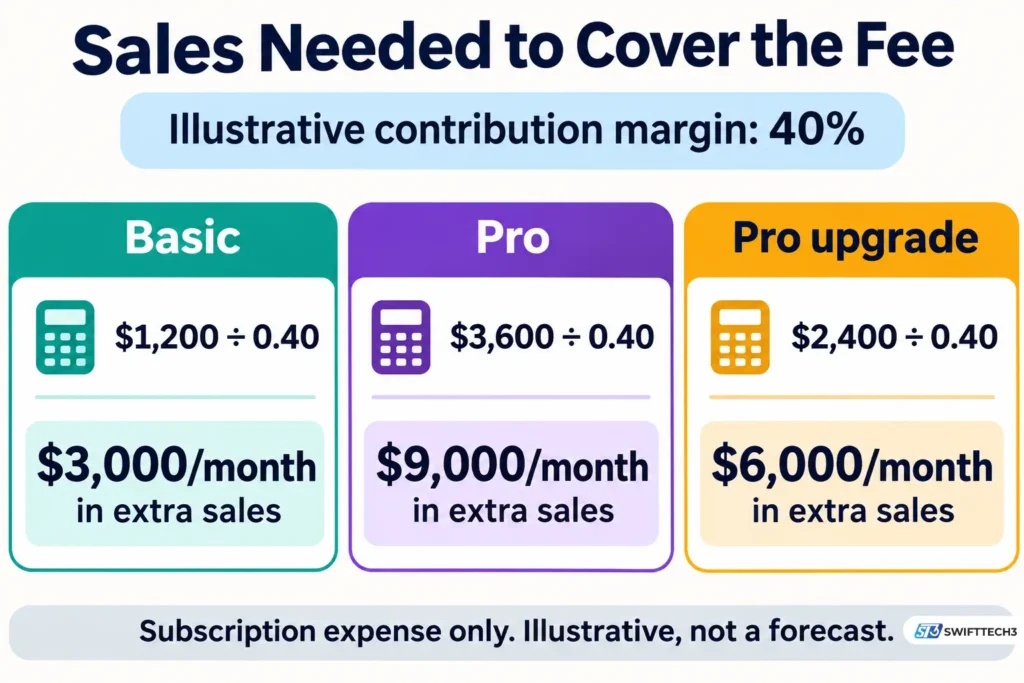
These calculations were checked with code. They isolate the subscription expense and exclude implementation work, other fees, and taxes; they do not predict a return on investment.
Time savings can also matter, but distinguish capacity from cash savings. Reducing report preparation may free someone for other work without reducing payroll. Count the benefit according to what actually changes in your operation.
A useful business case connects a report to a decision: reducing wasted campaign spending, improving a sponsor proposal, or shortening a recurring reporting task. Our guide to marketing systems that improve efficiency and ROI discusses connecting tools with repeatable work and measurable outcomes.
Which analytics would you be paying to add?
Start by identifying what your existing platforms already report. The purchase needs to add useful coverage, analysis, or workflow improvements beyond that baseline.
As of November 2026, these documented tools provide useful comparison points:
| Starting point | Documented information | Boundary to understand |
|---|---|---|
| Spotify for Creators | Audience segments and downloadable audience reports within a free creator platform | Some reports cover other platforms when Spotify hosts the show; age and gender breakdowns are Spotify-only |
| Apple Podcasts Connect | Episode consumption, engagement, and performance information | Apple Podcasts activity; the selected analytics metric requires at least five unique users playing content during the chosen period |
This makes coverage a purchasing question. If a provider promises audience demographics, ask which listening platforms supply those fields, what share of your audience is represented, and whether any values are estimated.
Two developments in 2026 also affect the comparison:
- June 11, 2026: Spotify announced that podcast plays would require at least 30 seconds of listening or viewing. Its current analytics glossary uses that definition, and the update introduced more tools for examining new and returning audiences.
- September 2026: IAB Tech Lab released Podcast Measurement Technical Guidelines version 2.3. Its explanation distinguishes server-based delivery measurement from confirmed playback and warns against treating a download as proof of consumption.
Apple’s consumption reporting measures how much of an episode was played. A download total, a Spotify play count, and an Apple consumption percentage therefore answer different questions.
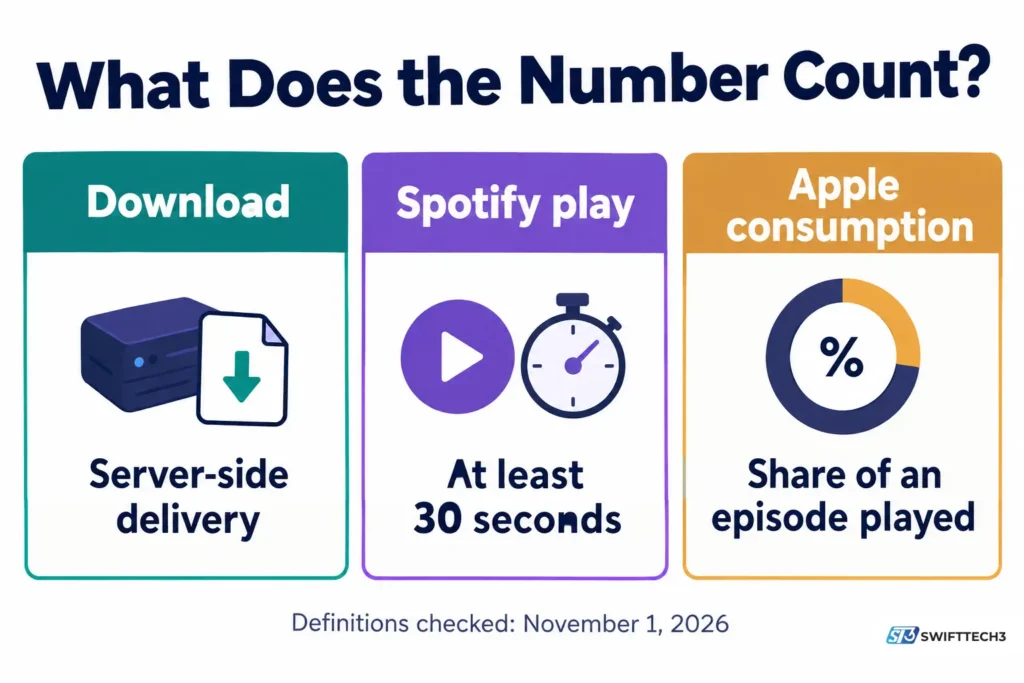
A more expensive report is useful only if you understand what its numbers represent. Combining several sources into one screen does not, by itself, make their definitions comparable.
How should you evaluate a product demonstration?
Ask the provider to produce one report you need and trace its numbers to their sources. This is an editorial evaluation method, not a published BackToFrontShow procedure or a test we performed inside the product.
For example, request an episode-level sponsor report for a defined period, using a sample dataset or an appropriately authorized connection. Then apply the one-report test:
- Source: Identify where each field comes from and which connections are required.
- Definition: Establish what counts as a play, person, download, or completed episode, including the reporting period.
- Coverage: Identify missing platforms, suppressed data, estimates, and refresh delays.
- Export: Demonstrate the format your team receives and whether it can reproduce the calculation outside the dashboard.
Write down the acceptance criteria before the demonstration. For instance, a sponsor may need a documented delivery total, while an editor needs episode retention. A report can serve one purpose well and fail the other.
If the provider cannot explain a number that drives your buying decision, the feature label is not enough to justify the upgrade.
What needs written clarification before you pay?
You need a defined service scope, complete billing terms, and usable data-handling information. The public pages reviewed did not settle those questions sufficiently to calculate a final invoice or evaluate an actual contract.
| Item to settle | What the proposal should specify |
|---|---|
| Seller and currency | Legal contracting entity, contact details, and billing currency |
| Included allowance | Number of shows and users, history available, export access, and API limits |
| Full cost | Recurring price, implementation work, optional services, applicable taxes, and whether any overages apply |
| Commitment and exit | Minimum term, renewal rules, cancellation notice, refunds, and downgrade timing |
| Data handling | Data collected, permissions, retention, deletion, subprocessors, and access after cancellation |
These are unresolved purchasing questions, not a claim that every listed fee applies.
There was also a specific policy-access problem. In our November 1, 2026 check, following the contact form’s “Privacy Policy” link returned to the same contact page. We could not verify a policy through that link; this does not establish that no policy exists elsewhere.
Obtain the applicable policy and contractual terms before sending confidential audience, client, or financial information. A broad security statement on a marketing page cannot establish how a particular dataset will be handled.
Frequently asked questions
These answers distinguish published information from terms that remained unverified as of November 2026.
Can you cancel BackToFrontShow at any time?
We could not verify a cancel-anytime commitment in the reviewed pages. Do not interpret a monthly price as proof of a monthly cancellation right; the agreement needs to specify the commitment and notice period.
Does one subscription cover unlimited podcasts and users?
An unlimited allowance was not established by the public pricing information reviewed. A network should have its show count and team access written into the proposal before comparing subscription totals.
Are annual discounts or promotional codes available?
No specific annual discount or promotional offer was verified in this review. The annual figures above are arithmetic comparisons, so they should not be used as evidence of a discounted yearly contract.
Does advertised API access prove compatibility with my systems?
No. An API feature listing does not establish that your required endpoints, authentication method, data fields, or usage allowance are supported. Make the required integration part of the demonstration and written scope.
Is BackToFrontShow legitimate and safe to use?
This review established what public pages display, not the service’s operational reliability or security. We did not verify an authenticated product session, customer outcomes, or an independent security assessment, so the evidence does not support a blanket assurance or an accusation of wrongdoing.
Should you pay for BackToFrontShow?
Consider paying only when a demonstrated reporting benefit and complete written terms justify the expense. Independent creators should first identify the limits of their existing platform reports; larger teams need evidence that additional coverage or saved work is worth the commitment.
Your next step is to request one dated proposal covering a specific report, the total price in your billing currency, included shows and users, and the cancellation terms. That makes the purchase assessable before money changes hands.
Related: Evaluating unfamiliar software claims: the GDTJ45 Builder investigation.
Disclaimer
This article is for informational purposes only and is not financial or legal advice. SwiftTech3 is not affiliated with, sponsored by, or endorsed by any brand mentioned. Prices, features, and policies may change; information last verified on November 1, 2026. Do not submit payment or sensitive data until you have verified the provider and the applicable written terms.