Introduction
Search for how Mogothrow77 software is built and you will encounter familiar technology names: Python, PostgreSQL, Node.js, Go, Docker and Kubernetes. The descriptions sound plausible. The difficulty is connecting those descriptions to an identifiable software release.
A convincing explanation of a build should answer more than which programming language someone prefers. It should identify the product, explain what its components do, and connect the source code to the version people can actually run.
That connection matters here. The website using the Mogothrow77 name presents itself as a technology publication, while an article on the same site describes building software. Other coverage offers different architectural accounts. Those pages establish that claims have been published; they do not, by themselves, verify the implementation.
This guide examines those distinctions, explains the development process through a clearly labeled practical example, and introduces a way to evaluate the missing evidence: tracing one specific release from its source revision to its downloadable file.
How Is Mogothrow77 Software Built? The Direct Answer
The research reviewed for this article did not establish a verifiable, release-specific account of Mogothrow77’s construction. An article on the website using that name claims Python, PostgreSQL and an initial monolithic architecture. Other coverage describes Node.js, Go and microservices. These remain published claims because an authenticated source-to-release connection was not established.
The distinction is between three kinds of information:
- Observed: What the reviewed websites actually publish about themselves and the software.
- Unverified: Product-specific claims about implementation, licensing, performance and installation.
- Illustrative: General engineering methods that explain how an application could be built.
Missing public evidence does not prove that a product is nonexistent or malicious. It limits how confidently its internals can be described.
What Does the Mogothrow77 Name Actually Identify?
A Publication Identity and a Software Claim Are Different
One important detail is easy to overlook: the website using the Mogothrow77 name describes its type as an “Independent Publication & Information Resource.” Its homepage also presents technology articles and troubleshooting guides.
Separately, its article about software construction makes first-person claims about development choices. A website can publish technology coverage and develop software, so those activities are not inherently incompatible. However, a publication’s brand page does not authenticate a particular application, installer or engineering team.
The practical question is whether the claimed software can be tied to a version, documentation and distribution channel. That relationship was not established in this review.
Readers encountering a similar ambiguity may find our examination of how Endbugflow software works useful. It explores the gap between a described workflow and a reproducible product setup.
Why Different Stack Descriptions Need Version Context
The reviewed material offers these contrasting accounts:
| Build question | Published accounts reviewed | What remains unresolved |
|---|---|---|
| Backend technology | Python on the named website; Node.js and Go in third-party coverage | Which components, if any, use these technologies in a particular release |
| Architecture | An initial monolith in one account; a three-layer microservices design in another | Whether these describe different versions, separate components or unsupported assumptions |
| Licensing | Proprietary in an article on the named website; substantially open source in other coverage | The applicable terms and component boundaries for an authenticated release |
Different language names are not automatically contradictions. One application can contain Python workers, a Go service and a JavaScript interface. A product can also move from a monolith to services over time.
The missing detail is scope: which component, which release and which evidence? Without those answers, neither account becomes a confirmed technical specification.
The Overlooked Question: What Does “Built” Mean?
Many explanations mix together three separate subjects.
Architecture describes how the application is organized: interfaces, business logic, storage and communication between components.
The build process turns a particular source revision and its dependencies into a package, executable, container image or other release output.
Deployment concerns where that output runs and how it is configured. A container image does not establish that Kubernetes runs it. A JavaScript interface does not reveal every technology used by a remote backend.
This distinction gives the topic a more useful direction. Learning how Mogothrow77 software is built requires evidence about the actual release process, alongside any architectural description.
A Better Investigation: Trace One Release From Source to Download
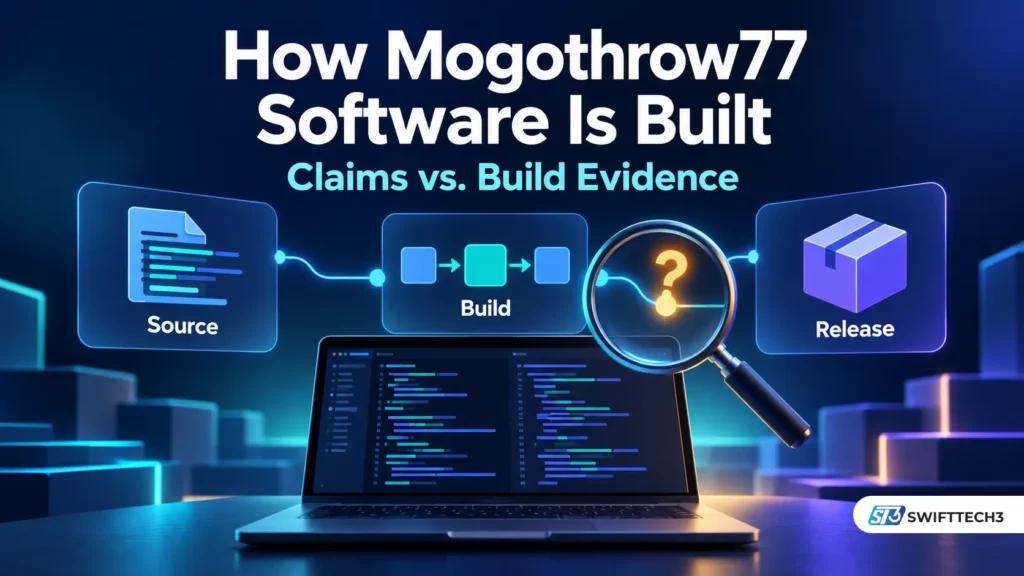
Rather than collecting longer technology lists, connect the records for one version. The following method applies to software generally; it is not a verified Mogothrow77 build procedure.
1. Establish the Product and Release Identity
Begin with a publisher-controlled product page or other authenticated distribution record. Record the product version and the exact package being evaluated.
A useful release record contains:
| Record | Why it matters |
|---|---|
| Publisher identity and distribution channel | Connects the software to the party claiming responsibility |
| Version and release date | Prevents details from different releases being combined |
| Source revision, where available | Identifies the precise code associated with the build |
| Build instructions or workflow reference | Describes how the release output was produced |
| File digest and verification information | Helps identify and check the exact downloaded artifact |
| License and component inventory | Clarifies which terms and dependencies apply |
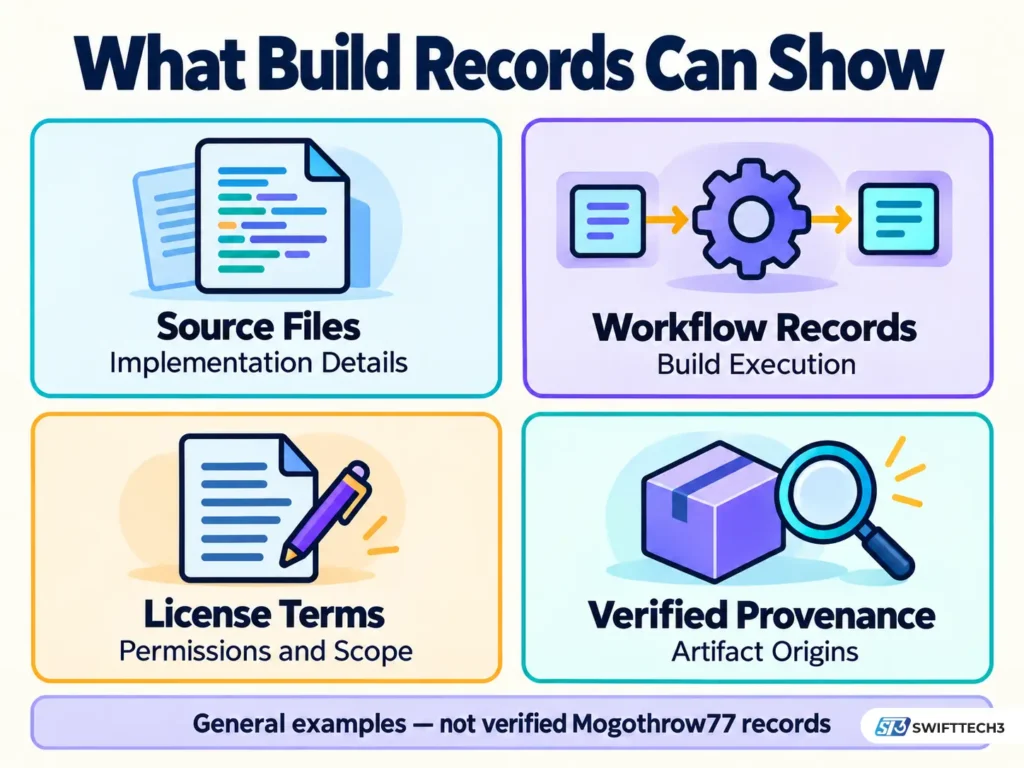
This record can expose an otherwise invisible mismatch. Documentation might describe a newer version while a download mirror supplies an older installer. Both may look credible independently, yet they do not answer the same build question.
2. Read Build Files Without Overinterpreting Them
If authenticated source is available, inspect the relevant files at the release revision. Different files support different conclusions:
| Evidence found | What it can support | What it cannot establish by itself |
|---|---|---|
package.json | Declared npm package metadata, scripts and dependencies | That Node.js powers the production backend |
pyproject.toml | Python build-system, project or tool configuration, depending on its contents | That the complete application is written in Python |
go.mod | A Go module’s identity, Go requirements and module dependencies | That every service uses Go |
Dockerfile | Instructions for assembling a container image | That production uses Kubernetes |
.github/workflows/ files | Configured GitHub Actions automation | That the workflow successfully produced the distributed file |
These are inspection examples, not files verified in a Mogothrow77 repository.
The lesson is to keep the conclusion as narrow as the evidence. A React dependency in a demonstration interface does not prove that the whole product uses React. A workflow file shows intended automation; a matching execution record provides evidence of what actually ran.
3. Connect the Workflow to the Release File
GitHub Actions supports automated build, test and deployment workflows. But naming a CI/CD platform does not establish how a specific product uses it.
Look for a successful run associated with the claimed source revision, then check how its output relates to the published release. Where available, verified artifact attestations can connect a file to information such as its repository, commit and build workflow.
The SLSA framework calls information about an artifact’s origins provenance. In plain language, it helps answer where the file came from and how it was produced.
Attestations still require verification against the expected publisher and repository. They provide evidence about origins; they do not certify that the application is free from vulnerabilities.
4. Understand What File Checks Actually Prove
A cryptographic checksum can help establish that two files have identical content. However, a checksum copied from the same untrusted download page does not independently authenticate the publisher.
A signature or attestation can provide stronger origin evidence when its verification and expected signer identity are checked correctly. These checks answer different questions, so a download page displaying a hash should not be described as a security audit.
5. Separate a Successful Build From a Reproducible Build
Software is not reproducibly built merely because two people can compile it.
Under the Reproducible Builds definition, the same source, specified build environment and instructions must allow another party to recreate identical specified artifacts, byte for byte.
That is a stronger, testable claim. No such reproducibility result was established for Mogothrow77 during this review.
A Practical Example: Building a Small Workflow Application
To explain the engineering process concretely, consider a hypothetical application that accepts a CSV file, validates its rows, schedules processing and exports a report. This example is not a description of Mogothrow77’s verified features or implementation.
Step 1: Define the Smallest Useful Workflow
Start with user actions and acceptance criteria:
- Upload a supported file.
- Identify missing or invalid values.
- Process valid rows according to documented rules.
- Show progress and useful error messages.
- Export the result and remove stored files when requested.
This makes requirements testable. “Processes data efficiently” is vague. “Rejects a missing required column with a clear explanation” describes behavior someone can verify.
Good planning also identifies permissions and data boundaries. Which account owns an uploaded file? Who can access the resulting report? Those decisions belong in the design before additional features are added.
Step 2: Choose Architecture Around the Work
A small team could begin with a modular monolith: one deployable application with clearly separated responsibilities inside it.
Microservices could become appropriate if components need independent scaling, deployment or ownership. They also introduce distributed-system concerns, including network failures, service coordination and more complex troubleshooting.
There is no universal team-size threshold that makes a migration necessary. The decision should follow measured needs and operational capacity. Our guide to why web applications stop scaling discusses the maintenance problems behind growing applications.
Step 3: Implement the Interface, Rules and Storage
In this hypothetical build, the interface would show upload progress and explain validation failures. Application logic would enforce processing rules. Storage would retain job state and whatever files the documented retention policy requires.
The technologies could vary. What matters is whether the implementation meets the requirements and whether another developer can understand its boundaries.
For the interface, prioritize clear labels, readable error messages and accessible controls. These UI/UX design practices provide useful context for making those decisions.
Step 4: Test Failure Paths Alongside Successful Ones
A useful test plan would include malformed files, interrupted processing, unauthorized access attempts and repeated requests.
For example, repeating a submission should follow a documented rule: either create a separate job or recognize the earlier request. Accidental duplicate processing should not determine the outcome.
Unit tests can check validation rules. Integration tests can check interactions with storage and job processing. User acceptance testing can reveal whether the workflow makes sense to the intended audience.
Passing tests supports the cases tested. It does not establish that every possible defect has been eliminated.
Step 5: Build and Release a Traceable Package
The pipeline would obtain the intended source revision, prepare the specified dependencies, run checks and produce a versioned release artifact.
The team should retain the build result and document how deployment is approved. Automated testing does not require every commit to be deployed immediately.
A release plan should also cover recovery. Restoring an older executable may not reverse a database migration or undo changes already made to customer data.
Step 6: Measure Behavior After Deployment
Useful measurements for this example include failed-job rates, processing duration, export failures and completion of the core workflow.
Those measurements help the team decide what to fix. An architecture label cannot substitute for evidence that users complete tasks reliably. Our overview of app performance metrics that affect user retention explains related product-level measurements.
If AI is later introduced, define the specific decision it improves and how errors will be reviewed. For broader implementation context, see our guide to AI engineering and workflow automation.
How Much Mogothrow77 Software Is Open Source?
No defensible open-source percentage was established in this review. An article on the named website calls the software proprietary, while other coverage describes an open-source model. Neither description should replace examination of the applicable product and license terms.
The Open Source Initiative’s definition concerns the rights granted by distribution terms, including access to source, modification and redistribution. Free downloading, visible code and open-source licensing are different things.
There is another important correction to make: a product can combine open-source and proprietary components. An open-core product may publish a base application while keeping certain commercial modules closed. Proprietary application code may also depend on open-source libraries.
Therefore, “open source” and “proprietary” claims need component boundaries before they can be compared meaningfully.
Percentages need a measurement method too. Counting files, dependencies, lines of code or features can produce different results. A software bill of materials, or SBOM, helps inventory components and dependency relationships, but its completeness and scope still need to be assessed. It does not automatically calculate the proportion of first-party code that is open source.
Security Claims Need Evidence Beyond a Technology Name
Security language can sound precise while leaving the important questions unanswered. Naming an encryption algorithm, container platform or testing tool does not establish how a product protects data.
For an application being evaluated, useful evidence includes documented permissions, vulnerability-reporting procedures, dependency management and explanations of which data is collected, stored and deleted.
NIST’s Secure Software Development Framework provides practices that teams can integrate into the software development lifecycle. OWASP CycloneDX supports machine-readable component inventories. These are useful references for evaluating development practices; mentioning them does not establish that Mogothrow77 follows them.
The same care applies to testing unfamiliar files. A Python virtual environment separates package environments, rather than providing a security boundary for arbitrary code. Docker isolation also depends on configuration; shared host directories and elevated privileges can expose the host.
Where a file’s origin cannot be established, the immediate task is to resolve that origin. An isolation tool does not replace publisher verification.
Seven Checks Before Trusting a Mogothrow77 Build Guide
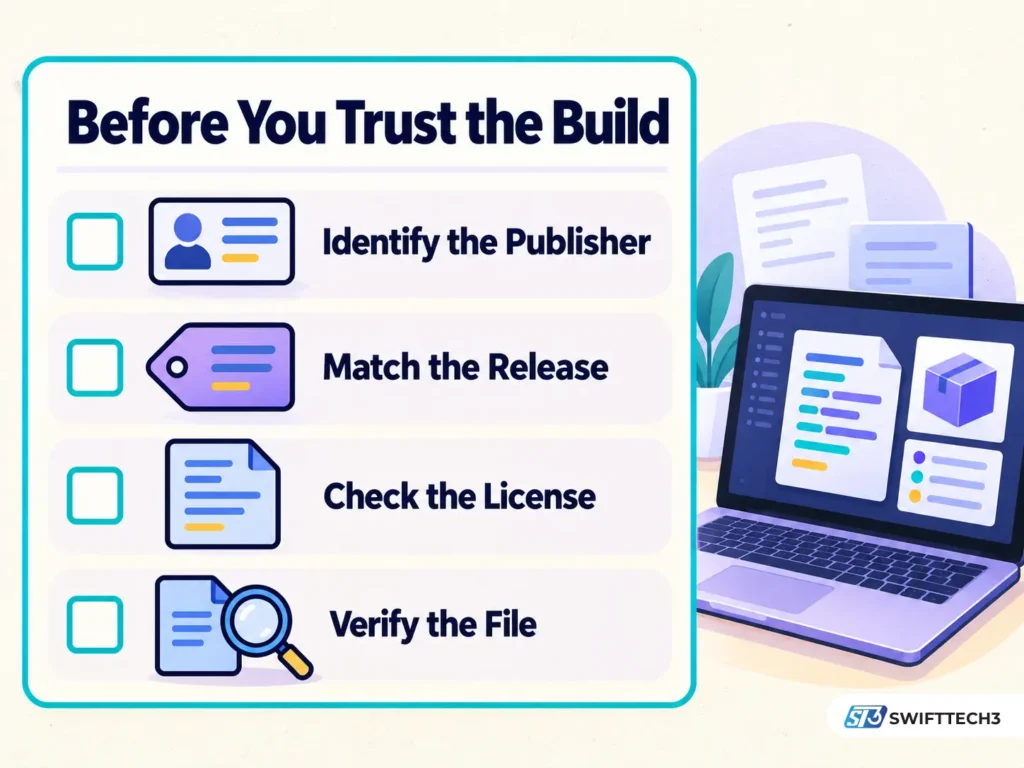
Use these checks to assess whether a guide answers the build question with evidence:
- Identify the product. Does the page distinguish a publication, concept, hosted service and downloadable application?
- Find the release context. Which version and date do its technical claims describe?
- Check publisher relationships. Are repositories and downloads connected through authenticated publisher channels?
- Inspect appropriate technical evidence. Do source files, manifests or documentation support each particular claim?
- Match the build to the download. Are workflow records, artifact identities or verified attestations available?
- Read the relevant licensing scope. Does the stated license cover the application, a component or only an example?
- Keep uncertainty visible. Does the guide distinguish observed facts, attributed claims and hypothetical examples?
The benefit is practical: this approach reduces the chance of installing the wrong file, citing an unsupported stack or choosing an integration based on a feature that has not been demonstrated.
Common mistakes include treating repeated coverage as independent confirmation, assuming a matching domain proves software ownership, and turning a reasonable architectural possibility into a product fact.
Personal Experience: What the Research Actually Showed
My experience for this article was a review of published material. I did not install, benchmark or inspect an authenticated Mogothrow77 release, so this is not a hands-on product review.
The most useful step was reading the named website’s identity information alongside its software articles. The publication description and the first-person development narrative raised a question that a stack list alone would miss: what connects this editorial account to a specific application?
Comparing architectural descriptions also changed the direction of the research. A Python monolith and Go-based services could represent different components or stages of development. Without release context, calling them either compatible or contradictory would go beyond the evidence.
The lesson was to stop at the boundary of each record. An article proves that its author made a claim. A manifest documents declared project information. A verified build record can connect an output to its inputs. Each contributes something different.
That approach produced a more useful result than choosing the most confident description: a clear account of what remains unknown and what evidence would change the conclusion.
Frequently Asked Questions
How is Mogothrow77 software built?
A release-specific build process could not be verified in this review. Published accounts mention several technologies and development methods, but the connection between those descriptions, authenticated source and a distributed application remains unresolved.
What programming language does Mogothrow77 use?
An article on the named website claims Python, while other coverage mentions Node.js and Go. These are attributed claims, not a confirmed language inventory for an authenticated release.
Does Mogothrow77 use a monolith or microservices?
Both descriptions appear in reviewed coverage. They could refer to different components or versions, but no release-specific architectural record was established to resolve that question.
How much Mogothrow77 software is open source?
No reliable percentage was established. Answering requires the relevant source or component inventory, applicable licenses, a defined product version and an explanation of how the percentage is measured.
Is the website using the Mogothrow77 name its official software publisher?
The website describes itself as an independent publication and also publishes software claims. That self-description does not, by itself, authenticate a separate software product or installer. The publisher-to-product relationship requires additional evidence.
Is there a verified Mogothrow77 installation procedure?
This review did not establish an authenticated, version-specific installation procedure. Generic instructions involving Git, npm or Docker should not be treated as official commands for this product.
Does a signed release prove the software is safe?
No. Correctly verified signing information can support an origin and integrity assessment. It does not prove that the code is harmless, vulnerability-free or appropriate for a particular use.
What new evidence would make the build details verifiable?
Useful evidence would connect an identifiable publisher, product version, technical documentation and release artifact. Authenticated source and build records, applicable licenses, verified provenance or independently reproduced artifacts could substantiate particular claims.
Conclusion
The responsible answer to how Mogothrow77 software is built remains limited by the available evidence. Published descriptions exist, including claims on the website using the name, but this review did not establish a verified chain from a specific source revision to an authenticated release.
The most useful next step is to identify one product version and evaluate the records attached to it. Keep architectural claims separate from build records, confirm the scope of licensing statements, and assess each file check for what it actually proves.
For developers building their own tools, the lesson is equally practical: document the product’s purpose, record its build inputs, retain release evidence and explain its component licenses. Those records make technical claims easier to assess and the software easier to maintain.
Disclaimer: This article reflects public material reviewed on October 25, 2026. Product-specific implementation, licensing and installation details remain unverified unless expressly described as observed publication content. The development example explains general engineering practices and is not a tested Mogothrow77 implementation.