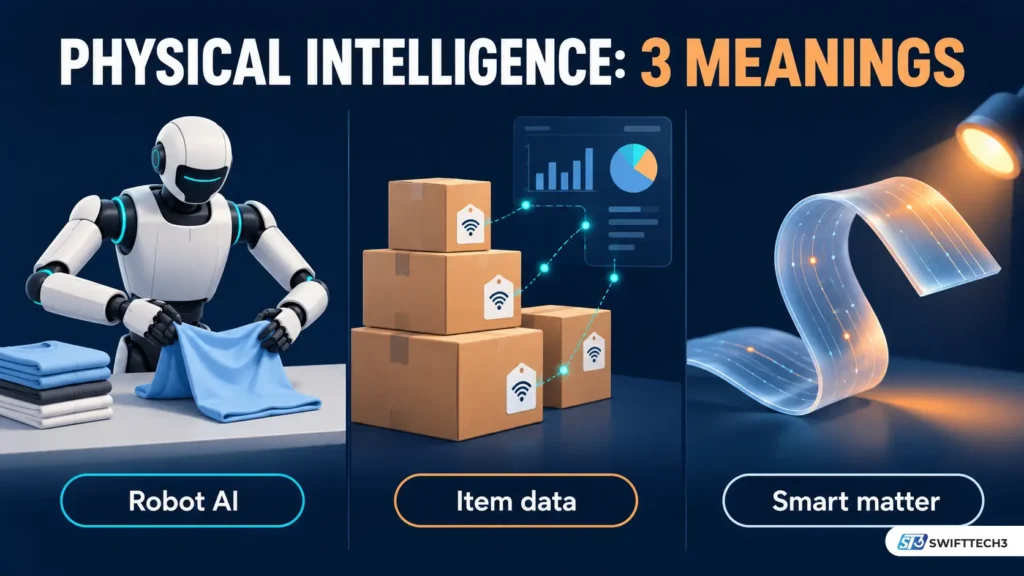
Search “physical intelligence” this week and you’ll get three unrelated results. One is a San Francisco robotics startup. Another is an RFID company that launched a product under the same name in September. The third is a materials-science review that went online on October 26.
Most often, physical intelligence means AI that can perceive and act in the physical world, usually through a robot. That is the sense used by the startup Physical Intelligence. This guide separates the three meanings, shows what the robotics company has and hasn’t proven as of October 2026, and answers the practical questions: can you use it, what does it cost, and can you buy the stock?
What does “physical intelligence” mean?
There is no single agreed definition. As of October 2026 the phrase is used in three main ways, and the speaker’s field tells you which one applies.
| Meaning | Who uses it | What it refers to | Can you buy it? |
|---|---|---|---|
| Robot foundation models | Physical Intelligence, Inc. (San Francisco) | AI models that control many kinds of robots across many tasks | Invitation-based API beta; older open weights |
| Item-level data layer | Impinj (Nasdaq: PI) | Real-time data about tagged items, feeding enterprise AI | Sold as part of Impinj’s RFID platform; software still in beta |
| Intelligence built into matter | Materials-science and small-scale robotics researchers | Behavior encoded in a material or body, with little or no software | Research, not a product |
Two neighboring terms add to the confusion. “Physical AI” is the broad label for AI that senses and acts in the real world. “Embodied intelligence” usually means intelligence shaped by having a body, most often in robotics.
What most people miss: even the people using the term disagree on it. An Impinj executive says physical intelligence and physical AI are not the same thing. A new review in Wiley’s Advanced Science treats embodied intelligence and physical intelligence as separate ideas. Before trusting any claim, check which meaning the author is using.
What is Physical Intelligence, the robotics company?
Physical Intelligence is a private US company, founded in 2024, that builds AI models to control robots. It develops software rather than robot hardware.
Seven people founded it: Karol Hausman, Sergey Levine, Chelsea Finn, Brian Ichter, Lachy Groom, Adnan Esmail and Quan Vuong. Several came from Google DeepMind, Stanford and UC Berkeley. The team works out of an office in San Francisco’s Mission District.
The company’s stated goal is a single model that can control any robot to do any task. Its homepage lists Bond, Jeff Bezos, Khosla Ventures, Lux Capital, OpenAI, Redpoint Ventures, Sequoia Capital, CapitalG and Thrive Capital as supporters.
It has also run early deployments in San Francisco. Bloomberg reported robots folding laundry in short-term rentals and folding cardboard boxes in the backroom of Dandelion Chocolate. The company’s own November 2025 research post describes a robot assembling and labeling 59 boxes used for chocolate packaging in a real factory.
How do its robot models work?
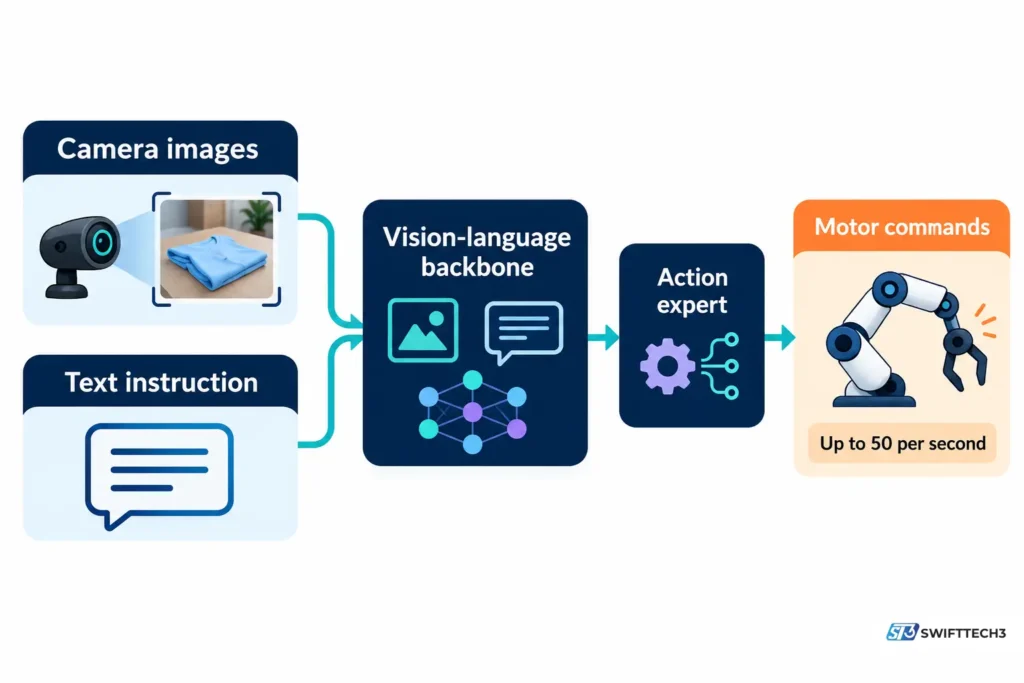
They are vision-language-action (VLA) models. A VLA takes camera images and a plain-language instruction, then outputs motor commands.
The first model, π0 (October 2024), started from a 3-billion-parameter vision-language model trained on internet-scale data. The team added a separate “action expert” that produces smooth, continuous motor commands up to 50 times per second, using a method called flow matching. Training combined an open robot dataset with the company’s own data from eight different robot types.
Folding a shirt is harder for AI than it sounds, and the company points to Moravec’s paradox to explain why. Chess and drug discovery turned out easier for AI than everyday manipulation.
There is also a problem specific to robots. When a model copies human demonstrations, small mistakes put the robot in situations it never saw in training. Those mistakes compound. The company’s fix, called Recap, combines three steps:
- training on demonstrations
- coaching with human corrections
- letting the robot learn from its own attempts using reinforcement learning
What have the models shown, and what is still unproven?
The company has published steady, dated progress, but every result below is self-reported on its own tasks and robots.
| Date | Release | What the company reports |
|---|---|---|
| Oct 31, 2024 | π0 | First generalist policy; beat two academic baselines (OpenVLA, Octo) on five tasks the company chose |
| Feb 4, 2025 | openpi | Public release of π0 and π0-FAST weights and code |
| Apr 22, 2025 | π0.5 | Open-world generalization; a mobile robot tidying an unfamiliar kitchen or bedroom |
| Nov 17, 2025 | π*0.6 | Learning from experience; throughput more than doubled on some of the hardest tasks, failure rates cut by half or better |
| Mar 3, 2026 | Memory (MEM) | Adds short- and long-term memory for tasks running longer than ten minutes |
| Apr 16, 2026 | π0.7 | Steerable model with early signs of recombining skills for new tasks |
| Oct 13, 2026 | Pi API beta | Hosted fine-tuning and inference for outside developers |
Here is what that table doesn’t tell you:
- Partial results get less attention. In the π0.7 write-up, the robot’s first attempt at an air-fryer task, given only a one-line instruction, started the job but didn’t finish it. It succeeded much more often once a person talked it through the steps.
- “Matched human performance” is narrow. On a bimanual UR5e laundry task, π0.7’s success rate matched that of expert teleoperators doing the task on that robot for the first time. Those operators averaged 375 hours of teleoperation experience. This is a comparison with first-attempt humans, not a claim of expert human skill.
- The company itself says it’s early. Its October 2026 API announcement states “we’re still early.” Its open-source release note says π0 “may or may not work for you.”
- No independent replication. I found none of the headline results reproduced by a third party.
Robots with AI guidance already work in some operating rooms, but those systems are navigation aids, not generalist models. Our look at AI navigation and robotics in endoscopic spine surgery shows how different that is from a model that decides how to move.
Can you use Physical Intelligence’s models, and what does it cost?
You can download older models for free, and you can apply for the newer ones through the API beta, but the price isn’t published. In our check of the Pi API announcement and the waitlist page on October 31, 2026, neither listed a price.
| Item | What is published (as of Oct 31, 2026) |
|---|---|
| Pi API price | Not published |
| Access | Apply via waitlist; the page says it is “onboarding in batches” |
| Model behind the API | “The latest model available”; no model name given |
| Open weights | π0 and π0-FAST (released Feb 4, 2025) |
| Data needed to fine-tune π0 | The company’s tests found 1–20 hours of data enough for varied tasks, “your mileage may vary” |
Twenty hours of data is about 2.5 eight-hour shifts of teleoperation, so the data requirement is modest. The robot, the operator and the evaluation time are what cost real money.
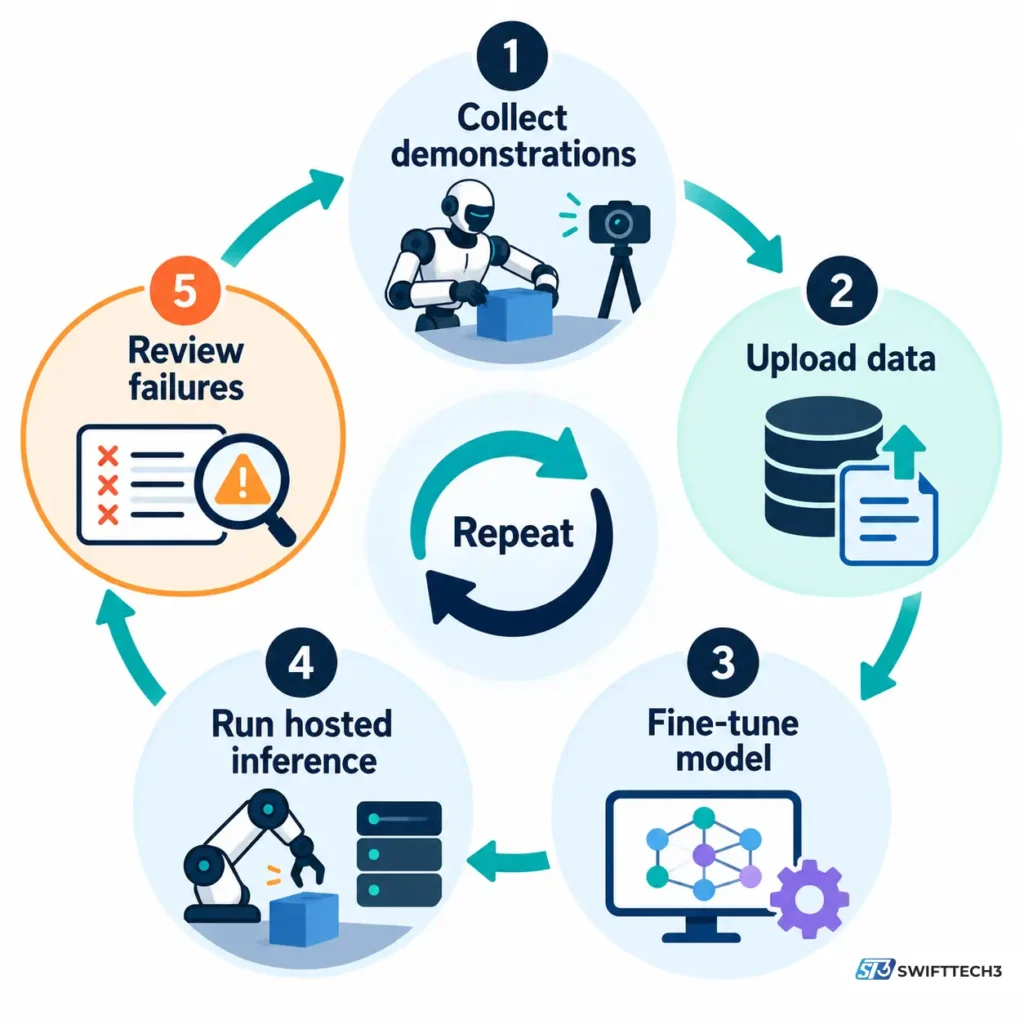
The API workflow is simple on paper. You upload robot data, fine-tune a π model on infrastructure Physical Intelligence manages, and run it on your robot through a hosted gateway. Then you use the failures to decide what data to collect next.
Hidden costs and limits to plan for:
- Hardware. The company supplies models, not robots.
- Data collection. The waitlist form asks how many hours of teleoperation, handheld-gripper (UMI), first-person video and simulation data you have.
- Connectivity. Most of the company’s showcased applications ran on cloud inference, and the announcement admits some had network problems. The form asks whether you need cloud, local or both.
- Fit. The form asks whether your team has integrated a model into a robot’s control stack and run a policy on physical hardware. It reads as built for teams that already have a working robot.
Early partners show what the loop looks like in practice. Almond reports getting a usable deburring model after four days of iterating. Actor reports an autonomous wheel loader loading a dump truck during a real commercial deployment in Utah, with no operator inside. Both are company-reported.
Who should apply: robotics teams with a working robot and some demonstration data.
Who should skip it for now: hobbyists without hardware, anyone expecting a ready-made household robot, and anyone who needs a published price or service guarantee before committing.
If you’re weighing how to fold a hosted robot model into an engineering process, our AI engineering workflow automation guide covers the surrounding pipeline questions.
What is Impinj’s “Physical Intelligence”?
Impinj’s version is a data layer, not a robot model. Impinj sells RAIN RFID, a passive, battery-free tagging technology, and branded its platform around the term. Its CEO said on the October 28, 2026 earnings call that the company launched Physical Intelligence in September.
Impinj describes it as trusted, real-time item data (identity, location, how long an item has been somewhere, authenticity, and events like shipped or expired) that enterprise AI systems consume. In Impinj’s framing, physical AI systems act on that data. The two are different layers.
Three points keep the marketing in perspective:
- Revenue. On the same call, the CEO said Impinj’s revenue still comes mainly from hardware. Its software is in beta at flagship customers and not yet producing meaningful revenue. Total third-quarter revenue was a record $112.1 million, up 17% year over year.
- The Kroger numbers. The CEO cited Kroger’s bakery pilot results: nearly 70% faster inventory counts, 50% lower waste, and a sales lift of about 200 basis points. These are vendor-relayed figures from a single category pilot, not independently verified.
- The ticker. Impinj trades on Nasdaq as PI. Physical Intelligence, Inc. is private.
Retailers also tackle shelf accuracy with cameras instead of tags. Our guide to AI and computer vision in planogram compliance monitoring covers that neighboring approach.
What does physical intelligence mean in materials science?
In this research tradition, it means intelligence located in a body or material rather than in software. The Physical Intelligence department at the Max Planck Institute for Intelligent Systems studies small-scale robots built this way.
At millimeter and micrometer scales, a robot can carry almost no computing power. So behavior has to come from the body itself, using materials like hydrogels, liquid crystal elastomers and shape-memory polymers.
The most recent example is a review in Advanced Science (DOI 10.1002/advs.78384, published October 26, 2026, with Zhejiang University affiliations). It frames smart manufacturing as a progression from AI to embodied intelligence to physical intelligence. The authors say physical intelligence has mostly been developed in materials science, soft matter, mechanical metamaterials and responsive structures. It is a review of existing work, not a new experiment.
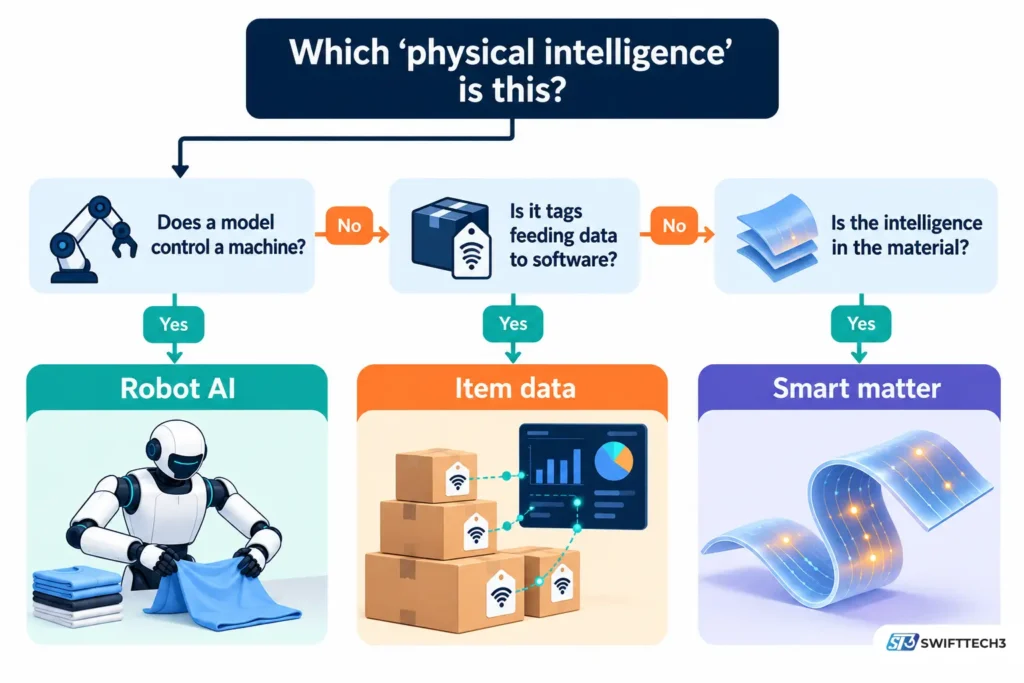
Which meaning are you looking at? A three-question test
Use this quick test, an illustrative framework built from the distinctions above, to classify any article, product page or investor pitch.
| Question | If yes | Likely meaning |
|---|---|---|
| Does a model output motor commands for a machine? | Look for robots, VLA models, fine-tuning | Robot foundation models |
| Is the product tags and readers feeding data into software? | Look for RFID, item data, enterprise AI | Impinj-style data layer |
| Is the “intelligence” a property of a material’s structure? | Look for smart materials, soft robots | Materials meaning |
If none fit, the author probably means “physical AI” in a general sense. Ask them to name the specific system.
Can you invest in Physical Intelligence?
Not on a public market. Physical Intelligence is private, and the “PI” ticker belongs to Impinj.
The funding history, as reported:
- 2024: about $400 million raised, according to Wikipedia’s summary of New York Times and Bloomberg reporting.
- November 2025: $600 million at a roughly $5.6 billion valuation.
- 2026: Bloomberg reported in March that the company was in talks to raise about $1 billion at more than $11 billion. Later coverage, relaying Bloomberg, refers to a valuation of about $11.5 billion earlier this year. I found no company announcement confirming the round.
- October 27, 2026: Bloomberg reported talks to raise at least $1 billion at about $20 billion, with existing backers Avenir and Lux Capital in talks to lead. The Next Web noted it had not independently verified the report, and Bloomberg’s sources said the company has no revenue.
At those reported figures, $20 billion is about 1.7 times the $11.5 billion mark and about 3.6 times the November 2025 valuation. Reported valuations are negotiating positions, not audited numbers.
Common misconceptions
| Myth | What the sources show |
|---|---|
| Physical Intelligence builds humanoid robots | It develops models and software; its published work runs on arms and mobile platforms from other makers |
| “PI stock” means Physical Intelligence | The PI ticker is Impinj; the robotics company is private |
| A demo video means a home-ready robot | The company calls the field early and shows partial failures in its own write-ups |
| Impinj’s physical intelligence is about robots | It is an RFID-based data layer; Impinj itself separates it from physical AI |
How to check physical intelligence claims yourself
- Identify the meaning. Use the three-question test above before reading further.
- Look for the evaluation details. How many tasks, how many trials, which robots, who chose the tasks?
- Find the date. “Latest model” claims go stale in weeks; the company shipped four named releases between November 2025 and April 2026.
- Check access terms. Is it open weights, a waitlist, or a paid product? Is there a published price?
- Separate announced from confirmed. Funding “in talks” is not a closed round.
- Weigh vendor-relayed numbers. Pilot results quoted by the vendor deserve a second source.
For teams planning to deploy AI that acts in physical spaces, start with accountability. Our guide to AI governance and compliance is a reasonable first stop.
FAQs
Is Physical Intelligence the same as physical AI?
No. Physical AI is a broad term for AI that senses and acts in the real world. Physical Intelligence is one company building such models. Impinj uses “physical intelligence” for something else entirely, an item-data layer that physical AI systems can consume.
Is Physical Intelligence open source?
Partly. The company released weights and code for π0 and π0-FAST on February 4, 2025. Its newer models are reached through the Pi API beta, and the announcement doesn’t say whether they will be open-weights.
How much does the Pi API cost?
No price was published as of October 31, 2026. Access is by application, in batches. Budget separately for robot hardware, data collection and evaluation.
Who founded Physical Intelligence?
Karol Hausman, Sergey Levine, Chelsea Finn, Brian Ichter, Lachy Groom, Adnan Esmail and Quan Vuong. The company was founded in 2024 and is based in San Francisco.
Is Physical Intelligence publicly traded?
No. It is a private company. The Nasdaq ticker PI belongs to Impinj, a different company that also uses the phrase “physical intelligence.”
What is a VLA model?
A vision-language-action model takes camera images and a text instruction as input and outputs robot actions. Physical Intelligence’s π models are built this way, starting from a pretrained vision-language model and adding an action component.
Does Impinj’s physical intelligence involve robots?
Not directly. It is RAIN RFID data about tagged items such as retail goods and shipments. Impinj positions that data as fuel for AI systems, including ones that control machines.
Conclusion: key takeaways
- Physical intelligence has three live meanings in 2026: robot foundation models, an RFID item-data layer, and intelligence built into materials.
- The robotics company’s results are impressive but self-reported, on its own tasks and robots, and its leaders describe the field as early.
- The Pi API beta is invitation-based, has no published price, and suits teams that already have a robot and demonstration data.
- You cannot buy Physical Intelligence stock, and “PI” on Nasdaq is Impinj.
Your next step: decide which meaning matters to you. If you build robots, prepare a summary of your hardware and teleoperation data and apply through the Pi API waitlist. If you work in retail or logistics, ask any “physical intelligence” vendor for pilot data from a second source.
Related: How AI Navigation and Robotics Are Redefining Endoscopic Spine Surgery
Disclaimer: This article is for informational purposes only and is not investment, financial or engineering advice. It is not affiliated with, sponsored by or endorsed by Physical Intelligence, Impinj or any organization mentioned. Funding figures, features, access terms and policies may change, and reported valuations are unconfirmed. Information last verified on October 31, 2026. AI output can be inaccurate, so confirm critical details with primary sources before making decisions.