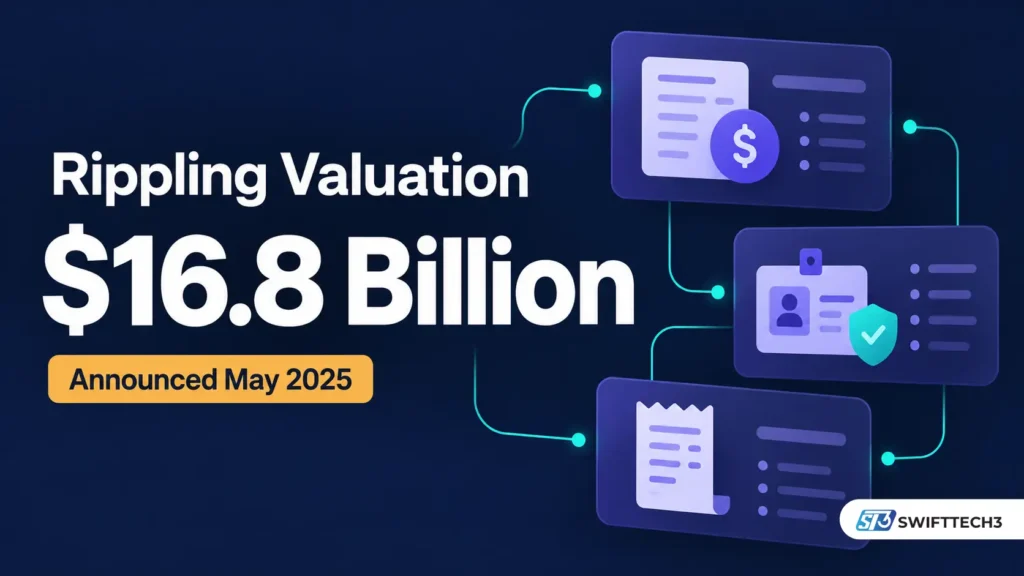
Rippling’s last company-announced valuation is $16.8 billion, from its May 9, 2025, Series G announcement. The company disclosed $450 million in new financing and agreements to repurchase up to $200 million of employee equity. No newer company-announced valuation was verified through October 20, 2026.
Since that financing, CEO Parker Conrad has reported ARR above $1 billion and 78% year-over-year revenue growth. Those figures add useful context, but they do not establish a new valuation or a current investment price.
Rippling valuation at a glance
The most useful starting point is to separate a confirmed funding announcement from operating statements and private-market estimates.
| Item | Verified information | How to interpret it |
|---|---|---|
| Last company-announced valuation | $16.8 billion | Attached to the May 2025 Series G |
| New financing | $450 million | Capital raised, separate from employee share purchases |
| Employee liquidity | Agreements to repurchase up to $200 million of equity | Announced ceiling for current and former employees |
| Previous company-announced valuation | $13.5 billion | Series F in 2024 |
| CEO’s subsequent growth statement | ARR above $1 billion; revenue growing 78% year over year | A management statement, not a full set of audited accounts |
| Public-market status | Privately held in the materials reviewed | No confirmed public ticker or IPO date verified |
Rippling’s Series G announcement named Elad Gil, Sands Capital, GIC, Goldman Sachs Alternatives, Baillie Gifford and Y Combinator among the participating investors, alongside existing backers.
For a technology business, the question behind the headline is whether its products can create enough lasting customer value to support investor expectations. Funding alone cannot answer that.
Rippling valuation history: the recent funding rounds
Rippling’s own announcements establish the following later-stage financing record.
| Financing period | Round | New financing announced | Company valuation |
|---|---|---|---|
| 2022 | Series D | $250 million | $11.25 billion |
| 2023 | Series E | $500 million | $11.25 billion |
| 2024 | Series F | $200 million | $13.5 billion |
| May 2025 | Series G | $450 million | $16.8 billion |
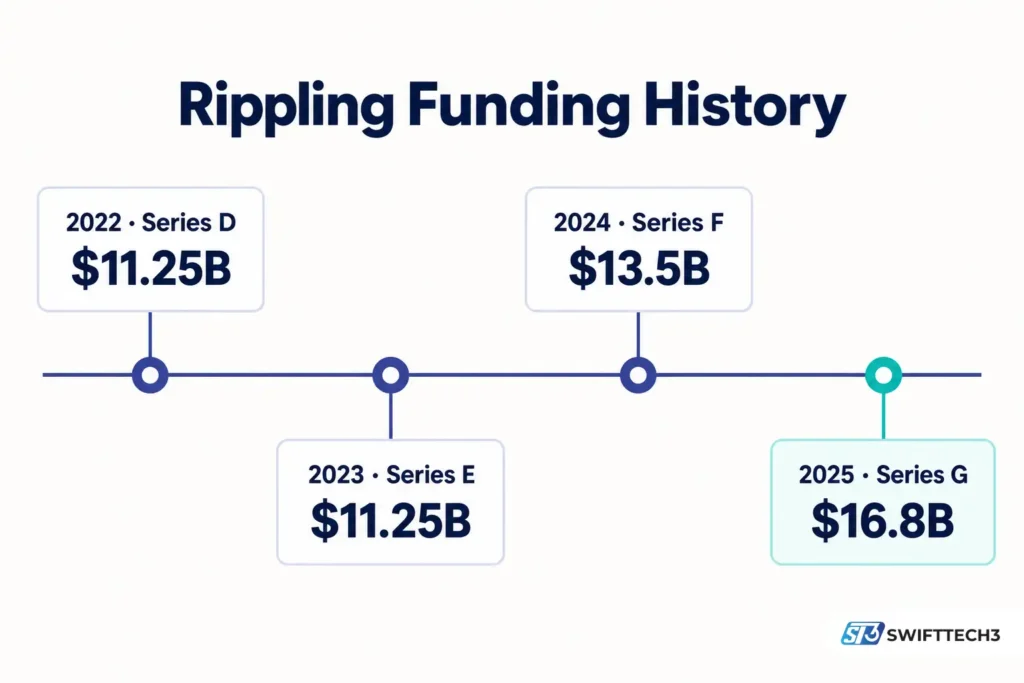
The Series E valuation was unchanged from Series D. That is a useful reminder that raising more capital does not necessarily mean raising the company’s valuation.
The Series F financing also included agreements for investors to purchase up to $590 million of equity from employees, former employees and early investors. Those purchases were separate from the new capital.
Using the company’s stated figures, the increase from Series F to Series G was $3.3 billion, approximately 24.4%:
($16.8 billion − $13.5 billion) ÷ $13.5 billion × 100 = 24.4%.
This measures the change between two financing valuations. It does not measure revenue growth or an individual shareholder’s return.
Use the underlying financing period when reading historical announcements. Some company webpages display later editorial update dates; a refreshed page does not make an old round new.
Valuation, new funding and employee liquidity are different
Three numbers in the Series G announcement answer three different questions.
| Figure | What it describes | What it does not establish |
|---|---|---|
| $16.8 billion valuation | Company value stated for the financing | Annual sales, cash reserves or guaranteed sale proceeds |
| $450 million financing | New capital raised | The company’s total value |
| Up to $200 million equity repurchase | Agreements for employee share liquidity | Another $200 million of operating capital |
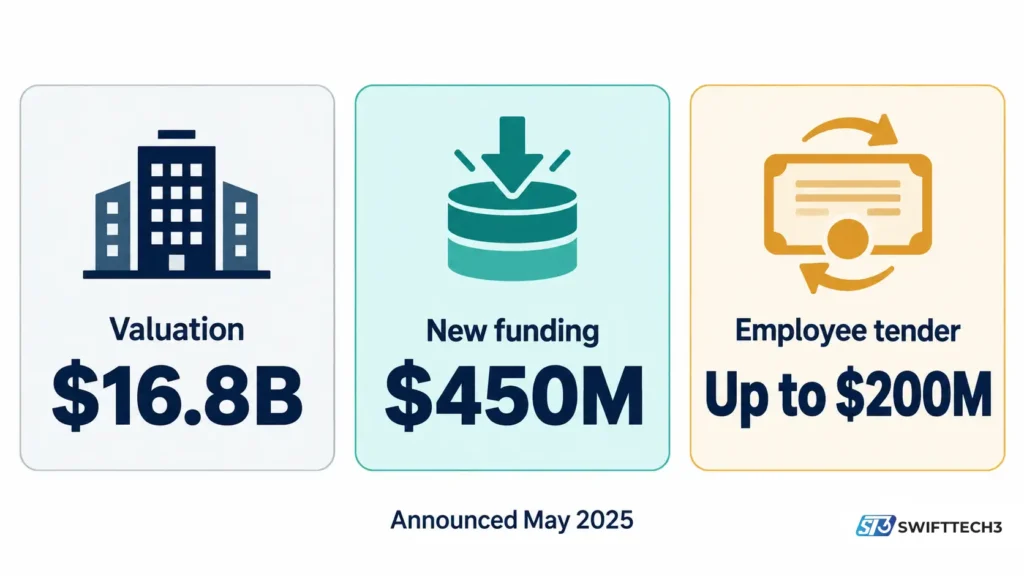
Adding the financing and repurchase amounts gives $650 million, but describing that sum as new capital for Rippling would be misleading. Purchases of existing equity provide liquidity to the selling shareholders.
The qualifier “up to” also matters. The announcement describes a maximum agreed amount, rather than proving that every dollar was ultimately purchased.
The U.S. Securities and Exchange Commission distinguishes pre-money valuations, measured before a financing, from post-money valuations, measured after it. Ownership calculations need the relevant transaction basis, share counts and terms.
A funding headline therefore cannot establish the value of a particular equity award or the price available to an outside buyer.
What Rippling’s revenue statement tells us
In a public post reviewed for this article, CEO Parker Conrad said Rippling’s revenue was growing 78% year over year at ARR above $1 billion. He also said the growth rate had increased for three consecutive quarters.
That is stronger evidence than an unattributed revenue estimate because the statement comes directly from the CEO. It is still a management disclosure, and the post does not provide audited financial statements, detailed revenue recognition policies or a complete financial model.
Annual recurring revenue, or ARR, is a measure of recurring business expressed on an annual basis. It should be distinguished from recognized revenue for a completed reporting period, and definitions can vary between companies.
Why “about 17 times ARR” needs an explanation
A simple calculation using the disclosed valuation and a round-number revenue threshold is:
$16.8 billion ÷ $1 billion = 16.8 times.
The arithmetic is correct, but its interpretation requires care:
- The valuation comes from a financing announced in May 2025.
- The CEO’s operating statement is subsequent to that financing.
- The CEO said ARR was above $1 billion, rather than exactly $1 billion.
- The calculation uses company valuation rather than a separately established enterprise value.
Consequently, 16.8 times is an illustrative ratio using the $1 billion threshold. It is not a verified current trading multiple or the multiple at which investors priced the original round.
The useful analytical point is conditional: if recurring revenue increases while the reference valuation stays unchanged, the ratio falls. That observation alone cannot establish that the shares are inexpensive.
A fuller assessment would also need margins, cash use, retention, customer concentration and the terms of the security being purchased.
Secondary-market prices: what they can and cannot show
Employees and early investors may seek liquidity through transactions involving existing shares. Those secondary transactions are different from a new financing in which a company issues securities to raise capital.
The SEC explains that private-company securities may have resale restrictions and may not be freely traded. A displayed quote, an indicated asking price and a completed transaction are therefore different kinds of evidence.
Private-market trackers reviewed for this article did not provide a sufficiently consistent basis for treating one secondary estimate as Rippling’s current company-wide value. Their figures should not replace the company-announced financing valuation without a clear account of the transaction and methodology.
Before interpreting a secondary quote, establish:
- Whether it represents a completed sale. A seller’s asking price is not proof that a buyer paid it.
- The date and size of the transaction. An isolated small transaction may provide limited evidence about broader demand.
- The security involved. Common and preferred shares can have different economic rights.
- The share-count assumption. Converting a share price into a company valuation requires a consistent capitalization basis.
- The sale conditions. Fees, approval requirements and transfer restrictions can affect what a buyer receives or a seller realizes.
These are evaluation principles, rather than claims that every Rippling transaction has the same restrictions.
Why Rippling valuation numbers online disagree
Different figures can describe different things. The first step is to identify what a page is actually measuring.
| Type of figure | What to establish before using it |
|---|---|
| Company-announced financing valuation | The round, announcement date and transaction basis |
| Rounded headline | Whether it refers to the same underlying financing |
| Secondary price or estimate | Transaction evidence, security class, date and methodology |
| Fund’s portfolio mark | The holder’s valuation method and reporting date |
| Total funding raised | Which rounds are counted and whether secondary purchases are excluded |
For example, “about $17 billion” can simply be a rounded description of the Series G figure. It does not demonstrate another funding event.
Likewise, a newly updated profile can repeat an older valuation. Publication dates should not be substituted for transaction dates.
A proposed deal, a completed financing and an estimate of what a company might command in an IPO should also remain distinct. None should silently be presented as the others.
Why Rippling’s software strategy matters
Rippling describes its platform as connecting employee information across HR, payroll, IT and spending. Its commercial thesis extends beyond selling a single payroll tool.
The potential growth mechanism is straightforward: a customer using shared organizational data across several products may have reasons to add more capabilities within the same platform. That creates an opportunity for expansion within existing accounts.
It does not prove that every customer adopts the full suite or that expansion is profitable.
An employee transfer illustrates the potential benefit
Consider a hypothetical employee moving to another department. Their manager, expense approver, software access and reporting categories may all need attention.
A connected data model could reduce the need to update those records separately, provided the relevant products and integrations support the process.
This is the same integration issue discussed in how AI is reshaping modern hiring workflows: making one task faster helps less when information must still be manually copied into the next system.
For investors, evidence of the platform thesis would include product adoption, renewal behavior and the economics of serving customers. For buyers, it is whether a specific combination removes a costly operational handoff.
What changed in 2026: AI, data and governance
Rippling’s official announcements document several developments after the Series G financing.
| Announcement date | Development | Company-described purpose |
|---|---|---|
| March 18, 2026 | Rippling AI | Answer company-specific questions and support actions across business functions |
| June 25, 2026 | Rippling Data Cloud | Connect business data with workforce identity for analysis and related workflows |
| August 20, 2026 | Rippling AI Governance | Manage AI access, spending visibility and agent accountability |
| September 1, 2026 | Rippling Helpdesk | Handle supported employee IT requests using organizational context |
| September 23, 2026 | Plugins, skills and automations | Connect systems, reuse instructions and support recurring AI work |
These launches show the company’s subsequent product direction. They do not establish a new funding price or independently prove that the products deliver the advertised outcomes.
Availability and approval rules need precise treatment
The announcements include meaningful qualifications.
The AI Governance release described MCP Gateway and Agent Identity Management as live at announcement, while AI Gateway and Shadow AI Detection carried waitlist notices. The September announcement also marked automations with a waitlist notice.
These are statements about the announcements, rather than a guarantee of availability for every customer today.
Approval behavior also varies across the product descriptions. Rippling’s integration documentation says plugin write actions may require confirmation depending on configuration. Its Helpdesk announcement describes administrator choices over automatic actions, approvals and escalation.
A blanket claim that every Rippling AI action always requires the same human approval would therefore be too broad.
For buyers, the useful task is to establish what the intended product and configuration actually permit. The related guide to AI engineering and workflow automation discusses the wider operational context.
Rippling vs. Deel: compare dated funding announcements
Deel provides a relevant comparison because it offers payroll and workforce products and has published its own financing announcement.
In October 2025, Deel announced a $300 million Series E at a $17.3 billion valuation, co-led by Ribbit Capital, Andreessen Horowitz and Coatue Management. Reuters coverage independently corroborated the financing and valuation.
| Company | Financing reference | New financing | Announced valuation |
|---|---|---|---|
| Rippling | Series G, May 2025 | $450 million | $16.8 billion |
| Deel | Series E, October 2025 | $300 million | $17.3 billion |
These are historical financing references, not a claim that both companies would command those prices in a transaction today.
Deel’s announcement also said it had surpassed $1 billion in ARR and marked three consecutive years of profitability. Those were Deel’s own statements, and they should not be used to infer Rippling’s profitability.
The valuation difference alone cannot establish which business offers better investment value. Comparable financial periods, revenue definitions, margins and transaction terms would be needed.
For a software customer, the more useful comparison concerns required products, implementation, supported workflows and total contractual cost.
Is Rippling publicly traded, and is an IPO scheduled?
Rippling is privately held in the materials reviewed. No confirmed public trading ticker or scheduled IPO date was verified through October 20, 2026.
Preparation for public-company reporting and statements about an eventual listing should not be converted into a promised timetable.
There is another limit to public research: the SEC permits nonpublic review of certain draft registration statements. The absence of a publicly visible filing cannot, by itself, establish that no confidential submission exists.
A future public registration statement could provide more financial information. It would not automatically reset the valuation of an earlier financing.
What private-share buyers and employees should understand
Private offerings can involve eligibility conditions, less disclosure and limited liquidity. The SEC warns that investors may have difficulty reselling private securities.
A platform listing does not establish that a particular investor can purchase the shares, that a displayed price will be accepted or that an IPO will follow.
Employees should also assess their own award documents. Vesting, security class, exercise costs, dilution and transfer terms can affect the value they ultimately receive.
The IRS explains that stock-option tax treatment depends on the option type and relevant events. A company valuation cannot establish an employee’s after-tax proceeds.
Practical Insights
How to assess a valuation headline
A useful research sequence is:
- Find the originating announcement. Identify who stated the valuation and what event established it.
- Classify the transaction. Separate new financing, employee liquidity and secondary transactions.
- Record the dates. If a financial ratio uses different periods, say so explicitly.
- Identify the financial measure. Distinguish ARR, recognized revenue, profitability and estimates.
- Check the security and methodology. Company value alone does not describe an individual investment’s rights.
- State what remains unknown. A precise-looking number does not eliminate missing information.
This process helps explain why a company announcement can be the strongest reference for its last financing while still being insufficient for an investment decision today.
How buyers should evaluate Rippling
Start with one operational problem: duplicate employee records, expense approvals, access changes or a recurring reporting task.
Then map the products and integrations required, obtain a complete quote and review a demonstration that includes an exception. A missing manager, conflicting record or unsupported action can reveal more than a smooth standard demonstration.
Rippling’s current U.S. pricing page directs customers to a custom quote based on selected services and per-employee pricing. The contract should clarify which capabilities are included, what requires additional purchase and what implementation involves.
Before committing, establish who owns the process, what runs automatically, what requires review and how errors are corrected.
A smaller employer with a recruiting bottleneck may need a narrower product. The guide to AI hiring tools for small businesses provides related context for that decision.
What employees and investors should monitor
For employees, a tender opportunity is useful only when its eligibility and sale terms fit their award. It should not be treated as a permanent ability to sell.
For investors and technology readers, useful future evidence includes new financing announcements, financial disclosures with clear definitions, customer adoption and product availability.
AI features deserve attention, but their financial value depends on useful adoption after the costs of setup, review and correction.
FAQs
What is Rippling’s current valuation?
The last company-announced funding valuation verified for this article is $16.8 billion, from May 2025. It should be presented with that date rather than as a live market price.
Did Rippling announce a new valuation in 2026?
No newer company-announced valuation was verified through October 20, 2026. Its 2026 product announcements and management growth statement do not themselves establish another priced financing.
How much did Rippling raise in its Series G?
Rippling announced $450 million in new financing. It separately disclosed agreements to repurchase up to $200 million of equity from current and former employees.
How much did its valuation increase from Series F?
It increased from $13.5 billion to $16.8 billion, a $3.3 billion change, approximately 24.4%. That calculation measures financing valuations and does not establish any individual investor’s return.
What is Rippling’s revenue?
CEO Parker Conrad stated that ARR exceeded $1 billion and revenue was growing 78% year over year. This is a management statement about operating performance, rather than a complete audited financial disclosure.
Is Rippling valued at about 17 times ARR?
Dividing the last announced valuation by a $1 billion ARR threshold gives 16.8 times. The dates differ, and the CEO reported ARR above that threshold, so this should not be presented as an exact current trading multiple.
Is Rippling profitable?
The CEO’s growth statement does not establish profitability. A verified current profit figure was not available in the primary materials reviewed, so this article does not label Rippling currently profitable or unprofitable.
Are secondary-market estimates an official valuation?
A secondary estimate does not become a company-announced financing valuation. Its usefulness depends on the underlying transaction evidence, date, share class and methodology.
Is Rippling publicly traded or scheduled for an IPO?
Rippling is private in the materials reviewed, and no confirmed public ticker or scheduled IPO date was verified. Nonpublic SEC review procedures also mean that public research cannot rule out every confidential preparation step.
Does a higher valuation make Rippling better payroll software?
Valuation does not measure product fit, payroll accuracy or support quality. Buyers should assess their workflows, required integrations, availability, implementation and contract terms.
Conclusion
Rippling’s $16.8 billion Series G valuation remains the last company-announced financing reference verified for this article. The CEO’s later ARR statement and the 2026 product launches add context, while answering different questions from the funding price.
Keep financing valuations, operating metrics and secondary estimates separate. Buyers should focus on workflow fit and complete commercial terms; employees and investors need the rights, disclosures and liquidity conditions attached to their particular security.
The next meaningful update could be a new priced transaction or more detailed financial disclosure. Each should be assessed for what it actually establishes.
Disclaimer
This article provides general information about Rippling’s financing and software business; it is not financial, investment or tax advice. Investment outcomes vary, private shares may be difficult to sell, and a licensed financial or tax professional should be consulted before investment or equity decisions. Information is current as of October 2026; software pricing, features and availability can change, so confirm relevant terms with the official provider.