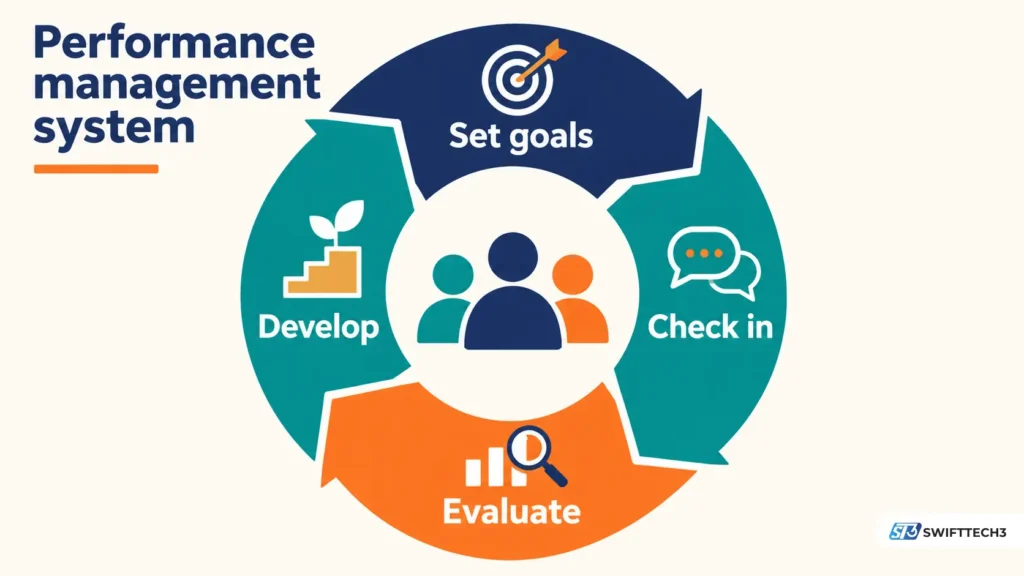
Quick answer: A performance management system is the combination of processes and, often, software that an organization uses to set goals, monitor progress, give feedback and evaluate employee performance. In Gallup’s 2023 survey of 135 Fortune 500 CHROs, only 2% strongly agreed that their system inspires employees to improve.
In a 2015 Harvard Business Review article, Deloitte reported that forms, review meetings and ratings were consuming close to 2 million hours a year. At 2,080 working hours per full-time job, that is roughly 960 people doing nothing but performance paperwork.
This guide explains what a performance management system includes and what independent data says about whether it works. It also gives you US list prices for popular tools as of November 2026, the AI-in-employment rules that now apply to review software, and a way to choose a review rhythm that fits your team.
What is a performance management system, and what does it include?
It is the full cycle of setting expectations, checking progress, evaluating results and developing people, plus any software that runs that cycle. Writers use the term for both. Culture Amp separates them into the process (for example OKRs or 360-degree feedback) and the platform (the tool).
Sources label the same loop differently:
- SAP names three processes: plan and act with goal management, monitor with continuous performance management, and evaluate and recognize through performance assessments.
- McKinsey (May 2024) names four elements: goal setting, performance reviews, ongoing development and rewards.
- The US Office of Personnel Management (OPM) describes performance management as planning, monitoring, developing, evaluating and rewarding.
Terms you will meet:
- OKRs (objectives and key results) pair one objective with measurable results.
- MBO (management by objectives) has manager and employee agree goals, then judge performance by how many are met.
- 360-degree feedback gathers input from managers, peers and direct reports.
- Calibration is a step where managers compare ratings so similar roles are judged consistently.
Performance management system, appraisal, HRIS or engagement tool: which is which?
They are different things that vendors often bundle. Confusing them is the most common way buyers pay for the wrong product.
| Term | What it means | Where people mix it up |
|---|---|---|
| Performance management system | The whole cycle of goals, check-ins, evaluation and development, with or without software | Used for both the process and the tool |
| Performance appraisal or review | One step: evaluating performance against the standards in an employee’s plan (OPM’s definition) | Treated as the whole system |
| Corporate (enterprise) performance management | Organization-level measurement such as balanced scorecards and KPI dashboards | Shares the name but is about company results, not individual employees |
| HRIS or HCM suite with a performance module | A broader HR system where performance is one module, such as SAP SuccessFactors Performance & Goals, or an HRMS with a built-in performance module | Buyers assume a standalone tool will connect to payroll |
| Engagement survey product | Pulse and engagement surveys | 15Five’s Engage plan ($4) lists surveys and benchmarking and no performance reviews |
| Federal “performance management system” | A regulated framework under 5 CFR Part 430 for US federal agencies | Different legal meaning from a private-sector tool |
Do performance management systems actually improve performance?
Not by themselves. The independent data shows widespread dissatisfaction, and the strongest positive findings concern practices such as clear goals and frequent check-ins, not software.
| Finding | Source and date | What it shows | Label |
|---|---|---|---|
| 2% of Fortune 500 CHROs strongly agree their system inspires improvement | Gallup, survey of 135 CHROs, June–July 2023 | Leaders are doubtful | Survey (Gallup also sells advisory services) |
| 22% of employees strongly agree reviews are fair and transparent; 47% strongly agree they know what is expected | Gallup, 18,665 US employees, August 2023 | Clarity is the weak point | Survey |
| 56% review goals with their manager once a year or less | Gallup, same survey | Annual rhythm is still common | Survey |
| 93% of North American employers cite driving organizational performance as a key objective; 44% say their program meets it | WTW 2022 Performance Reset Survey, reported by SHRM Magazine in March 2023 | Goals and results diverge | Survey (cite WTW, not SHRM) |
| 89.4% of HR leaders say performance management improves outcomes; 44% can provide a metric | Betterworks study of 894 leaders, reported October 16, 2026 | Few can prove it | Vendor-run survey |
| Companies that focus on people’s performance are 4.2 times more likely to outperform peers, with 30% higher revenue growth | McKinsey, May 2024 | A correlation about management focus | Not a software effect |
| Feedback interventions improved performance on average, but over one-third decreased it | Kluger and DeNisi, Psychological Bulletin, 1996 (607 effect sizes) | More feedback is not always better | Peer-reviewed |
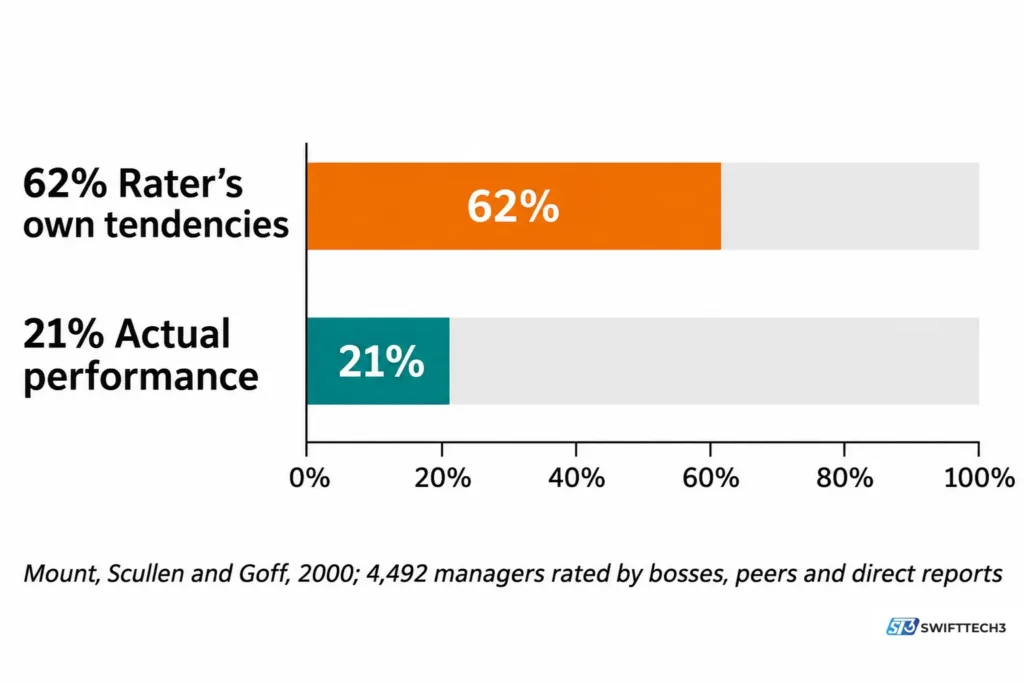
| 62% of rating variance came from the rater’s own tendencies; 21% from actual performance | Mount, Scullen and Goff, 2000 (4,492 managers) | Single-rater scores are noisy | Peer-reviewed |
| About 80,000 manager hours saved after Adobe dropped annual reviews | Adobe’s own March 2014 blog post | Time saved | Company-reported |
Three details most guides miss:
- The rater-effect study measured 360-degree ratings of managers. It does not prove every annual review is mostly noise, but it explains why Deloitte moved away from rating skills and why Gallup recommends multiple inputs.
- Adobe’s figures are company-reported. Adobe’s blog says it abolished annual reviews, ratings, rankings and forms. The 30% drop in voluntary attrition appears in Deloitte’s 2014 Human Capital Trends report, not in an independent audit. A Chartered Management Institute write-up of an update Adobe gave authors Sutton and Rao also reported involuntary departures up 50%, so part of the change was managers addressing problems earlier.
- The “3.6 times” feedback statistic is a survey comparison. Gallup reports that employees are 3.6 times more likely to strongly agree they are motivated to do outstanding work when their manager gives daily rather than annual feedback. That compares groups of employees. It shows association, not proof that changing frequency causes the result.
Gallup’s own advice is that the exact system matters less once managers know how to hold regular, constructive conversations.
How does a performance management cycle work?
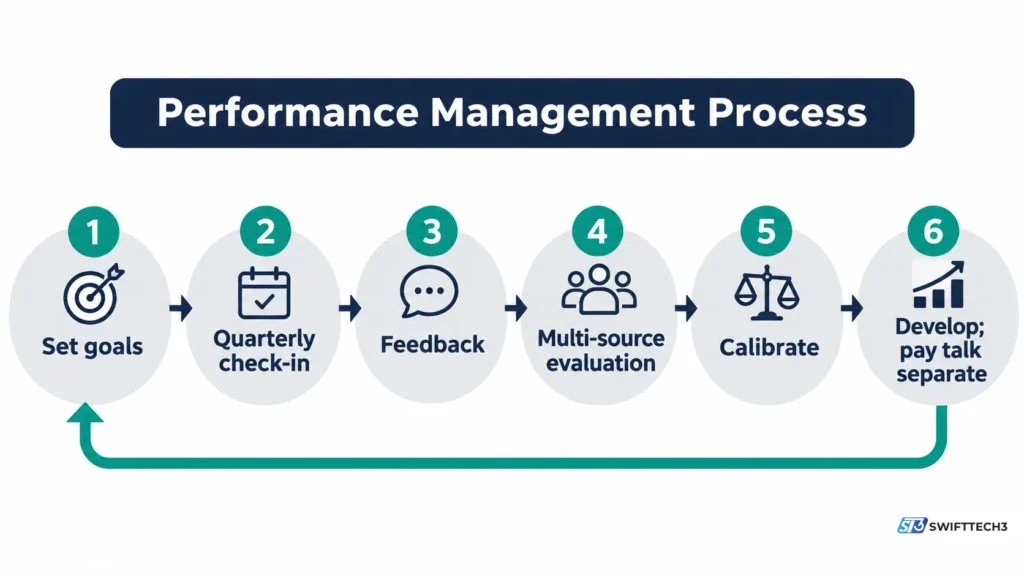
It repeats six steps, and the evidence points to the conversation steps, not the software, as the part that matters.
- Set goals with the employee. Gallup found that employees actively involved in setting goals are twice as likely to have clear expectations. Individual goals are the most common type (58%), while employees receive team goals 36% of the time and customer goals 19% of the time.
- Hold quarterly progress conversations. According to Gallup, employees with quarterly progress checks are 90% more likely to be engaged and 2.1 times as likely to find the process fair and transparent.
- Give feedback close to the work. Feedback tied to the task works better than feedback aimed at the person, which is the pattern behind Kluger and DeNisi’s negative cases.
- Evaluate with more than one input. Gallup reports that evaluations most often rest on manager observation (67%) and ratings (54%). It recommends mixing objective measures, team and customer goals, and observation.
- Calibrate. SAP recommends a calibration process so workers in similar roles are assessed with one method.
- Include development goals, and talk about pay separately. Gallup advises omitting pay and promotion from the review conversation so feedback is not drowned out.
Annual reviews or continuous check-ins: which fits your team?
Most teams do best with a hybrid: frequent check-ins plus one formal summary. SAP describes the shift to continuous performance management as less formal, with regular one-on-ones, and Culture Amp notes it does not eliminate reviews.
The table below is an illustrative starting point built from the verified data, not a research-proven threshold.
| Your situation | Suggested starting rhythm | Why |
|---|---|---|
| Under about 25 people, one layer of managers | Monthly one-on-ones, quarterly goal check, one yearly summary; a shared document may be enough | Software at this size can cost more per person (see the cost section) |
| 25–250 people | Quarterly goal conversations, calibrated yearly summary | Gallup ties quarterly checks to engagement and perceived fairness |
| 250+ people, multiple sites, or regulated work | Formal cycle with documented calibration, connected to your HR system | SAP notes a system helps show that pay, promotion and termination decisions were justified |
| Field, shift or deskless staff | Mobile-friendly check-ins and short forms | SAP flags that deskless workers often do not fit existing systems |
| Collaborative teams such as engineering | Team goals alongside individual development goals | Culture Amp and Gallup both argue for team-level goals |
How much does performance management software cost in 2026?
For the vendors with public prices, list prices run from $4 to $16 per person per month, billed annually. The cheapest headline price buys engagement surveys, not performance reviews.
Prices below were read from each vendor’s official page on November 14, 2026.
| Vendor and plan | List price | What the official page lists | Catch |
|---|---|---|---|
| Lattice Foundations | $13 per seat/month | Performance, Goals & OKRs, meetings, updates, feedback, analytics, AI Agent, integrations | $4,000 minimum annual agreement; billed annually in USD |
| Lattice Performance alone | $10 per seat/month | Reviews, succession planning, promotions, PIPs, talent reviews, calibration | Goals & OKRs sold separately at $8 |
| Lattice Engagement | $4 per seat/month | Pulse, onboarding and exit surveys, eNPS | Surveys, not reviews |
| Lattice add-ons | Compensation +$6, Grow +$4 | Pay cycles; competencies and career tracks | Raises the per-seat total |
| 15Five Engage | $4 per user/month | Engagement surveys, action planning, benchmarking | No performance reviews in this plan |
| 15Five Perform | $11 per user/month | AI-assisted reviews, OKRs, 360° feedback, talent matrix, calibrations, one-on-ones | Billed annually |
| 15Five Total Platform | $16 per user/month | Engage plus Perform plus manager microlearnings | $1 more than buying Engage ($4) and Perform ($11) separately |
| 15Five add-ons | Kona Notetaker $2 per employee/month; Kona Coach $19 per manager/month; Manager content $49 per manager/month | Notes, AI coaching, learning library | Quoted through sales |
| Culture Amp (Engage, Perform) | No public price | Surveys, reviews, goals, AI Coach | Quote based on employee count, product and service tier; billed annually |
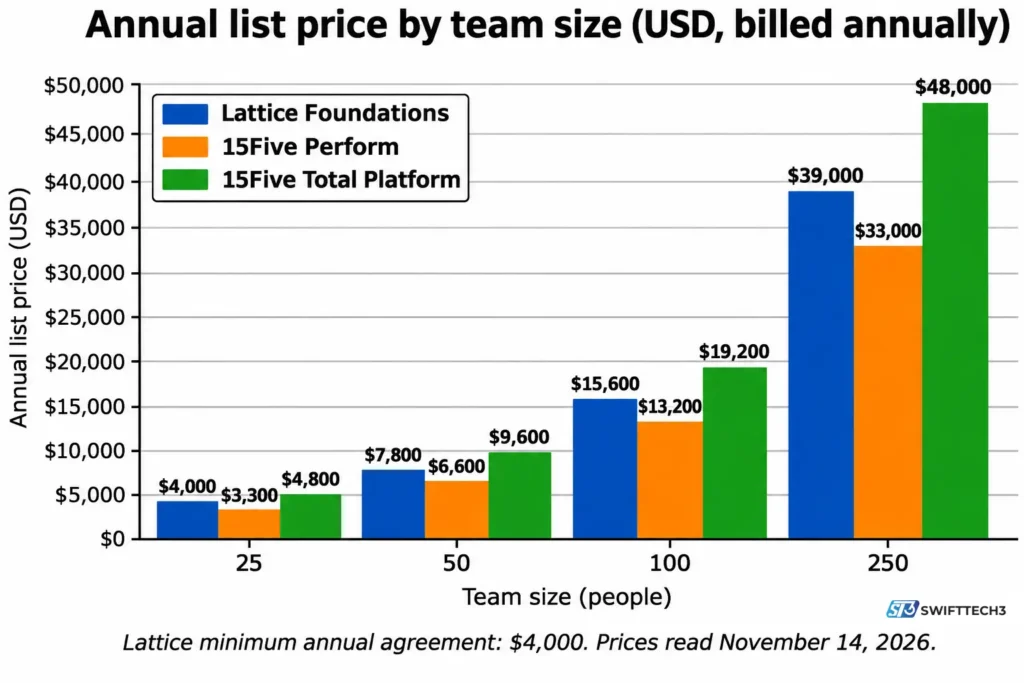
Cost math, calculated November 14, 2026 at list price:
| Team size | Lattice Foundations | 15Five Perform | 15Five Total Platform |
|---|---|---|---|
| 12 people | $4,000 (minimum applies; $27.78 per seat/month) | $1,584 | $2,304 |
| 25 people | $4,000 (raw total $3,900) | $3,300 | $4,800 |
| 50 people | $7,800 | $6,600 | $9,600 |
| 100 people | $15,600 | $13,200 | $19,200 |
| 250 people | $39,000 | $33,000 | $48,000 |
An illustrative 100-person company with 10 managers that buys 15Five Perform ($13,200), Kona Notetaker for everyone ($2,400), Kona Coach for each manager ($2,280) and manager content ($5,880) pays $23,760 a year, or $19.80 per employee per month. Adding Engagement ($4) and the Grow and Compensation add-ons ($4 and $6) to Lattice Foundations at 100 seats takes it from $15,600 to $32,400.
What most buyers miss:
- Third-party directories lag. Several still list Lattice’s bundle at $11 and 15Five’s Perform plan at $10. The official pages now show $13 and $11. In our check, Lattice’s pricing page listed no HRIS or payroll product, although directories still show them.
- The license is not the biggest cost. Deloitte’s 2 million hours, and Adobe’s roughly 80,000 manager hours, show that manager time dominates. Lattice states there are no additional implementation or change-management fees for its performance software.
- Feature lists are vendor claims. Where a vendor says AI drafts reviews or flags risk, no independent evidence was found that these features improve performance.
What changed in 2026?
| Date | Change | Source |
|---|---|---|
| January 1, 2026 | Illinois HB 3773 took effect (notice and non-discrimination for AI in employment decisions) | Gibson Dunn, October 5, 2026 |
| February 2026 | 15Five’s pricing page was last updated; Perform lists AI-assisted reviews | 15Five pricing page |
| May 14, 2026 | Colorado replaced its 2024 AI Act with SB 26-189 | Gibson Dunn |
| September 30, 2026 | California signed SB 947, the No Robo Bosses Act | Gibson Dunn |
| October 16, 2026 | Betterworks study: 44% of leaders can provide a metric for performance management impact | Canadian HR Reporter |
| November 14, 2026 | Lattice’s pricing page lists Foundations at $13 per seat/month | Lattice pricing page |
Can you use AI to write or score performance reviews in the US?
Generally yes, but a growing set of state and city rules now covers it. According to Gibson Dunn’s October 5, 2026 newsletter, there is no federal statute governing AI in employment, so employers face a patchwork.
| Jurisdiction | Status | What it requires for employment decisions |
|---|---|---|
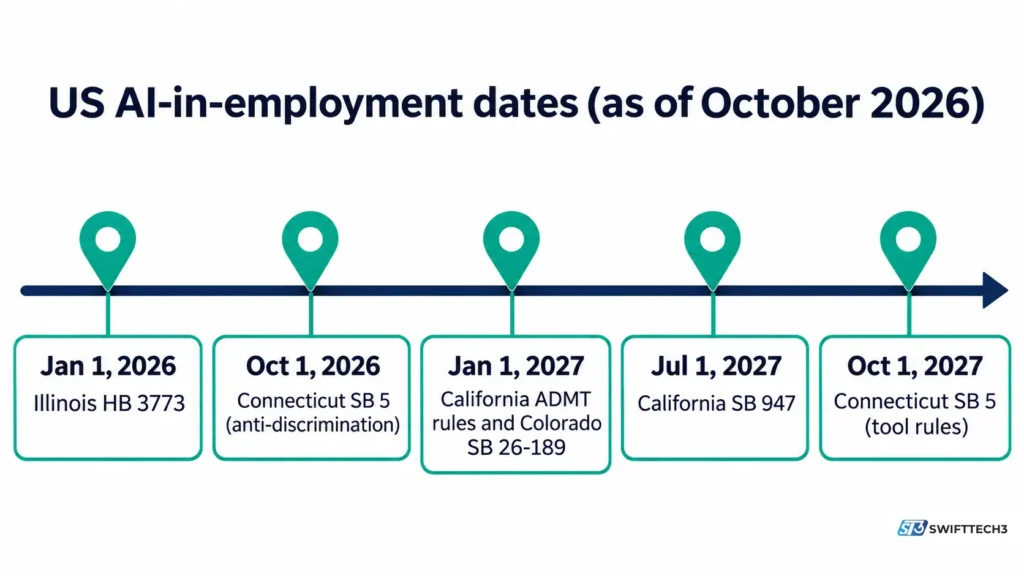
| Illinois HB 3773 | In effect since January 1, 2026; state rules were issued in May 2026 and withdrawn in June 2026 | Notice that AI is used; no AI use with a discriminatory effect |
| California Civil Rights Council rules | In effect since October 1, 2025 | Discrimination by automated decision systems is unlawful; records kept four years |
| California CCPA ADMT rules | Compliance by January 1, 2027 | Pre-use notice, opt-out or human appeal, risk assessment |
| California SB 947 | Effective July 1, 2027 | No sole reliance on AI for discipline or termination; human corroboration; notice |
| Colorado SB 26-189 | Formally effective January 1, 2027; enforcement stayed in xAI v. Weiser as of October 5, 2026 | Pre-use notice, 30-day explanation of adverse outcomes, human review on request |
| Connecticut SB 5 | Anti-discrimination provisions since October 1, 2026; tool provisions from October 1, 2027 | Notice and disclosure for covered tools |
| New York City Local Law 144 | In effect since January 1, 2023 | Bias audit and 10 business days’ notice for tools that screen employees for promotion |
| Texas TRAIGA | In effect since January 1, 2026 | Bans AI built or used with intent to discriminate; no notice or audit duty |
Executive Order 14365 (December 2025) directed a multi-agency effort to challenge state AI laws, and the Justice Department set up an AI Litigation Task Force in January 2026. Whether federal action will displace these rules is still open.
To reduce risk:
- List every AI feature in your review tool. According to its pricing page, 15Five Perform includes AI-assisted performance reviews, and Lattice says its AI Agent helps managers write reviews.
- Keep a person responsible for ratings, pay and discipline.
- Tell employees where AI is used.
- Ask each vendor in writing for bias-testing evidence. Gibson Dunn notes such evidence is relevant to claims and defenses in California and Connecticut.
- If you hire or promote with AI, see our guide to AI hiring tools for small businesses.
What are the most common mistakes?
- Buying a tool to fix a manager problem. Gallup says the exact system matters less once managers can hold regular, constructive conversations.
- Mixing pay talk into the review meeting. Gallup advises separating them.
- Trusting one rater’s score. The 62%-versus-21% finding is the reason to add peers, objective measures and calibration.
- Setting only individual goals. Gallup found managers rank team and customer goals above individual ones, yet employees receive them far less often.
- Leaving out deskless staff. SAP warns these workers often do not fit existing systems.
- Repeating vendor statistics as proof. Some guides cite Adobe’s saved hours as 78,000; Adobe’s own post says approximately 80,000.
- Ignoring culture. A system cannot fix a workplace where feedback feels risky; see our piece on building a healthy, positive work environment.
Who should buy a system, and who should skip it?
| Buy software if | Skip it for now if |
|---|---|
| You have more than about 25 people and run formal cycles | You have under 25 people and no review process yet |
| Managers spend hours on forms and spreadsheets | Managers do not hold regular check-ins yet |
| You must document decisions for audit or legal defense | You want software to create a feedback culture |
| You need calibration across many managers | You cannot name who owns the process |
Myth vs fact
| Myth | Fact |
|---|---|
| More feedback always improves performance | Over one-third of feedback interventions in a 1996 meta-analysis decreased performance |
| A performance management system is an annual review | The review is one step; OPM lists planning, monitoring, developing, evaluating and rewarding |
| “Starting at $4” buys performance reviews | At 15Five and Lattice the $4 products are engagement surveys |
| Ratings measure the employee | In one 360-degree study, 62% of variance reflected the rater and 21% actual performance |
| Software drives McKinsey’s 4.2 times outperformance | The finding concerns companies that focus on people’s performance, and it is a correlation |
FAQs
What is a performance management system?
It is the combined processes and tools an organization uses to set goals, track progress, give feedback and evaluate employees. Many writers use the term for the software alone, so check which meaning a source intends.
What are the stages of a performance management cycle?
SAP names three: plan and act with goal management, monitor with continuous performance management, and evaluate and recognize through assessments. McKinsey lists four elements: goal setting, reviews, ongoing development and rewards.
How is performance management different from a performance appraisal?
An appraisal is the evaluation step. OPM defines it as comparing performance with the elements and standards in a performance plan. The full system also covers planning, monitoring, developing and rewarding.
Do small businesses need performance management software?
Not necessarily. Goals, check-ins and a yearly summary can run in shared documents. Lattice’s $4,000 annual minimum means a 12-person team pays about $27.78 per seat per month, while 15Five’s page lists no minimum for standard packages.
How much does it cost per employee?
As of November 14, 2026, 15Five Perform is $11 and Total Platform is $16 per user per month, and Lattice Foundations is $13 per seat per month. Culture Amp publishes no per-seat price.
Is 360-degree feedback part of a performance management system?
It is one method, collecting input from managers, peers and direct reports. 15Five lists 360° reviews in Perform. Because rater tendencies explain most rating variance in the Mount study, use several inputs.
Is it legal to use AI in performance reviews?
It is not banned federally, but states such as Illinois, California, Colorado and Connecticut, and New York City, impose notice, anti-discrimination or human-review duties of varying scope. Ask an employment lawyer which apply to you.
How often should you review performance?
There is no universal number. Gallup found 56% of employees review goals once a year or less, and that quarterly progress checks are associated with higher engagement and perceived fairness.
Key takeaways and your next step
- A performance management system is a cycle of goals, check-ins, evaluation and development; software is optional.
- Independent data shows low confidence in current systems, and the best evidence supports clear goals and regular conversations.
- Check what a “starting at” price covers, the minimum annual spend and the add-ons before comparing vendors.
- If AI touches reviews, pay or discipline, check notice and human-review rules in each state where you employ people.
Next step: Ask five people on one team to write down what is expected of them this quarter, then compare their answers with their manager’s. Gallup found only 47% of employees strongly agree they know what is expected, so this test shows whether you need better conversations before you need a tool.
Related: AI governance and compliance guide
Disclaimer: This article is for information only and is not legal, HR or financial advice; employment and AI laws vary by state and change often, so consult a qualified employment lawyer before acting. It is not affiliated with, sponsored by or endorsed by Gallup, Lattice, 15Five, Culture Amp, SAP, Adobe or any other organization mentioned. Prices, features and laws may change after publication, and AI-assisted content can contain errors. Information last verified on November 14, 2026.