Growth Navigate Funding is the name used by a website advertising startup fundraising advice, pitch decks, investor introductions, and financial modeling. The phrase also appears in broader business-funding articles, making the search results easy to misread. For U.S. technology founders, the first task is to identify the provider and understand exactly what it offers. Then compare any proposed financing with your business’s cash needs, repayment capacity, and ownership goals.
This guide explains the advertised services, the checks worth making before paying an advisor, and the funding options that deserve consideration.
What Does Growth Navigate Funding Offer?
The homepage at growthnavigatefunding.com markets fundraising strategy, pitch deck development, investor access, financial modeling, growth advisory, and preparation for investor due diligence. Its stated audience includes startups seeking funding from pre-seed through Series C.
Those descriptions establish the services being advertised. They do not independently verify completed transactions, client results, or the likelihood that another founder will obtain funding.
There is also a similarly named website, GrowthNavigate.com, offering business funding and financial services. Similar names are insufficient evidence of common ownership. Match the website, legal business name, named professionals, and engagement agreement before treating two services as the same organization.
For a founder evaluating Growth Navigate Funding, the practical question is: what specific work will the provider deliver, at what cost, and who will make the actual funding decision?
An advisor might improve a financial model or organize investor outreach. A lender or investor still needs to evaluate the business and agree to provide capital.
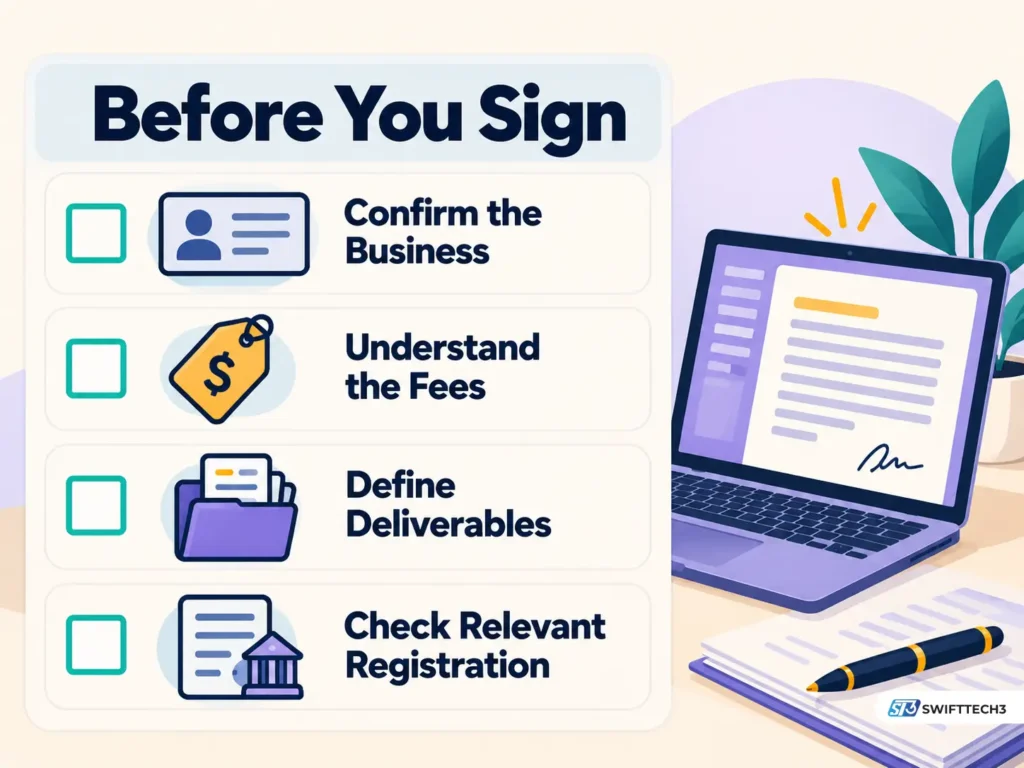
What to Check Before Hiring a Funding Advisor
A useful engagement should describe work you can inspect and accept. “Access to investors” is difficult to evaluate without an explanation of who will be approached, why those investors fit, and what the advisor will actually do.
Use these questions to assess the agreement:
| Check | What a clear answer should establish |
|---|---|
| Contracting business | The legal entity receiving payment and responsible for delivering the work |
| Deliverables | Whether you receive a deck, editable financial model, investor research, introductions, or ongoing support |
| Fees | Retainers, project fees, success fees, expenses, cancellation terms, and any continuing fee obligations |
| Relevant experience | References or transaction details that can be checked with the parties involved |
| Conflicts | Whether lenders, investors, or other providers also compensate the advisor |
| Information handling | Who can access your financial records and how documents will be shared |
Our guide to consulting services for tech startup growth provides broader context for deciding where outside expertise fits into a small team.
Investor Introductions Can Raise Registration Questions
According to the U.S. Securities and Exchange Commission, finding investors, soliciting securities transactions, and receiving compensation tied to a transaction’s outcome or size can raise broker-dealer registration requirements.
The actual activities matter. A contract calling someone a “consultant” does not settle the issue.
For an engagement involving securities fundraising, have a qualified securities lawyer review the work and compensation structure. Where broker registration is relevant, check the individual and firm through FINRA’s BrokerCheck and consult the appropriate state securities regulator.
This is a general due-diligence principle, not a finding about the registration status of Growth Navigate Funding.
Understand the Difference Between a Fee and a Guarantee
The Federal Trade Commission explains that legitimate lenders can charge application or appraisal fees. However, paying a fee does not guarantee that a borrower will receive a loan.
That distinction also helps when evaluating advisory work. An upfront charge should have a clearly described purpose and contractual terms. Treat promises of guaranteed approval in exchange for payment as a serious warning sign.
U.S. Funding Options for Technology Businesses
A software startup, an online retailer, and a digital agency can have very different financing needs. Compare the obligation created by each option before focusing on the amount available.
| Funding route | Potential use | Main trade-off |
|---|---|---|
| Founder funds and customer receipts | Testing demand or financing manageable expansion | Personal capital is at risk, and available cash limits spending |
| Bank or SBA-backed 7(a) loan | Eligible working capital, equipment, or other business needs | Repayment, underwriting, and contractual conditions |
| SBA microloan | Smaller eligible working-capital or equipment needs | A maximum loan of $50,000 and intermediary lending requirements |
| Angel investment or venture capital | Development and expansion where investors accept business risk | Ownership dilution and negotiated investor rights |
| Targeted research grants | Projects meeting a specific research program’s objectives | Restricted eligibility, permitted spending, and application requirements |
| Regulation Crowdfunding | Raising investment from a wider group through a regulated platform | Securities disclosures, intermediary requirements, and compliance costs |
The Small Business Administration states that 7(a) loans can reach $5 million. Applications go through participating lenders; the program provides a loan guarantee to lenders, and borrowers remain responsible for repayment.
SBA microloans are made through approved nonprofit intermediaries. They can finance eligible working capital and equipment, but proceeds cannot be used to repay existing debt or buy real estate.
Grants Require a Specific Program Fit
The SBA says it does not provide general grants for starting or expanding an ordinary business. Its guidance separately identifies scientific research programs, including Small Business Innovation Research and Small Business Technology Transfer.
A technology label alone does not establish eligibility. Before budgeting an award, examine the responsible agency’s current solicitation, eligible applicants, research objectives, permitted costs, and deadlines.
Investment Crowdfunding Has Its Own Rules
Under SEC Regulation Crowdfunding, eligible companies can raise up to $5 million in a 12-month period. Transactions must take place through an SEC-registered broker-dealer or funding portal, with required disclosures.
This differs from collecting product preorders or rewards-based contributions. Decide which fundraising structure you are using before choosing a platform or promoting an offer.
Build a Funding Plan Your Numbers Can Support
1. Describe the Result the Money Should Buy
Write an operating objective that can be measured. For example, a software team might seek capital to complete a required integration, launch paid pilots, and establish whether customers renew.
Prepare a budget for that work, including engineering, infrastructure, customer support, and professional costs. Explain which evidence will show whether the project succeeded.
Avoid using another startup’s round size as your starting budget. A financing headline says little about your own expenses. Our explanation of Rippling’s valuation and funding explores the differences between valuation, new capital, and employee share transactions.
2. Forecast When Cash Actually Moves
Use expected collection dates and payment dates. Keep signed contracts, unpaid invoices, and money already received in separate categories.
For a subscription business, include hosting, model usage, support, refunds, and the cost of delivering services already sold. For an online retailer, include inventory purchases and settlement timing. Our guide to managing online-store cash flow discusses that operating context.
Build a base case and a downside case. Test what happens if sales arrive later, customer losses increase, or a technology discount ends.
3. Calculate Runway With the Proposed Obligations
The following is a hypothetical planning example, not a business result or financing quote.
Assume a startup has $240,000 available for operations, monthly cash payments of $55,000, and monthly customer collections of $40,000.
| Calculation | Result |
|---|---|
| Monthly net cash burn: $55,000 − $40,000 | $15,000 |
| Runway: $240,000 ÷ $15,000 | 16 months |
| Burn after an additional $5,000 monthly payment | $20,000 |
| Runway at that higher burn, before adding loan proceeds | 12 months |
To assess an actual loan, add the net proceeds after fees to available cash and include its repayment schedule. The example isolates the payment’s effect; it does not measure the full financing outcome.
These calculations assume steady collections and spending. A dated cash forecast is more useful when there are large annual bills, delayed receipts, or uneven expenses. If the business generates cash rather than consuming it, this simple burn-based runway calculation does not apply.
4. Compare Written Offers on the Same Basis
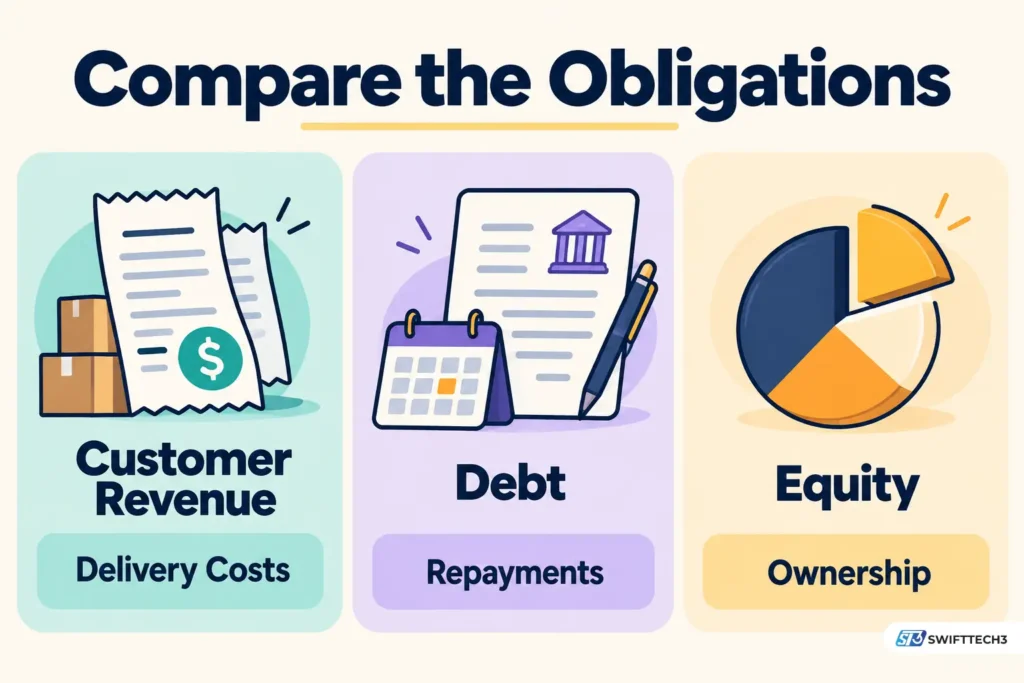
For debt, compare net cash received, total scheduled payments, payment frequency, fees, security, personal guarantees, and early repayment terms.
For equity, compare the ownership being issued, voting arrangements, board rights, and how proceeds would be distributed on a sale or winding-up. Ask your lawyer to explain the proposed terms in the context of your existing ownership structure.
Prepare supporting financial statements, customer evidence, corporate records, ownership records, and material contracts. Make sure the numbers in the deck match the underlying records and model.
Practical Insights
The following are planning judgments drawn from the official rules and the cash-flow examples above.
Cloud Credits Have a Different Budgeting Role From Cash
AWS promotional credits offset eligible service charges, have no cash value, and expire. AWS billing documentation also explains that credits are applied until exhausted or expired.
For a technology startup, the practical implication is to model credits as reductions in eligible bills. They cannot fund payroll directly.
For example, assume an award provides $20,000 in credits, but your planned eligible usage before expiry totals $8,000. In that hypothetical budget, the usable expense reduction is $8,000. Include the expected cash cost after the credits end, and avoid creating unnecessary usage merely to consume the award.
Budget for the Net Amount You Can Use
If a project requires a certain amount of operating cash, account for fundraising, legal, and advisory costs separately. Ask which fees are payable even if financing does not close.
This makes it easier to compare proposals that advertise the same funding amount but leave different sums available for the work.
Treat an Advisor’s Work as a Measurable Purchase
An advisor can provide value through clearer financial assumptions, better documentation, or relevant introductions. Define those outputs before paying and agree how progress will be reported.
A polished deck should still reconcile with the business’s records. Use advice to improve decisions and preparation rather than treating presentation quality as evidence that funding will follow.
Common Funding Mistakes to Avoid
- Counting anticipated funding as available cash. Keep financing that has not closed separate from money the business can spend.
- Choosing debt from the best-case forecast. Test repayments against a slower collection scenario.
- Confusing provider claims with verified results. Request evidence relevant to your stage and industry.
- Ignoring the cost after discounts expire. Include future infrastructure and software bills.
- Comparing equity offers only by valuation. Review ownership and control terms alongside price.
FAQs
What Is Growth Navigate Funding?
Growth Navigate Funding is a website marketing startup fundraising advisory services, including pitch preparation, financial modeling, and investor outreach. The phrase is also used more broadly in articles about financing business growth, so identify the specific provider before making a decision.
Is Growth Navigate Funding a Lender?
The reviewed homepage presents fundraising advisory services. It does not establish that the website itself will lend money or invest in a business; the contracting entity and actual source of capital should be identified in any proposal.
Is Growth Navigate Funding Legitimate?
The published service description alone is insufficient to independently confirm the provider’s advertised funding outcomes or justify an endorsement. Assess the legal entity, relevant references, written fees, deliverables, and any registration requirements associated with the proposed activities.
How Much Does Growth Navigate Funding Charge?
The homepage reviewed did not display a fee schedule. Obtain a written quote covering project charges, retainers, success fees, expenses, and cancellation provisions before comparing the service with alternatives.
Can a U.S. Startup Apply for an SBA Loan?
A startup may be eligible for SBA-supported financing, depending on the program, business, and lender’s requirements. Approval is not automatic, and borrowers must satisfy the applicable underwriting and repayment criteria.
Does the SBA Give Grants to Start a Software Business?
The SBA does not offer general startup or expansion grants for ordinary businesses. A software-related research project may fit a targeted federal research opportunity, but eligibility depends on the current program and solicitation.
Should a Tech Founder Choose Debt or Equity?
Debt creates repayment obligations, while equity involves ownership and negotiated investor rights. Compare both against the downside cash forecast, the uncertainty of the proposed work, and the founder’s goals for control and growth.
Do Cloud Credits Count as Startup Funding?
They can support a startup by reducing eligible technology expenses, but they should be tracked separately from cash. Their practical value depends on the charges they cover, how much the business will use, and when they expire.
Conclusion
Start by identifying which Growth Navigate Funding service you are evaluating and what its contract promises to deliver. Build a dated cash forecast, compare financing obligations, and calculate how much usable money remains after costs.
For a tech business, include infrastructure spending and expiring credits in that decision. Choose financing that supports a defined operating result and remains manageable if progress is slower than expected.
Disclaimer
This article provides general information about startup financing and funding advisors; it is not financial, investment, tax, or legal advice. Funding results and eligibility vary, so consult a licensed financial professional and a qualified attorney before committing to financing or an advisory agreement. Information is current as of October 2026; provider services, fees, program rules, and availability can change.