
Last verified: October 11, 2026, against the official FictionLab documentation, its public update log and its Google Play listing.
Search for FictionLab AI and you will find an app listing, a handful of review blogs, and a few pages that describe the product so differently you would think they were about separate tools. One calls it a copywriting assistant. Another says it has no image generation or voice. Neither matches what the platform’s own documentation says.
This guide is built the other way around. I started with the primary sources (the official docs, the dated changelog and the store listing) and then checked what third parties say against them. The result is a practical explanation of what FictionLab AI is, how its memory and lore system actually works, what each tier gives you, where the documentation contradicts itself, and what to do before you invest hours into a story.
Quick answer: FictionLab AI is a free-to-start, 18+ web and Android platform for AI roleplay and interactive storytelling. You chat inside user-made scenarios built from characters, locations and “lore pieces,” choose from three free AI models or paid Plus and Ultra models, and rely on a memory system designed to keep long stories consistent.
What Is FictionLab AI?
FictionLab AI is a scenario-driven AI storytelling platform found at fictionlab.ai. The AI plays every character other than yours, and you play your own character or a pre-defined one, as FictionLab’s official chat guide describes it. That makes it closer to a shared writing room than a single-persona companion bot.
Where FictionLab AI came from
The official update log gives the origin story, and it is more interesting than most reviews mention. FictionLab was announced on November 19, 2024, as a new service for a community Discord server that had been left without a purpose after the Animeflix shutdown. By mid-December 2024 it reported more than 2,000 registered users. The Android app followed in 2025, and its Google Play listing now shows 100K+ downloads, an 18+ content rating and a rating of about 4.0 stars from roughly 2,800 reviews at the time of writing.
That community origin explains a lot. Features such as scenario bounties, creator leaderboards and badges grew out of a Discord-style culture of sharing and competing, not out of a corporate chatbot roadmap.
Why “scenario-first” matters
Most AI chat apps revolve around one character card. FictionLab revolves around a scenario containing many characters, places and rules. The docs say plainly that it focuses on multi-character roleplay rather than basic chatbots. If you mainly want a single companion to talk to, this structure can feel like overkill. If you want a cast, a world and a plot that evolves, it is the point.
How FictionLab AI Works Under the Hood
Lore pieces and the Librarian
Every scenario has a backstory, a greeting message, custom instructions and lore pieces. According to the official scenario creation guide, the backstory works like a prologue and is dropped over time in favor of lore pieces, which is why characters and locations should each get their own piece instead of living in the backstory.
A feature called the Librarian decides which lore pieces to load into each scene. It looks at trigger words, a short description field and, if “Smart Activation” is on, the meaning of the conversation. A few details from the docs are worth knowing:
- Trigger words are not case sensitive but match whole words, so “art” will fire for “Art” but not for “artist.”
- Pinned pieces are always included when budget allows, so pinning too many starves everything else.
- Linking pieces makes them appear together, but over-linking pulls in irrelevant material.
- Most pieces should stay at standard weight or lower.
Memory Matrix
The official Memory Matrix guide explains how the platform remembers a long chat. Memories are short summaries of past events, generated automatically every 30 messages (counting your replies and the AI’s together), or manually with the /memory-cards command for 10 to 50 messages. Free accounts hold up to 100 memories; FictionLab+ holds up to 500, and paid memories are more detailed.
Two details deserve more attention than they usually get. First, unpinned memories are deleted oldest-first when you hit the cap, so pin the ones that matter, but never so many that new ones have nowhere to go. Second, memories are generated by a separate AI from a separate provider, not by the chat model you selected. If memory creation fails during a busy period, it is not necessarily the same problem as a slow chat model.
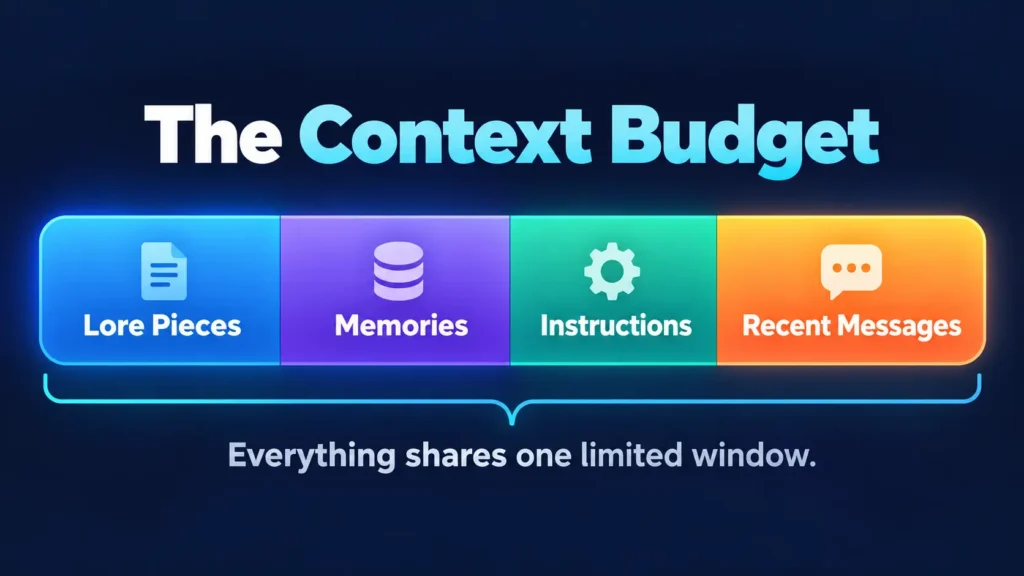
Think of it as a context budget
The official tiers page lists a maximum AI context of 32K for free, 131K for Plus and 131K+ for Ultra. That is the working space shared by your scenario instructions, activated lore pieces, memories and recent messages. A useful mental model is a desk of fixed size: every pinned lore piece, every long memory and every paragraph of custom instruction takes up space that recent dialogue could have used. Many “the AI forgot” complaints are really budget problems, not intelligence problems.
FictionLab AI Models Explained
The official chatting guide lists the current models and describes each one’s personality. Here is the lineup as documented:
| Tier | Model | What the docs say it is good at |
|---|---|---|
| Free | Default | Good creativity and decent memory, unlimited and unfiltered |
| Free | Ophelia | Smaller details and slower pacing; slow burn and slice of life |
| Free | Wraithmind | Darker roleplay such as horror and high-stakes survival |
| Plus | Glendora V4 | Flagship Plus model blending several models; emotional coherence and instruction following |
| Plus | Oracle V3 | Balanced and reliable storytelling; based on DeepSeek V3.2 |
| Plus | Chimera | Variety in the plot while keeping characters true to their definitions; based on GLM V4.6 |
| Plus | Solara | Precise instruction following with a warmer voice |
| Plus (limited) | Quasar | Undisclosed experiment, offered for a limited time |
| Ultra | Eclipse | Fast reasoning all-rounder for long arcs |
| Ultra | Paragon | Built on DeepSeek V4 Pro; plans scenes before replying |
| Ultra | Lumina | Built on Xiaomi MiMo V2.5 Pro; richly descriptive prose |
Models change faster than reviews do
The update log shows how quickly the lineup moves. Ophelia replaced the older Aurelius model in September 2025. The Eidolon test model became Oracle V3 in December 2025. Chimera, introduced as a beta in January 2026, replaced Riddleheart by February. Even Chimera’s base was switched back from GLM 4.7 to 4.6 after the team judged the newer version weaker at creative writing. Any review that names a model without a date is probably describing something that has already been retuned.
Which model should you start with?
- Slow, atmospheric stories: Ophelia on the free tier.
- Horror or survival: Wraithmind.
- Stories that need surprises without losing character consistency: Chimera, if you are on Plus.
- Tactical or plot-heavy scenarios: Paragon on Ultra, which the docs position for planning and complex instructions.
Free vs Plus vs Ultra
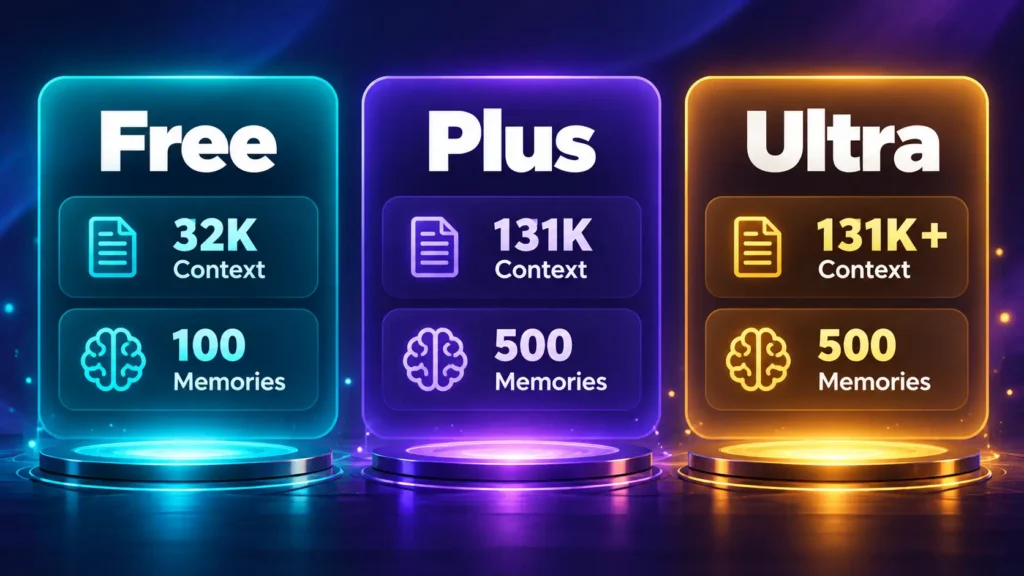
The tiers page is unusually open about differences. These are the figures that matter most:
| Feature | Free | FictionLab+ | Ultra |
|---|---|---|---|
| Max AI context | 32K | 131K | 131K+ |
| Max parameter count | 70B | 685B | 685B |
| Models available | 3 | 7 + 1 limited | 10 + 1 limited |
| Reasoning (“thinking”) models | No | No | Yes |
| Max memories | 100 | 500 | 500 |
| Lore pieces combined length | 100,000 | 250,000 | 400,000 |
| Image generation credits | 20 | 200 | 400 |
| In-chat image generation | No | No | Yes |
On price, the update log says FictionLab+ moved to €6.99 per month (about $7.99) in July 2025, and the Ultra tier launched in May 2026 at $24.99 per month, with Patreon added as an extra checkout route. Prices and plans can change, so confirm them inside the app before subscribing.
Everyday Features Worth Learning
The slash commands save the most time. Type “/” in any chat to see them. The useful ones include /ooc for out-of-character instructions, /recap to summarize earlier messages, /pov to write from another character’s perspective, /improve to rewrite your draft in your character’s voice, and /model to switch models mid-chat.
Other practical tools include chat branching (to try an alternate path without losing the original), rewind, unlimited regenerations you can flip between, voice narration, message translation, and chat export as PDF or JSON. Each account is capped at 500 chats, and you can reorganize scenarios into folders.
What Most FictionLab AI Guides Get Wrong
This is where checking primary sources paid off.
Capabilities are misreported. One comparison site lists FictionLab as having no voice chat and no image generation. The official docs describe a narration feature with selectable voices and an image generator with monthly credits (and in-chat generation on Ultra). To be fair, “voice chat” as in speaking to the AI live is not documented, but voice narration and image generation are.
Some pages describe a different product. At least one page on an unrelated university domain presents FictionLab AI as a marketing and copywriting tool. It is not. It is a roleplay and storytelling platform with an 18+ rating.
The “70B” figure is outdated for paid tiers. The Play listing still advertises 70B models, which matches the free tier’s cap. The tiers page lists up to 685B parameters for paid plans.
The documentation contradicts itself in places. The chatting guide gives the free limit for per-chat custom instructions as 300 characters, matching a September 2025 update note, while the tiers table shows 200. When numbers conflict, trust the live character counter in the app.
Safety, Privacy and Age Suitability
FictionLab AI is not a children’s product. Google Play rates it 18+ for sex and nudity, and the platform markets unrestricted chats. Within that framework it does add controls: scenarios can be flagged as sensitive 18+ content, public scenarios go through staff review, messages can be reported, and users can filter sexual, violent, gore or “dead dove” scenarios from their feeds with options to hide or blur covers. Since January 2026, sexually explicit or disturbing profile images are blurred by default.
On data, the Play listing’s developer-provided safety section says no data is shared with third parties, that personal info and messages may be collected, that data is encrypted in transit, and that deletion can be requested. That is the developer’s own declaration, so read FictionLab’s privacy policy and terms of service yourself before sharing anything sensitive. One more warning from the docs: cleared chats cannot be restored and account deletion is instant and permanent. Export anything you want to keep first.
Benefits, Drawbacks and Common Mistakes
Benefits
- A usable free tier without paywalled basics such as editing or regenerating messages.
- Strong structure for long stories: lore pieces, memory cards, branching and exports.
- Transparent tier comparison and a public changelog.
- Active creator community with bounties, search by tags and creators, and a Reddit community called r/FictionLab.
Drawbacks
- Quality is not constant. Verified Play reviews in July and August 2026 conflict: one user praises free-tier coherence, while another says quality dropped after the Memory Matrix update. Both are single opinions, but they show how much experiences vary.
- Free users face tight limits (32K context, 100 memories).
- Models and features change often, so tutorials age quickly.
Common mistakes
- Putting character personalities and locations in the backstory instead of lore pieces.
- Pinning too many lore pieces or memories and leaving no space for new ones.
- Using memories to plan future events or give instructions. The docs say memories are only for summarizing the past.
- Telling the AI only what not to do. The docs advise stating what it should do instead.
- Over-linking lore pieces so unrelated details keep surfacing.
- Skipping a private test run before publishing a scenario.
Best practices
- Write the greeting message in the perspective and tone you want, since it strongly shapes the AI’s style.
- Keep lore piece content concise, with clear descriptions the Librarian can match.
- Start private (turn off Public), test which pieces activate, then publish.
- Pin only the memories that truly anchor the plot, and review them every few hundred messages.
FictionLab AI vs Alternatives
Comparison sites typically place FictionLab against Character.AI and Janitor AI. Third-party write-ups describe Character.AI as stricter on mature content and stronger on its sheer library of characters, while describing FictionLab as better for story-first use. One review frames Janitor AI as offering more control at the price of more setup. Treat those as editorial opinions rather than benchmarks. If you want to see how a different story-focused tool handles memory and worldbuilding, SwiftTech3’s DreamGen AI review is a useful companion read, and the Artificial Intelligence section covers other tools in this space.
Personal Experience: What Working Through FictionLab AI Taught Me
I want to be upfront about the limits of my testing: I did not buy FictionLab+ or Ultra for this guide, so I will not pretend to describe how Glendora or Paragon “feel” in a long session. What I did was read the full documentation set and the entire update log, cross-check them with the store listing and independent reviews, and map how the system is meant to behave. Here is what stood out.
The docs preach restraint, repeatedly. Warnings about weights, linking and pinning appear on several separate pages. When documentation repeats itself like that, it usually reflects real support tickets. My takeaway: start simple, and add complexity only when a specific problem demands it.
Memory is the platform’s constant project. The changelog is full of memory work: an overhauled memory system in September 2025, lore engine rebuilt around the Librarian in May 2026, and a fix for Oracle’s short-term memory and lore activation problems the same month. That tells me improvement is ongoing, and it also means behavior you tested last month may differ today. Re-test after major updates.
Reviews split sharply, and both sides can be right. Within weeks of each other, one reviewer called the free version good and cohesive, and another called it unplayable after an update. Different scenarios, different models and different expectations produce different outcomes. The lesson is to judge it with your own scenario, not with someone else’s verdict.
Documentation gaps are a signal to trust the interface. Finding two different custom-instruction limits taught me to treat every numeric limit in any guide, including this one, as a snapshot.
If I were starting today, my plan would be: build one small private scenario on a free model, give each character and location its own lore piece, run about 40 messages so the first automatic memory generates, then read what the memory system actually wrote before deciding whether Plus is worth paying for.
Frequently Asked Questions
What is FictionLab AI used for?
FictionLab AI is used for AI roleplay, interactive fiction and collaborative storytelling. People play inside community-made scenarios or build their own with characters, locations and rules.
Is FictionLab AI free?
Yes, there is a free tier with three models, 32K context, 100 memories and 20 image credits. Paid FictionLab+ and Ultra tiers add larger context, more models, more memory and more image credits.
How much does FictionLab+ cost?
Official update notes put FictionLab+ at €6.99 per month (about $7.99) as of July 2025, and Ultra at $24.99 per month from May 2026. Check the in-app price before you subscribe, as plans can change.
Is FictionLab AI safe to use?
It is an 18+ platform with content filters, report tools and staff review of public scenarios. The developer declares in Google Play that no data is shared with third parties, but you should read the privacy policy and avoid sharing personal details in chats.
Does FictionLab AI have a mobile app?
Yes. There is an Android app on Google Play, and the web version also works on phones. Some third-party sites list APK downloads, but the official store listing is the safer source.
Can I export my chats from FictionLab AI?
Yes. Open chat settings, scroll to the bottom and choose Export as PDF or Export as JSON. Do this before clearing chats or deleting your account, because both actions are permanent.
Why does the AI forget details in long chats?
Usually because of the context budget. Scenario instructions, lore pieces, memories and recent messages share a limited window. Pin only essential memories, keep lore pieces concise, and use the /recap and /memory-cards commands to reinforce important events.
Which FictionLab AI model is best?
There is no single best one. Ophelia suits slow, detailed stories, Wraithmind suits darker tales, and Plus or Ultra models such as Glendora V4, Chimera or Paragon offer larger context and stronger instruction following. Try the same scene on two models and compare.
Conclusion and Actionable Takeaways
FictionLab AI is best understood as a storytelling system with a chat window on top, not a chatbot with story features bolted on. Its strengths are structure (lore pieces, the Librarian, memory cards), an unusually open tier comparison and a public changelog. Its weaknesses are variable quality from update to update and plenty of outdated or inaccurate third-party coverage.
What to do next:
- Verify any claim you read (including prices and limits) against the official docs and the in-app counters.
- Build a small private scenario first and test lore activation before publishing.
- Treat context as a budget: keep lore concise and pin sparingly.
- Export chats you care about regularly.
- Re-test your favorite model after each major update, since models are retuned often.
- Keep it 18+ only, and read the privacy policy before sharing sensitive information.
For more explainers on how fast-moving AI tools change, see SwiftTech3’s AI Productivity Tools Updates 2026 and the rest of the SwiftTech3 homepage coverage.
Disclaimer: This article is independent and not affiliated with or endorsed by FictionLab. Information was checked on October 11, 2026, and features, models, limits and prices change frequently. FictionLab AI contains mature content and is intended for adults only. Nothing here is legal, financial or professional advice. Verify details on the official website before subscribing or sharing personal data.