P0172 and P0299 repairs range from about $100 for a loose charge-pipe clamp to $1,800–$4,500 for a new turbocharger, according to Empire Auto Protect’s 2026 estimates. One boost leak can set both codes, so pay for a diagnosis (about $120–$180) before approving any expensive part.
You plug in an OBD-II scanner after the check engine light comes on and see two codes at once: P0172 and P0299. One says the engine is running rich. The other says the turbo is not making the boost the computer asked for. It looks like two expensive problems, but it is often one cheap one. This guide covers what each code means, what each repair costs as of November 2026, and how to keep a small fault from becoming a turbocharger bill.
Why Do P0172 and P0299 Show Up Together?
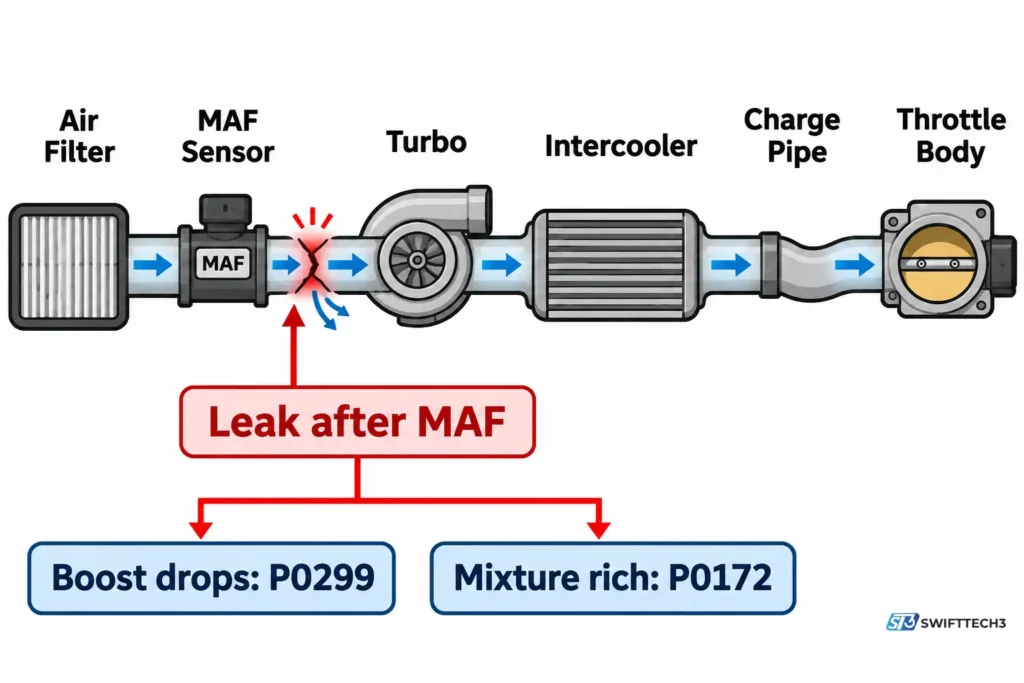
A single air leak on the pressurized side of the intake can set both codes. P0172 means “System Too Rich (Bank 1)”. P0299 means “Turbocharger/Supercharger A Underboost Condition”, so measured boost stayed below what the engine control module requested.
The mechanism works like this on engines that fuel from a mass airflow (MAF) sensor. The sensor counts the air, the module adds matching fuel, and then a loose or cracked pipe lets some of that counted air escape before it reaches the cylinders. Boost drops (P0299) and the mixture runs rich (P0172).
This pairing is documented by a manufacturer. A GM TechLink article from November 2022 describes reduced power on some 2018–2022 Malibu, Equinox and Terrain models with the 1.5L engine. The stored codes included P0101, P0172, P0299, P0506 and P1101. GM says the cause can be a charge air cooler outlet tube that has separated from the throttle body. GM also advises against replacing the throttle body or MAF sensor unless they are damaged or found to be the cause.
Other shared causes
Not every pair of codes is a leak. A restricted air filter or intake can starve the turbo and upset fueling. An exhaust restriction, such as a clogged catalytic converter or diesel particulate filter, can choke the turbine. A faulty sensor can feed the module wrong data. Identifix lists sensor and wiring faults among the common P0299 causes.
How Much Do P0172 and P0299 Repairs Cost?
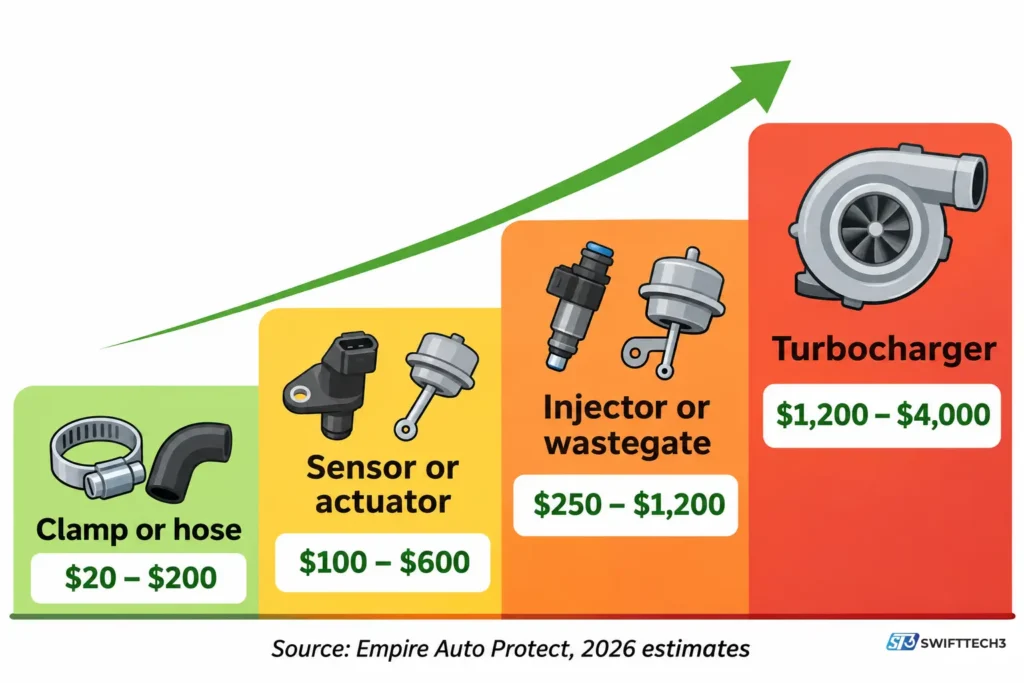
The cost depends almost entirely on the failed part. Empire Auto Protect, which sells vehicle service contracts, puts P0299 repairs at $100 to $4,500. It says most land between $300 and $1,200. Identifix lists parts-only prices that are lower because they leave out labor. Treat every figure here as a range, since prices vary by vehicle, region and parts source.
P0172 parts cost by repair
| Repair | Typical parts cost (Identifix) |
|---|---|
| MAF sensor cleaning | $10–$20 for cleaner |
| Engine air filter | $15–$40 |
| MAF sensor replacement | $80–$300 |
| Fuel pressure regulator | $50–$150 |
| Fuel injector | $75–$250 per injector |
| Upstream oxygen sensor | $50–$250 |
Identifix describes these as aggregated estimates and says labor is extra. It also says to expect roughly an hour of diagnostic labor, and more when fuel pressure testing is involved.
P0299 cost by repair
| Repair | Parts only (Identifix) | Parts and labor (Empire, vendor estimate) |
|---|---|---|
| Charge pipe, hose, coupler or clamp | $20–$150 | $100–$300 (hose or clamp); $150–$450 (intercooler pipe or coupler) |
| Vacuum lines to the actuator | $10–$40 | Not listed |
| Diverter or bypass valve | Not listed | $150–$400 |
| Boost, MAP or MAF sensor | $30–$150 | $150–$350 (boost pressure sensor) |
| Boost control solenoid | $30–$100 | Not listed |
| Wastegate actuator | $50–$250 | $300–$800 |
| Diesel vane (VGT) actuator | Not listed | $500–$1,200 |
| Turbocharger replacement | $500–$2,500 or more | $1,800–$4,500 |
What most people miss: the two columns measure different things. Parts-only prices make a job look cheap, and parts-plus-labor prices are what you pay. Compare quotes line by line, which is the same habit that works when you compare prices before buying online.
What Does a Diagnosis Cost, and Is It Worth It?
Empire says independent shops typically charge $120 to $180 to diagnose P0299. That usually includes a scan, a visual inspection and a boost or smoke test. The simple arithmetic below shows why that fee matters. The scenarios are illustrative and use Empire’s ranges.
| Scenario | Calculation | Total |
|---|---|---|
| Diagnose first, find a leak | $120–$180 + $100–$300 | $220–$480 |
| Diagnose first, turbo has truly failed | $120–$180 + $1,800–$4,500 | $1,920–$4,680 |
| Replace the turbo first, leak was the real fault | $1,800–$4,500 + $220–$480 to fix the leak later | $2,020–$4,980 |
The third row is the expensive mistake. You pay for a turbo you did not need and still pay for the leak. Empire calls replacing a $2,000-plus turbo when the real problem was a clamp “the classic P0299 mistake”.
What Is the Cheapest Order to Test These Codes?
Start with the tests that can explain both codes, then split by system. Identifix and Empire both put the turbocharger last.
- Pull every stored and pending code. A lean code beside P0299 strengthens the case for a leak.
- Compare requested and actual boost on a road test, and check bank 1 fuel trim.
- Inspect and pressure test the charge system from the turbo outlet to the throttle body. Check any connection at the throttle body, as in the GM example.
- Check the air filter and intake path.
- Test the wastegate actuator and boost control solenoid.
- If the mixture is still rich, check the MAF sensor, purge valve behavior, fuel pressure and injectors.
- Inspect the turbo last for shaft play, damaged compressor blades and oil in the housing.
Can You Read These Codes Yourself With an OBD-II Scanner?
Yes. A scanner that shows live data gives you two useful readings before you call a shop: requested versus actual boost, and bank 1 long-term fuel trim. Identifix says actual boost should track the request closely. It lists a few patterns:
- Actual boost stays near atmospheric: a major leak, a disconnected pipe or a failed turbo.
- Actual boost builds slowly: a restricted intake or exhaust, or sticking vanes on variable-geometry turbos.
- Boost is normal cold but falls off warm: a leak that opens as parts heat up.
For fuel trim, Identifix describes readings beyond roughly minus 25% as code-setting territory, since the module has run out of correction room. A scanner cannot replace a pressure test. Still, the data helps you ask better questions and spot a quote that skips the cheap checks.
Is It Safe to Drive With P0172 and P0299?
Short, gentle trips are usually acceptable, but not for weeks. Identifix says most vehicles cut power or enter limp mode to protect the engine. It says to park the vehicle if you hear grinding or metallic noises, because a turbo can shed debris into the engine. It also says sustained rich running fouls spark plugs and damages the catalytic converter. Avoid towing and heavy loads until the cause is found.
Myths and Facts About These Codes
| Myth | Fact |
|---|---|
| P0299 means the turbo is dead. | Identifix and Empire both say a boost leak is the most common cause. The turbo is checked last. |
| Rich and underboost codes mean two separate repairs. | GM documents one disconnected charge air cooler tube setting both codes on certain engines. |
| Replace the MAF sensor to clear P0172. | Identifix says cleaning with dedicated MAF cleaner resolves many cases. It advises replacing the sensor only if trims stay negative. |
| Clearing the code fixes it. | Identifix says the code returns once the module sees the same pressure gap again, usually on one firm acceleration. |
What Should You Ask a Shop Before Approving Repairs?
- Did you pressure test the charge system, and what did it show?
- What were requested and actual boost, and what was bank 1 fuel trim?
- Is the quote parts only or parts plus labor, and does the diagnostic fee apply toward the repair?
- If you replace a turbo, will you also address the oil supply and any debris in the charge piping?
- Is there a manufacturer bulletin for this engine and these codes?
The fifth question matters because of examples like GM’s bulletin. Keeping a repair fund also helps when a quote comes in high, and our smart financial planning tips cover how to build one. If the car will be in the shop for days, check how a loaner or rental is covered using our guide to rental car insurance.
Common Mistakes That Raise the Bill
- Replacing the turbo before a pressure test.
- Replacing a throttle body or MAF sensor that GM says should stay unless damaged.
- Fixing one leak and not retesting, since a second small leak can bring the code back.
- Installing a replacement turbo without finding why the first one failed, such as oil supply or debris.
- Comparing a parts-only price with a parts-plus-labor quote.
How Can a Shop Use Confirmed Fixes to Quote With Confidence?
Turbocharged engines often have known failure points, such as a specific coupler or bypass valve on one engine family. Identifix describes its Direct-Hit® service as showing confirmed fixes, OE service manuals and wiring diagrams filtered by year, make and model. That is a vendor description, so verify it for your own shop. Used this way, it can guide the test order, and boost and fuel data should still confirm the fault before parts are replaced.
Frequently Asked Questions
Can one boost leak cause both P0172 and P0299?
Yes, on some engines. GM TechLink documents a case where a separated charge air cooler outlet tube was linked to both codes on certain 1.5L models. Air that the MAF sensor has already counted escapes, so boost falls and the mixture runs rich.
How much does it cost to diagnose P0299?
Empire says most independent shops charge $120 to $180. Dealers may charge more. The fee is small next to a turbo replacement estimate.
What is the most common cause of P0299?
Both Identifix and Empire name boost leaks, such as a cracked pipe, split coupler or loose clamp. Wastegate and actuator faults come next.
Will cleaning the MAF sensor fix P0172?
Often, but not always. Identifix calls a contaminated MAF sensor the most common cause and says dedicated cleaner resolves many cases. If fuel trim stays negative afterward, other causes such as fuel pressure, a purge valve or an injector need testing.
Can I keep driving with these codes?
Briefly and gently, yes. Stop if you hear grinding or see smoke. Ignoring the codes risks fouled plugs and catalytic converter damage.
Does P0172 mean I need new injectors?
Not usually as a first step. Identifix lists leaking injectors among the possible causes, but it points to the MAF sensor, air filter, fuel pressure and oil dilution first. Injectors are tested with leak-down checks before replacement.
Will the code clear on its own after repair?
Empire says it clears after the module sees normal boost across several drive cycles, or a shop can clear it with a scan tool. If it returns within a week, the diagnosis likely missed something.
Conclusion
P0172 plus P0299 is a symptom pair, not a verdict. The key takeaways: test for a boost leak first, treat the turbo as the last suspect, and compare quotes on a parts-plus-labor basis. Your next step is to ask the shop for a charge-system pressure test and the boost and fuel trim readings before you approve any major part.
Related: Construction Estimating Tips
Disclaimer
This article is for informational purposes only and is not professional automotive advice. It is not affiliated with, sponsored by or endorsed by Identifix, Empire Auto Protect, GM or any brand mentioned. Prices and repair procedures vary by vehicle and region and may change. Information last verified on November 18, 2026. Vehicle repairs involve safety risks, so have a qualified technician inspect your vehicle.