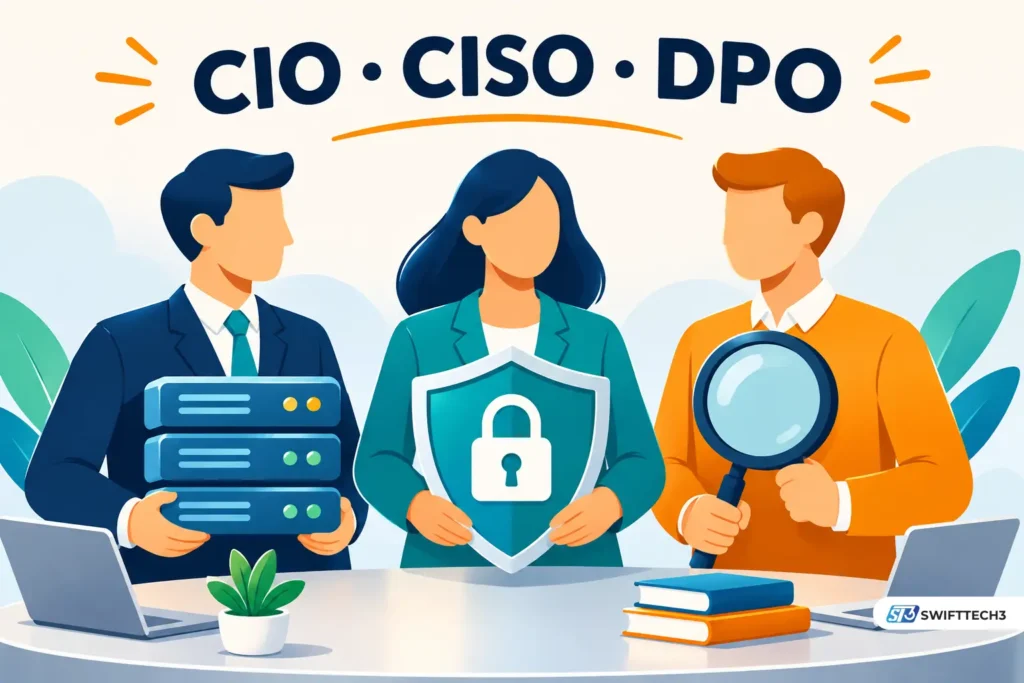
Neither the CIO nor the CISO owns data protection alone. The CIO oversees the technology that stores and moves data. The CISO owns security risk and controls. Where the GDPR applies, a Data Protection Officer (DPO) independently monitors compliance. The organization, as controller, remains accountable, so write the split down.
It is Friday afternoon. Your security team confirms that a database of customer records was copied out of a cloud environment. Within minutes, three people are asking the same thing: whose call is this? The CIO owns the system. The CISO owns the response. If the GDPR applies, a 72-hour notification window may already be running.
This guide explains how the CISO and CIO divide the work, where the DPO fits, what deadlines land on each role and how to build a data protection strategy that holds up when a regulator, auditor or customer asks who was in charge. Facts are current as of November 2026.
Who is responsible for data protection: the CIO, the CISO or the DPO?
All three hold a piece, and none holds all of it. The table below separates what each role is defined to do from what organizations commonly assign to it.
| Role | Core job | Typical reporting line | Legal standing |
|---|---|---|---|
| CIO (chief information officer) | According to ISACA, oversees overall technology strategy, which can include integrating IT resources, coordinating technology projects, managing personnel and overseeing the IT budget. | ISACA says typically the CEO or COO. | No role defined in the GDPR. |
| CISO (chief information security officer) | According to ISACA, oversees information security, including strategic planning, risk assessment, security policy and incident response. | ISACA lists the CIO, the CTO or the CEO. | No role defined in the GDPR. Article 32 requires security measures that a CISO usually designs and runs. |
| DPO (data protection officer) | Under GDPR Article 39, informs and advises on obligations, monitors compliance, advises on data protection impact assessments and cooperates with the supervisory authority. | Under Article 38, reports to the highest management level. | Defined in GDPR Articles 37-39. Mandatory only in the cases Article 37(1) lists. |
What most people miss: the GDPR never names a CIO or a CISO. It places duties on the controller, meaning the organization. How those duties are divided inside the company is a governance choice, and regulators expect you to be able to show it.
Name confusion worth clearing up
| Title | What it means |
|---|---|
| CISO vs. CSO | ISACA notes that a chief security officer (CSO) covers all security, including physical facilities and personnel. Cybersecurity is often part of a CSO’s remit but is not its main focus. |
| CPO (chief privacy officer) | A business role that oversees privacy programs. It is not the same as a DPO, which the GDPR defines and protects. |
| DPO | A role with legal independence. It advises and monitors but does not run the processing. |
What does the CIO own in a data protection strategy?
The CIO owns the technology choices that decide how easy data is to protect later. That covers hosting, platforms, system integrations and vendor selection.
Each choice has a data protection consequence. A platform that cannot delete records on request creates a privacy problem. An integration that copies personal data into a second system doubles the places that need securing. A CIO who writes security and privacy requirements into procurement and architecture decisions removes risk before the CISO ever has to defend it.
Cloud contracts are where this gets concrete, because providers secure some layers and customers secure the rest. For a plain-language look at that division, see our guide to how managed cloud providers share security duties.
What does the CISO own?
The CISO owns security risk: the controls that keep data confidential, intact and available, and the response when those controls fail. According to ISACA, the role includes risk assessment, security policy development and incident response.
GDPR Article 32 requires appropriate technical and organizational measures, and it lists a process for regularly testing and evaluating their effectiveness. In most companies the CISO designs, runs and evidences those measures.
One point the common summaries blur: the CISO runs security, but legal interpretation of privacy rules belongs elsewhere. Whether a use of personal data is lawful is a question for the DPO, privacy counsel or both. A CISO who is expected to answer it by default is carrying work the role was not built for.
Where does the DPO fit, and can the CISO or CIO be the DPO?
The DPO is the independent check, and a CISO or CIO should not normally hold that job as well. The GDPR lets a DPO have other duties, but Article 38(6) requires that they do not create a conflict of interests.
Article 38(3) bars instructions on how the DPO performs the tasks. The Article 29 Working Party, whose guidelines are now associated with the European Data Protection Board, said that senior roles such as head of IT are likely to conflict, because those people determine how personal data is processed. A CISO who sets access controls and then, as DPO, judges whether those controls are compliant would be marking their own work.
This has been enforced. The Belgian Data Protection Authority fined a company €50,000 after its DPO also served as head of compliance, risk management and audit, finding a conflict under Article 38(6). Reporting on the case says the authority found it while investigating a data breach.
Not every company needs a DPO at all. Article 37(1) sets the conditions for mandatory designation, and a company can also appoint one voluntarily.
Does the GDPR apply to a US company?
It can. Article 3(2) applies the GDPR to controllers and processors outside the EU when they offer goods or services to people in the EU or monitor their behavior there. If that describes your business, the CIO, CISO and DPO questions in this article apply to you even without an EU office.
How should the work be split in practice?
Give each area one owner and name the contributors. The split below is an illustrative starting point, not a legal standard. Adjust it to your size and structure.
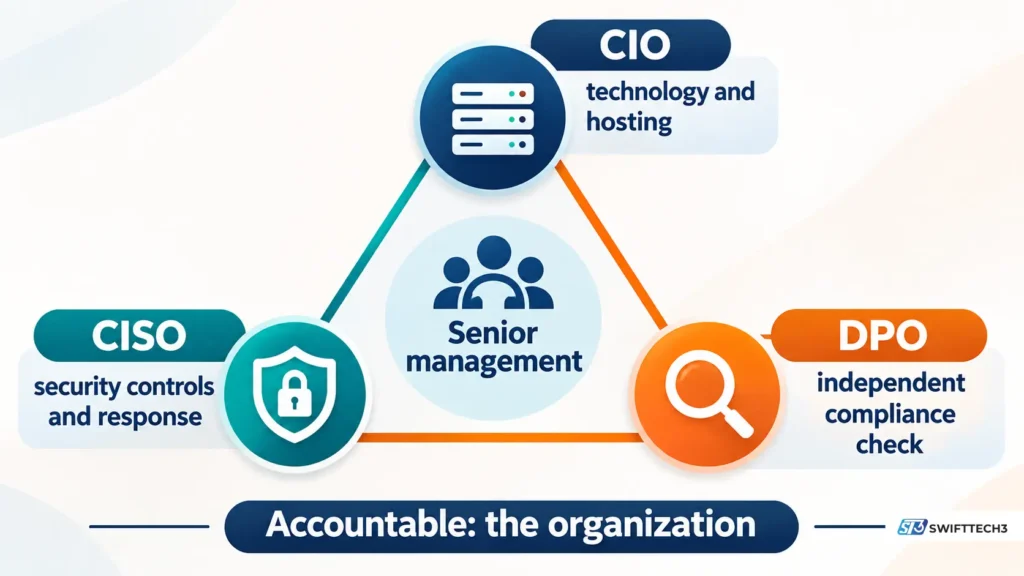
| Area | CIO | CISO | DPO (where appointed) |
|---|---|---|---|
| Data hosting and architecture | Owns | Sets security requirements | Advises on legal impact |
| Security controls | Supports delivery | Owns | Monitors |
| Breach response | Restores systems | Leads investigation | Advises on notification duty |
| Vendor and cloud selection | Owns | Reviews security | Reviews data processing terms |
| Impact assessments | Provides system detail | Assesses technical risk | Advises and monitors |
| Final sign-off on risk acceptance | Senior management or the board, not any one of the three | ||
The last row matters most. Accepting a risk is a business decision. When the CIO and CISO disagree, the disagreement should go to a named executive, not be settled by whoever argues longest.
Does it matter if the CISO reports to the CIO?
It can, but the evidence is less one-sided than the common warning suggests. A frequent claim is that security gets compromised when the CISO sits under the CIO. The data is mixed.
According to ISACA’s State of Cybersecurity 2021 survey, as reported by CIO Dive, security teams reported to the CISO in 48% of organizations, to the CIO in 25% and to the CEO in 12%. The same reporting says ISACA found an insignificant difference between CISO-led and CIO-led teams in how companies view cyberattacks or their confidence in detection. The differences showed up in how other executives view cyber risk assessments and in the board’s prioritization of cybersecurity. A newer ISACA figure was not located during research for this article, so treat these percentages as dated.
The practical reading: the reporting line is less important than whether the CISO has a direct route to the board and a budget that is not traded off against delivery deadlines. ISACA says a CISO may report to the CIO, CTO or CEO. Whichever you choose, document the reason.
What deadlines land on these roles after a breach?
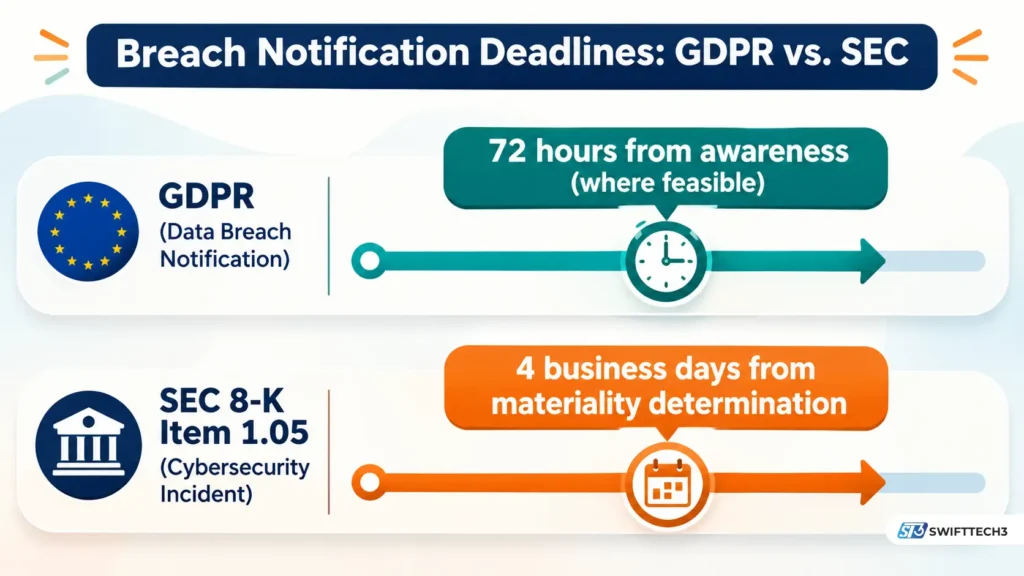
The clocks run in parallel, and each needs a named owner before an incident, not during one.
| Rule | Trigger and deadline | Who usually does what |
|---|---|---|
| GDPR Article 33 | Notify the supervisory authority without undue delay and, where feasible, within 72 hours of becoming aware of a breach, unless it is unlikely to result in a risk to individuals. A late notice must give reasons for the delay. | CISO supplies the facts. DPO advises on the duty. The controller files. |
| GDPR Article 33(2) | A processor must notify the controller without undue delay after becoming aware of a breach. The GDPR sets no fixed number of hours. | Vendor management (CIO) and the contract owner chase this. |
| GDPR Article 34 | Where a breach is likely to result in a high risk, individuals must also be told. | DPO and legal advise. Communications drafts the notice. |
| SEC Form 8-K Item 1.05 (US public companies) | File within four business days of determining that a cybersecurity incident is material. The materiality decision must be made without unreasonable delay after discovery. | CISO informs the disclosure committee. Legal and finance decide materiality. |
One caution on the SEC row. The rule has been in effect since December 2023 for most companies, but in 2026 the SEC sought comment on reforming its cybersecurity disclosures, and industry groups urged it to rescind Item 1.05. A final change was not confirmed in the sources read for this article. Check the SEC’s current rules before relying on this row.
A simple test for assigning ownership
When a task has no obvious owner, ask three questions in order. This is an illustrative framework built from the roles above, not a regulatory standard.
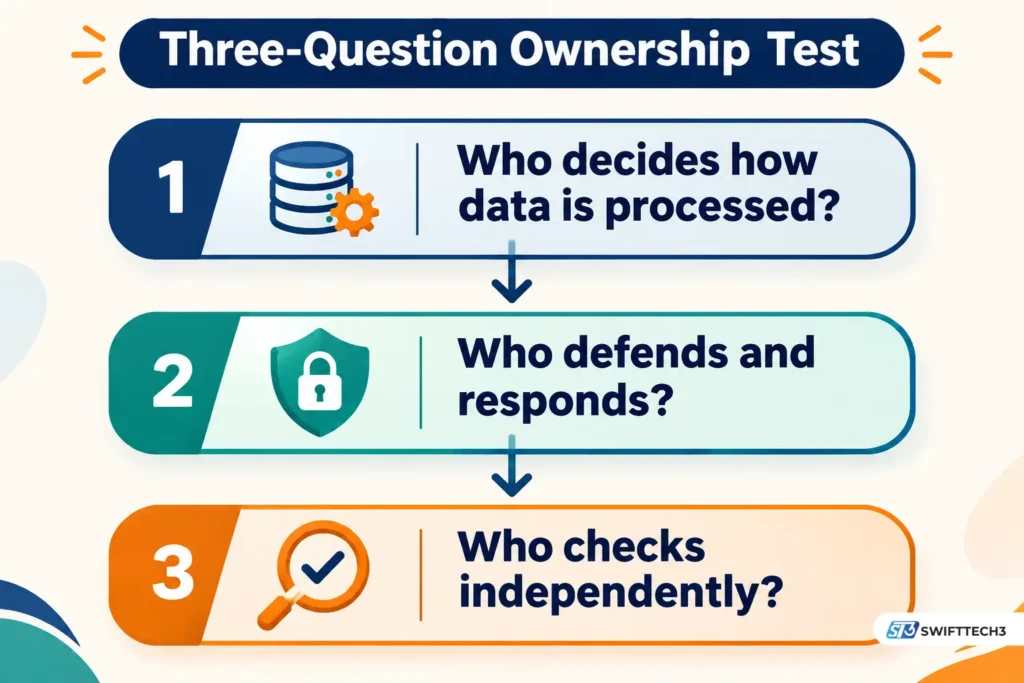
- Who decides how the data is stored, moved or processed? That is the CIO or the business owner of the system.
- Who defends it and responds when it fails? That is the CISO.
- Who checks, independently, that the use is lawful? That is the DPO or privacy counsel, and it must not be the person who answered question 1 or 2 for the same task.
If one person answers all three for the same decision, you have found a gap in checks and balances.
Common mistakes
- Naming the CISO as the DPO to save a salary. It creates the conflict the GDPR warns about.
- Letting “the CIO owns IT” stand in for ownership of data. Business units create and use most personal data, and they need a named owner too.
- Treating vendors as someone else’s problem. Processors must tell you about breaches, but your contract decides how fast and in what detail.
- Splitting privacy and security reporting. Directors who get two separate reports often cannot see where they overlap.
- Writing the split once and never testing it. Run a breach tabletop exercise and see whether the matrix survives contact with a real timeline.
Real incidents show how these gaps play out. Our write-up of lessons from an AI-service data breach is a useful companion read, and so is our look at AI in mobile app security and data protection.
How do you build a model that works?
Start with four elements that any organization can put in place.
- Write the responsibility matrix. Cover hosting, security controls, vendors, breaches and impact assessments, as in the table above.
- Create a shared steering group. The CIO, CISO and DPO or privacy lead meet regularly with business owners to review risks, incidents and upcoming projects.
- Keep one data map. Each role should work from the same record of systems, data categories and processing activities.
- Report to the board together. A joint view of privacy and security risk is easier to act on than separate reports.
Smaller organizations rarely have all three roles in-house. A part-time or outsourced CISO or DPO can fill the gap, and managed service providers for small business can cover the IT side. DPO Consulting states that it provides outsourced DPO and CISO-as-a-service support; this is a vendor claim and has not been independently verified here.
FAQs
Is the CISO or the CIO responsible for data protection?
Both, for different parts. The CIO is responsible for the technology that holds and moves data, and the CISO is responsible for security risk and controls. Where the GDPR applies, the organization as a whole is accountable, and a DPO monitors compliance independently.
Should the CISO report to the CIO?
ISACA says a CISO may report to the CIO, CTO or CEO, so no single answer applies. Reporting to the CIO can work if the CISO has direct access to the board and protected budget. Many organizations choose a separate line to keep security decisions from competing with delivery targets.
Can a CISO also be the DPO?
It is risky. GDPR Article 38(6) forbids DPO duties that create a conflict of interests, and the Article 29 Working Party flagged roles that determine how data is processed. A CISO who designs controls and then judges their compliance would be reviewing their own decisions.
What is the difference between a DPO and a CISO?
A CISO manages security risk and runs the controls. A DPO advises on and monitors compliance with data protection law, cannot be instructed on how to do that job and reports to the highest management level. One builds and defends; the other checks.
Do all companies need a DPO?
No. Article 37(1) of the GDPR sets the conditions for mandatory designation, and companies outside those conditions may still appoint one voluntarily. A company that is not required to appoint a DPO should not give anyone the title casually, because the role carries independence requirements.
Which certifications do CIOs and CISOs usually hold?
ISACA highlights CISSP and CISM for CISOs, and CGEIT and PMP for CIOs. It also says cybersecurity certifications can help a CIO who works closely with security. Certifications are not a legal requirement for either role.
What is the difference between a CISO and a CSO?
According to ISACA, a CSO oversees all aspects of security, including physical facilities and personnel. A CISO focuses on information and cybersecurity.
Conclusion
Key takeaways: the CIO owns the technology, the CISO owns security risk, the DPO provides the independent legal check where the GDPR applies, and senior management owns the final risk decision. Nobody should hold two of those roles for the same decision.
Next step: this week, draft a one-page responsibility matrix, then run a 60-minute tabletop exercise on a hypothetical breach and see whether each deadline has a named owner.
Related: AI governance and compliance
Disclaimer
This article is for informational purposes only and is not legal, compliance or security advice. It is not affiliated with, sponsored by or endorsed by ISACA, the SEC, DPO Consulting or any other organization mentioned. Laws, rules and guidance may change, and you should confirm current requirements with qualified counsel. Information last verified on November 17, 2026.