Your car’s anti-lock brakes, an autofocus camera and a factory robot arm all rely on one design idea. Yet the U.S. Bureau of Labor Statistics (BLS) counted only about 15,700 jobs in 2025 under its dedicated mechatronics technician occupation.
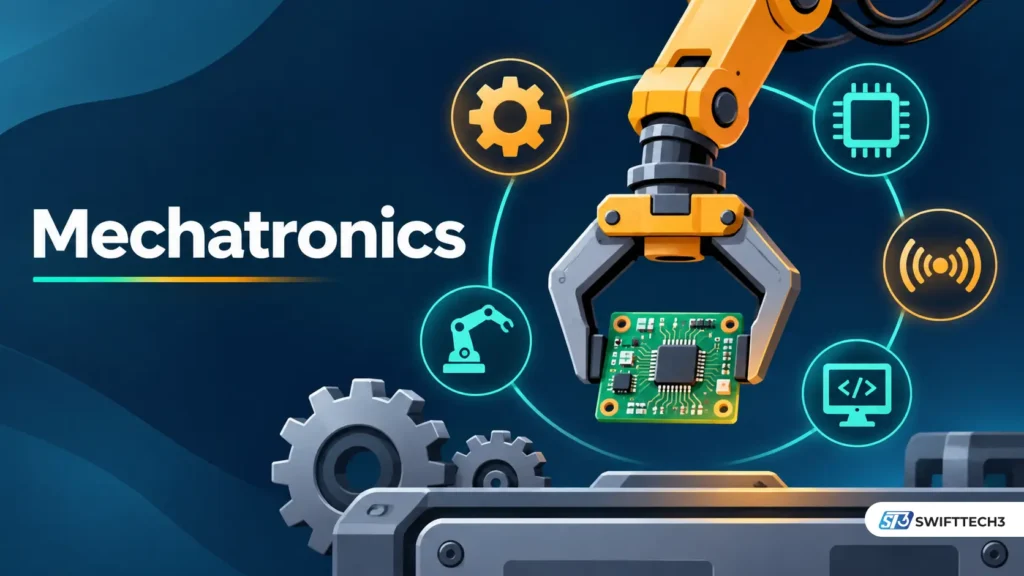
Mechatronics is the engineering approach of designing mechanical parts, electronics, sensors and software together, as one system, so a machine can sense its surroundings, decide what to do and act on that decision. The name joins “mechanics” and “electronics.” This guide covers what the term means, where it came from, what is and isn’t mechatronics, and what the jobs pay as of November 2026.
What is mechatronics, in plain terms?
Mechatronics is a design discipline, not a single product or job title. A mechatronic machine runs a loop: sensors measure something, a controller processes it, and an actuator (a motor, valve or solenoid) moves a mechanism in response.
In 1996, Harashima, Tomizuka and Fukuda wrote an editorial for the first issue of the journal IEEE/ASME Transactions on Mechatronics. They described the field as bringing mechanical engineering together with electronics and intelligent computer control when industrial products and processes are designed and made. The key word is “together.” The disciplines are designed side by side, not handed off one after another.
| Part of the loop | Its job | Example |
|---|---|---|
| Mechanism | Provides structure and motion | Gears, linkages, a robot arm |
| Sensors | Measure position, speed, temperature, images | Encoders, accelerometers, cameras |
| Controller | Decides what to do with the measurement | Microcontroller firmware, a PLC (programmable logic controller) |
| Actuators and power electronics | Turn decisions into motion | Motors, valves, motor drivers |
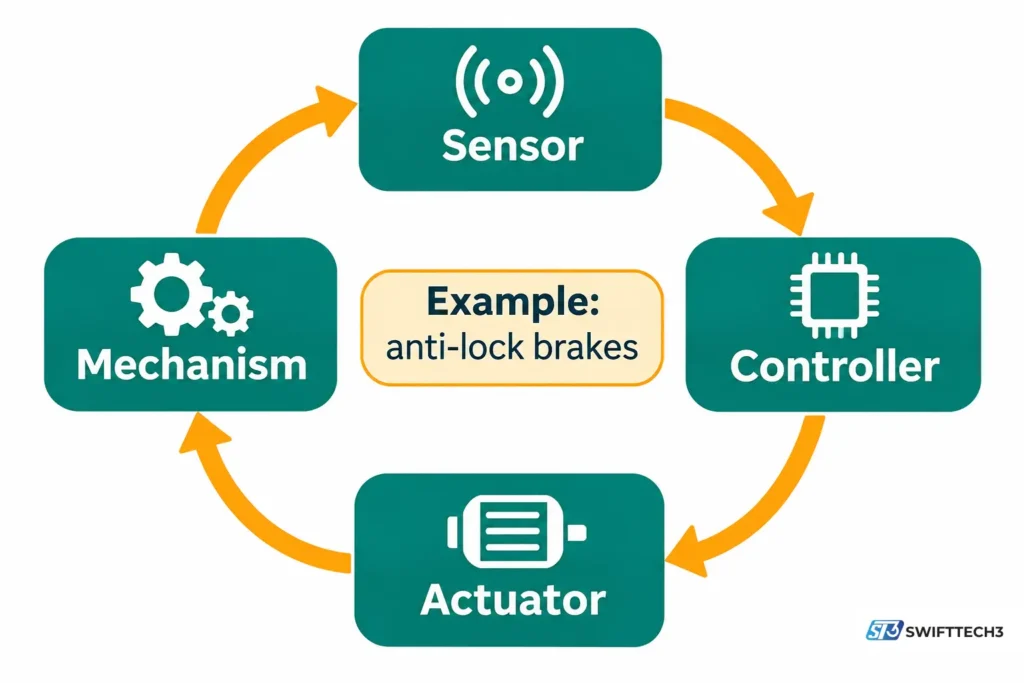
An anti-lock braking system is the textbook case. Wheel-speed sensors feed a controller, which adjusts brake pressure through a hydraulic valve to stop a wheel from locking. Remove the sensing and control, and you have an ordinary brake.
Where does the word mechatronics come from?
The word was created at the Japanese company Yaskawa Electric in 1969. Yaskawa’s own history credits engineer Tetsuro Mori, who applied that year to register “Mechatronics” as a trademark. According to Yaskawa, the registration followed in 1972, and the company then gave the trademark back so the word could be used freely.
Sources disagree on two details. Some references give 1971 as the registration year, and some academic papers credit Ko Kikuchi, a Yaskawa executive, as the originator. Treat the 1969 origin at Yaskawa as solid and the finer points as unsettled.
It is also not a recent buzzword. The first issue of IEEE/ASME Transactions on Mechatronics appeared in 1996, published jointly by two IEEE societies and the ASME Dynamic Systems and Control Division.
Is mechatronics the same as robotics, automation or electromechanical engineering?
No, but they overlap heavily, which is why the terms get mixed up. Wikipedia notes that many people treat mechatronics as a synonym for automation, robotics and electromechanical engineering. Here is how they differ in practice.
| Term | What it usually means | Relationship to mechatronics |
|---|---|---|
| Robotics | Machines with programmable, multi-axis motion | An industrial robot is a prime example of a mechatronic system, but most mechatronic products are not robots |
| Automation | A process that runs with little human intervention | A goal. Mechatronics is one way to build the machines that reach it |
| Electromechanical engineering | Coupling of electrical and mechanical systems | Very close. Mechatronics puts more weight on embedded computing and control |
| Mechatronics technician | Installs, tests and maintains the equipment (BLS occupation) | The hands-on side of the field |
| Mechatronics engineer | Designs and develops systems (O*NET occupation) | The design side of the field |
| SOLIDWORKS xMechatronics | A software product from a CAD vendor | Not the field itself. SOLIDWORKS introduced “3D Mechatronics Creator” in a 2025 blog post, and its current mechatronics page lists a product named xMechatronics with the same description. The page doesn’t say explicitly that it is a rename |
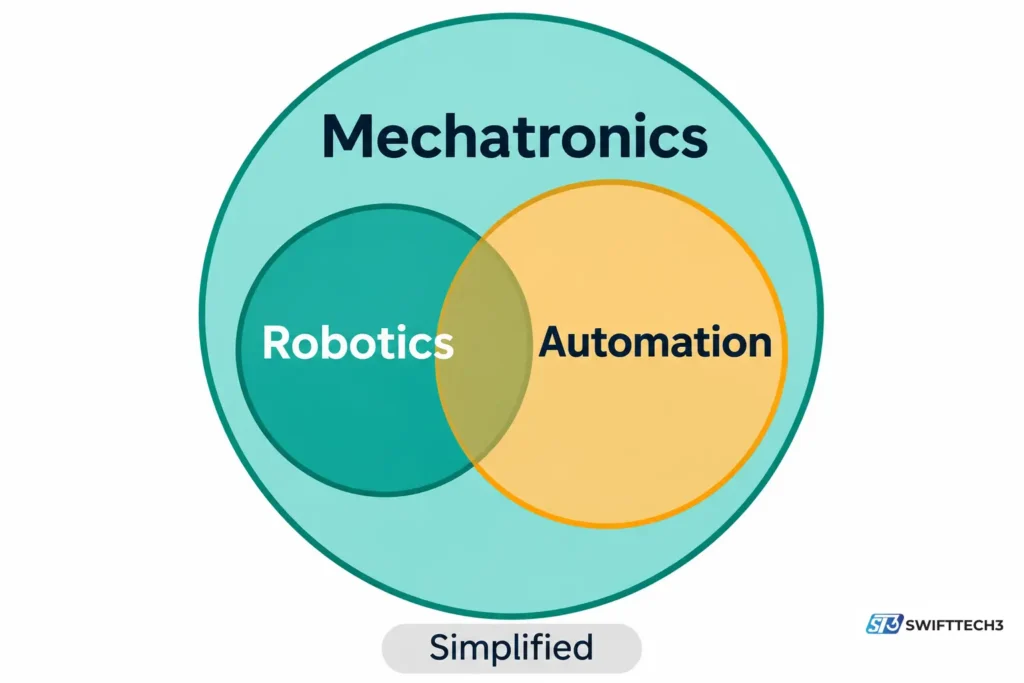
What most people miss: automation describes what a machine achieves, while mechatronics describes how it is engineered. A cam-driven filling line can be automated without any sensing, and a smart thermostat is mechatronic without being a robot. That split is illustrative, not an official taxonomy.
Where do you already use mechatronics?
You likely touch mechatronic systems daily. Wikipedia lists anti-lock brakes, cruise control, autofocus cameras and hard disks, and notes that vehicle makers often have development departments with “Mechatronics” in the name.
Beyond cars, the examples scale in both directions:
- Factory floors: robot arms, bottling and packaging line controls, and pick-and-place machines, according to Michigan Tech’s description of the field.
- Home devices: a robot vacuum is an electromechanical device with advanced controls, as a Michigan Tech professor put it in local news coverage.
- Hazardous work: BLS says technicians test, operate or maintain robotic equipment such as unmanned submarines and aircraft used in oil drilling, deep-ocean exploration and hazardous-waste removal.
- Medicine: surgical systems combine imaging, motion control and software. For one angle, read about AI robotics in endoscopic spine surgery.
Every one of these also depends on physical supply chains. Sensors, boards and drivers have lead times, which is covered in this piece on electronic component distribution and manufacturing timelines. The mechanical side often starts with fabricated frames and housings, as in sheet metal fabrication industries in Canada.
What do mechatronics technicians and engineers actually do?
The two roles differ in education, pay and focus, and many articles blur them.
Technicians (BLS: electro-mechanical and mechatronics technologists and technicians) install, repair, upgrade and test computer-controlled mechanical systems. BLS lists duties such as reading schematics, verifying part dimensions, calibrating hydraulic and pneumatic assemblies, soldering electronic parts and testing robotic equipment.
Engineers (O*NET: Mechatronics Engineers) research, design, develop or test automation, intelligent systems, smart devices and industrial control systems. Michigan Tech lists job titles such as control systems engineer, instrumentation engineer, project engineer, software engineer and systems engineer. Titles vary a lot, so search by skills (controls, embedded systems, PLCs, robotics) as well as by “mechatronics.”
How much do mechatronics jobs pay?
In the U.S., the dedicated technician occupation had a median wage of $73,900 in May 2025, according to BLS. BLS reports that the lowest-paid 10% earned under $47,840 and the highest-paid 10% earned over $109,890.
There is no separate BLS wage series for “mechatronics engineers.” O*NET lists the occupation, but its wage page says the data come from the catch-all category “Engineers, All Other.” As of November 2026, that category’s median is $122,930, with a 10th percentile of $66,810 and a 90th of $189,950.
| Role or comparison category | Median (May 2025) |
|---|---|
| Electro-mechanical and mechatronics technicians (BLS) | $73,900 |
| Mechanical engineers (BLS) | $104,110 |
| “Engineers, All Other,” used by O*NET for mechatronics engineers | $122,930 |
| Electrical and electronics engineers (BLS) | $125,040 |
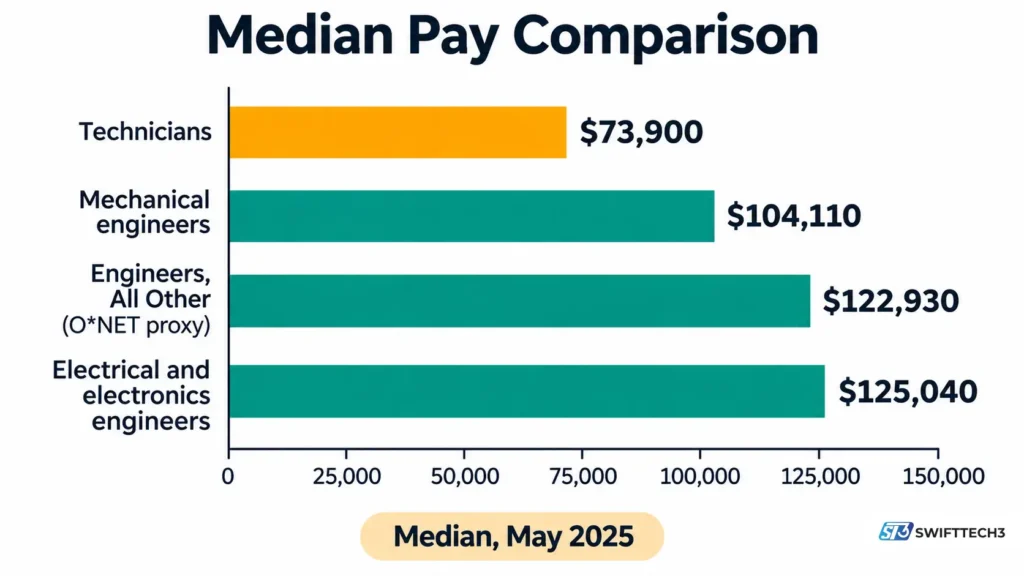
Our arithmetic from these published figures:
- The engineer proxy sits $49,030 (about 66%) above the technician median.
- Mechanical engineers sit $30,210 (about 41%) above it.
Two details cause confusion. Michigan Tech quotes a technician figure of $76,420, which is a mean, not a median. And a figure of $117,750 for mechatronics engineers circulates on career sites, but the current O*NET page shows $122,930.
Industry matters as much as title. BLS says technicians in scientific research and development services earned a median of $101,580, versus $64,220 in engineering services, roughly 58% higher. Other listed industries were transportation equipment manufacturing ($78,270), computer and electronic product manufacturing ($67,720) and machinery manufacturing ($64,700).
Is mechatronics a good career?
It can be, with one caution: the dedicated occupation is small. BLS counted about 15,700 jobs in 2025, projects 3% growth from 2025 to 2035 (about the all-occupation average, roughly 400 jobs) and expects about 1,400 openings a year, many from replacing workers who leave.
BLS also says automation could cut both ways. More robots and autonomous systems should raise demand for people who build and operate them, but automated equipment, testing and design may take over some of their tasks.
Who it suits: people who like both hardware and code and enjoy debugging across boundaries. Who should think twice: anyone who wants one deep specialty, since the breadth is the point. If you’re weighing a switch from another field, career change ideas may help you compare options.
Do you need a degree to work in mechatronics?
For technician roles, BLS says an associate’s degree or a postsecondary certificate is typical, offered by vocational-technical schools and community colleges. It adds that employers may prefer graduates of accredited programs, and that certifications are optional.
For engineering roles, Michigan Tech says most entry-level positions require at least a bachelor’s in a related field. It also says you don’t have to major in something called mechatronics, and suggests degrees in robotics and computer or electronic technology.
Read the degree label carefully, because there are two tracks:
- Engineering degree: accredited by ABET’s Engineering Accreditation Commission. ABET added its first program criteria for robotics and mechatronics engineering in 2024-2025, covering 50-plus programs, according to IEEE Robotics & Automation Magazine.
- Engineering technology degree: accredited by ABET’s technology commission, which has its own “Mechatronics Engineering Technology” criteria. Michigan Tech’s BS in Mechatronics is described in a university senate document as an engineering technology degree.
Do mechatronics engineers need a PE license?
Not always, and not in the way some articles claim. One competitor states that all 50 states require engineers to hold a Professional Engineer license, which overstates it. The National Society of Professional Engineers (NSPE) says a PE license is needed when your work falls within a state’s legal definition of engineering practice, unless an exemption applies. It acknowledges that industrial exemptions let engineers perform engineering work without a license in some settings.
A PE tends to matter if you consult, offer services to the public or sign off on designs. The rules differ by state, so check your state licensing board.
Myth or fact
| Claim | Verdict |
|---|---|
| Mechatronics means robots | Myth. Robots are one application of it |
| Mechatronics is a new buzzword | Mostly myth. The word dates to 1969 and the journal to 1996, though usage has broadened |
| Every engineer needs a PE license | Myth. It depends on state law and exemptions |
| One salary number covers “mechatronics” | Myth. Technician and engineer data come from different categories |
| You must hold a degree named mechatronics | Myth, per Michigan Tech’s advice |
What changed recently?
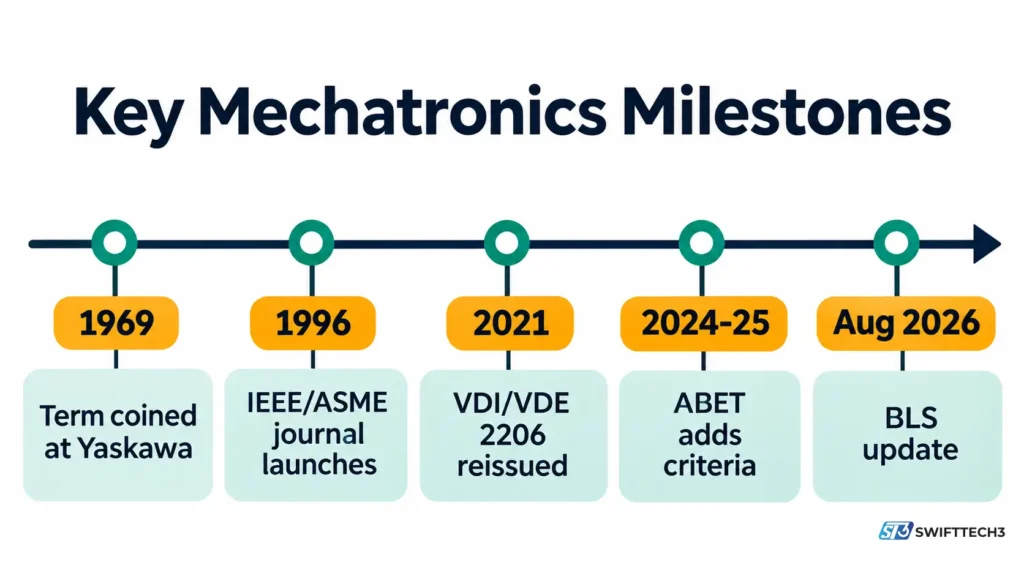
| Date | Change |
|---|---|
| 1969 | Yaskawa’s Tetsuro Mori applies to register “Mechatronics” |
| 1996 | IEEE/ASME Transactions on Mechatronics publishes its first issue |
| November 2021 | The German VDI/VDE 2206 guideline is reissued as “Development of mechatronic and cyber-physical systems” and is built around the V-model |
| 2024-2025 | ABET adds its first robotics and mechatronics engineering program criteria |
| August 27, 2026 | BLS updates its handbook page: 2025 median $73,900 and 3% projected growth for 2025-2035. The previous edition showed $70,760 and 1% for 2024-2034 |
How can you check this yourself?
- Search the BLS Occupational Outlook Handbook for “electro-mechanical and mechatronics technologists and technicians” and read the pay and outlook tabs.
- Search O*NET OnLine for “Mechatronics Engineers” and open the wages page. Note which category the data are collected from.
- Before enrolling anywhere, look up the program in ABET’s accredited program search and confirm whether the commission is engineering or technology.
- Ask your state engineering board whether the work you want requires a PE license.
Frequently asked questions
What does mechatronics mean?
It is the integrated design of mechanical systems, electronics, sensors and software. The word combines “mechanics” and “electronics.”
Is mechatronics mechanical or electrical engineering?
Neither alone. It draws on mechanical engineering, electronics, computing and control theory, and mechatronics engineers are expected to work across all of them.
Is mechatronics the same as robotics?
No. An industrial robot is a clear example of a mechatronic system, but plenty of mechatronic products, such as brake controllers and autofocus lenses, are not robots.
Who invented the word mechatronics?
It was created at Yaskawa Electric in 1969. Yaskawa credits engineer Tetsuro Mori, though some academic papers credit Ko Kikuchi.
How much does a mechatronics technician earn?
BLS reports a median of $73,900 per year for May 2025. The range runs from under $47,840 for the lowest 10% to over $109,890 for the top 10%.
Do you need a degree for mechatronics?
Technicians typically need an associate’s degree or certificate, per BLS. Engineers usually need a bachelor’s in a related field, and the degree doesn’t have to carry the word “mechatronics.”
Is mechatronics the same as electromechanical engineering?
They overlap, and BLS groups electro-mechanical and mechatronics technicians in a single occupation. Mechatronics generally adds more emphasis on embedded computing and control.
Conclusion
Mechatronics is the practice of designing a machine’s mechanics, electronics and software as one system so it can sense, decide and act. The field is real and long-established, but the dedicated job category is small and the pay data are easy to misread. The key points: technician and engineer wages come from different BLS categories, degree labels split into engineering and engineering technology, and a PE license depends on your state and your work.
Your next step: open the BLS handbook page for mechatronics technicians and the O*NET wage page, then compare them with the programs or job postings you’re considering.
Related: AI engineering workflow automation guide
Disclaimer: This article is for informational purposes only and is not career, legal or licensing advice. It is not affiliated with, sponsored by or endorsed by any organization or brand mentioned. Pay figures, job outlooks, accreditation rules and licensing laws change, so confirm them with the relevant agency, school or state board. Information last verified on November 9, 2026.