
You search “business tips RobTheCoins” and get a dozen pages that agree on almost nothing. One calls it a crypto platform. Another treats it as a person. A third says it is a scam. This guide sorts out which site the phrase points to, what its Business Tips section covers, and which common advice survives a check against official data.
The short answer: RobTheCoins is a content website, not a business platform or a service you sign up for. Its business advice is general and broad. The most useful part of this topic is learning how to test any business tip before you act on it.
What does “RobTheCoins” actually refer to?
It refers to at least four separate websites that use the same name, and they are not the same publication. This is the biggest source of confusion in search results.
On November 1, 2026, I read pages from each of these domains:
| Domain | What it presents itself as | What I saw on the pages I opened |
|---|---|---|
| robthecoins.com | Crypto, investing and business publication | Categories for Business Tips, Cryptocurrency, Investing, Gaming and Blockchain Business; footer names Fyona Menas and Reg Payton |
| robthecoins.net | Separate publication with its own branding | Menu with Business Tips, Cryptocurrency, Investing, Latest News; two articles in its Business Tips archive, by an author called “Mr. Lucas” |
| robthecoins.co.uk | Site tagged “Business and Investing Made Simple” | Menu with News, Home Improvement, Real Estate, Travel; a “RobTheCoins Business” article dated August 17, 2026 under a different author |
| robthecoins.org | Described by third-party pages as an educational crypto site | I could not open it directly, so I make no claim about it |
Several pages in the results make bigger claims. One describes “Business RobTheCoins” as a crypto-purchasing gateway for companies. Another calls it a type of cryptocurrency fraud. A third presents it as a site where you earn money for ad views. None of that matched the robthecoins.com pages I read. I found no official product, sign-up flow or fee schedule there.
What most people miss: a keyword that several unrelated sites share is an easy place for low-quality pages to invent a “platform” that does not exist. If a page tells you to deposit money with “Business RobTheCoins,” treat it as unverified.
What is in the Business Tips section?
It is a general business-and-technology blog, not a crypto-business course. As of November 1, 2026, the Business Tips category on robthecoins.com listed 37 posts. That compares with 99 in Cryptocurrency and 84 in Gaming.
The ten newest Business Tips posts I could see ran from January to July 2026. Their subjects included web-based apps versus local software, building a digital health platform, choosing online payment options, GPS trackers for commercial vehicles, high-risk payment processing, AI stock-analysis tools, social media for entrepreneurs, and monthly car rental demand. The posts carry at least three different author names.
So “RobTheCoins business tips” does not mean one coherent method. It is a set of unrelated articles. The competing pages that list “the RobTheCoins tips” (clear vision, know your audience, track your money, keep learning) are mostly summarizing generic advice that appears on thousands of business blogs.
One more observation from the same visit: the sidebar’s “Friends & Partners” list contained links that all pointed to online casino or gambling sites. That does not make the articles wrong. It does tell you something about the site’s commercial relationships, which is worth knowing before you act on its money advice.
Is RobTheCoins legit, and how do you check any site like it?
The sites I read present themselves as publications. I found no sign on robthecoins.com of a regulated financial service, and the site is not a company you deposit money with. That is as far as the evidence goes. I could not verify who owns the .net or .co.uk sites, and I did not confirm any registered company behind robthecoins.com.
The U.S. Federal Trade Commission gives a simple rule set that applies to every site like this:
- Only scammers guarantee profits or big returns.
- Only scammers demand payment in cryptocurrency, and crypto payments are typically not reversible.
- Crypto accounts are not backed by the government the way FDIC-insured bank accounts are.
If you want a deeper walkthrough of fraud patterns, how to spot and report investment fraud covers the warning signs in detail.
A 60-second check you can run yourself on any business-advice site:
- Find the About page and see whether a named, findable person or company stands behind it.
- Look at who writes each article. Do the author names change from post to post?
- Look at the sponsored or partner links. Do they match the site’s stated topic?
- Check whether the advice cites a source you can look up, such as a government agency.
- Search the site name plus “complaint” before you share any money or personal data.
Do the common tips hold up? What the data says
Some of the most repeated advice is that most new businesses fail. The official numbers are more specific than the folklore.
The U.S. Bureau of Labor Statistics tracks private-sector establishments with employees. Its Business Employment Dynamics Table 7, updated through March 2026, follows each year’s new openings forward. I recalculated the percentages from its raw counts.
| Opened (year ended March) | Establishments opened | Still operating after 1 year | After 5 years | After 10 years |
|---|---|---|---|---|
| 2015 | 677,876 | 79.6% | 50.2% | 34.6% |
| 2020 | 767,573 | 80.9% | 51.3% | not yet reached |
| 2021 | 839,297 | 79.1% | 47.2% | not yet reached |
Three things stand out:
- Year one is not where most exits happen. About one in five of the 2015 group was gone after a year. Roughly another three in ten had gone by year five.
- The 2021 group is weaker than recent ones. Its five-year rate of 47.2% is lower than any group opened from 2009 through 2020 in the same table. The table does not say why, so I will not guess.
- “Exit” is not the same as “failure.” BLS counts a location as gone when it stops reporting employees. That includes closures by choice and some sales or mergers.
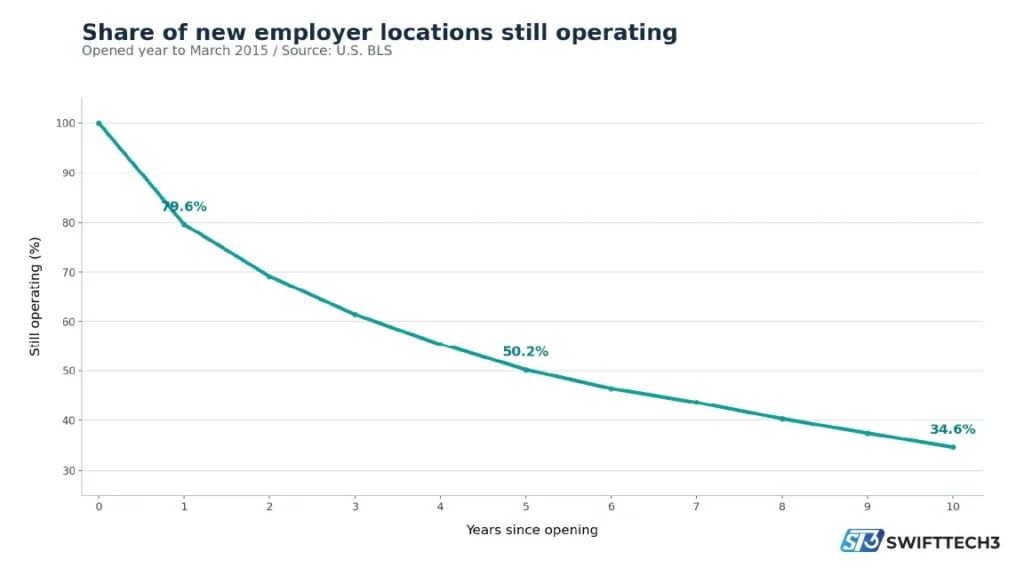
So the honest takeaway for anyone starting a business: the odds that a new employer location is still open after five years are close to a coin flip, and that has been true for years. A tip is worth following if it shifts those odds, which usually means planning, cash control and customer demand rather than hype.
What the SBA says about planning
The U.S. Small Business Administration says there is no right or wrong way to write a business plan, and that most fall into two types. A traditional plan is detailed and comprehensive, and lenders and investors commonly ask for it. A lean startup plan uses only a handful of elements to describe your value proposition, infrastructure, customers and finances, and suits simple businesses or plans you expect to change often.
Many “business tip” lists say “make a plan” without telling you which kind. The SBA’s distinction is the useful part. If you are borrowing, write the detailed one. If you are testing an idea, write the short one and revise it.
If your problem is customers rather than paperwork, why marketing efforts stop working is a practical next read. For checking demand before you spend, see research survey samples for marketers.
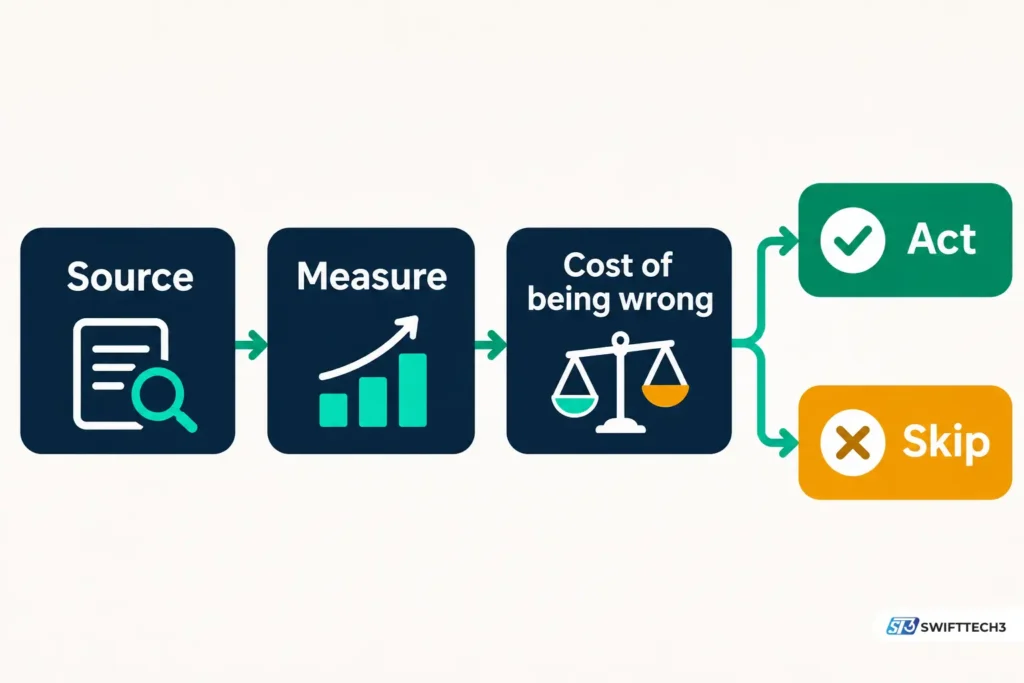
A simple filter for any business tip: the Three-Check Tip Filter
This is an original checklist, not a RobTheCoins method. Run any tip through three questions before you act.
| Check | Question | Passes when | Fails when |
|---|---|---|---|
| Source | Who says this, and what do they gain? | A named person or agency with a track record, and no hidden sales angle | Anonymous author, or an affiliate or casino-style sponsor behind the advice |
| Measure | What number or definition backs it? | You can find the figure and see what it counts | “Studies show” with no study, or a vague “success rate” |
| Cost of being wrong | What happens if this tip is bad? | You can undo it cheaply, such as a one-month test | It needs a large deposit, a loan, or irreversible payment |
The third check matters most. Reading a bad tip about email subject lines costs you an afternoon. Following a bad tip that asks you to move money into an unverified account can cost you the money.
What if your business takes crypto payments?
This is the one place where RobTheCoins-style content touches real rules. If you accept cryptocurrency for goods or services, the IRS treats it as property, not cash, so you need to record its dollar value on the day you receive it.
According to the IRS FAQ on digital asset transactions, when you receive digital assets for services, your basis is their fair market value in U.S. dollars at receipt, provided you include that value in income. The IRS’s virtual currency FAQ says the same for the amount included in income. The IRS Taxpayer Advocate Service also advises keeping records for at least three years after reporting a taxable event.
Here is an illustrative example (the numbers are made up to show the mechanics):
| Step | What happens | Amount |
|---|---|---|
| You invoice a client | Price of the work | $2,000 |
| You receive crypto | Fair market value on receipt, counted as income | $2,000 |
| You later sell it for $1,700 | Difference from your basis of $2,000 | $300 capital loss |
| Or you sell it for $2,300 | Difference from your basis of $2,000 | $300 capital gain |
Tax results depend on your situation, so a CPA should confirm them. The practical point is that your business can owe income on $2,000 even if the coin’s price falls before you sell it. Many guides skip this.
A habit that follows from it: keep your operating runway in dollars. Count crypto you are holding as an asset that can move, not as spendable cash.
Who should use this kind of content, and who should skip it
| Reader | Verdict |
|---|---|
| Curious beginner who wants general ideas | Fine as a starting point, then verify anything you act on |
| Owner deciding on a loan, a hire or a big spend | Skip; use SBA resources, your accountant and your own numbers |
| Someone considering a crypto business | Read official tax and compliance guidance first |
| Anyone asked to deposit money to “start” | Stop and apply the FTC rules above |
Myths versus facts
| Myth | Fact |
|---|---|
| “Business RobTheCoins is a platform you can join.” | On the pages I read, RobTheCoins is a content site with no sign-up product |
| “Half of all businesses fail in year one.” | BLS data shows roughly one in five new employer locations exits in year one |
| “Crypto payments are just like cash.” | The IRS treats them as property, so you track their value at receipt |
| “Every site using the name is the same publisher.” | At least three domains I opened had different menus and authors |
FAQs
Are RobTheCoins business tips good for beginners?
They are readable and general, which suits a first look. The articles I saw rarely cite official sources, so check any tip that involves money.
Who is behind RobTheCoins?
The robthecoins.com footer names Fyona Menas and Reg Payton. I could not verify who runs the .net or .co.uk sites, which show different authors.
Does RobTheCoins give financial advice?
Nothing I read presented it as a licensed advisory service. Treat the content as general information.
Is there an official RobTheCoins business app or platform?
I found none on the pages I opened. Be cautious with any page claiming otherwise.
What percent of new businesses survive five years?
For employer locations opened in the year to March 2020, 51.3% were still operating five years later, according to BLS. For the year to March 2021 group, it was 47.2%.
Do I need a business plan?
The SBA says plans take two common forms and there is no single right way. Choose a detailed one if lenders or investors will review it, and a lean one if you are still testing.
How do I report a suspected crypto scam?
The FTC accepts fraud reports at ReportFraud.ftc.gov, and you should also tell the exchange or bank you used.
The short version
“RobTheCoins business tips” points to a general content site, and several unrelated sites share the name. The tips themselves are mostly standard advice. The numbers that matter come from BLS, the SBA and the IRS, and they say that planning, cash control and careful record-keeping beat hype. Your next step: pick one tip you are considering, run it through the Three-Check Tip Filter, and write a one-page lean plan before you spend anything.
Related: More business guides in the Business category
Two further reads on turning an audience into income and keeping customers: monetizing your brand and feature adoption versus user retention.
Disclaimer
This article is for informational purposes only and is not affiliated with, sponsored by or endorsed by RobTheCoins or any website, agency or brand mentioned. It is not financial, tax or legal advice, so speak to a qualified professional before making money decisions. Prices, rules and website content may change, and AI-assisted writing can contain errors. Information last verified on November 1, 2026.