Most California homeowners start with the same question: how many panels do I need? It’s the wrong first question. By late 2026, whether a system pays off depends on things that have little to do with panel count: how many years your roof has left, whether your electrical panel can accept the extra power, which export rates your utility will lock you into, and a property tax deadline that is now roughly nine weeks away.
This guide walks through those decisions in the order they actually bite. It also introduces a simple way to organize them, the Three-Clock Method, that most installer brochures skip. If you are weighing installing solar panels in California this winter, the checklist below should save you from the expensive surprises.
Quick Answer: What Should You Check Before Installing Solar Panels in California?
Check five things, in this order: (1) your roof’s remaining life and structural condition, (2) whether your main electrical panel can accept a solar breaker, (3) which tariff and export rates will apply to you, (4) your utility’s interconnection timeline, and (5) your contractor’s license and workmanship warranty. Then check the calendar, because California’s solar property tax exclusion is scheduled to end on January 1, 2027.
What Changed for California Homeowners, and Why Design Matters More Now
Three policy shifts moved the math, and all three raise the cost of getting the design wrong.
Export credits are lower. For applications filed on or after April 15, 2023, new customers are on the Net Billing Tariff, often called NEM 3.0. The California Public Utilities Commission (CPUC) explains that export credits are usually lower than the retail rate, though they can rise above it on late summer evenings. The CPUC also notes that nearly 70 percent of net billing customers had paired a battery with their solar by the end of 2024. Customers who stayed on older net metering rules generally keep them for 20 years from the date their system was interconnected.
The federal homeowner credit is gone. Under the 2025 federal budget law, the 30 percent Residential Clean Energy Credit (Section 25D) does not apply to property placed in service after December 31, 2025. Leased and power-purchase systems are handled under different business-credit rules with their own deadlines, so ask any lease or PPA provider to explain in writing what applies to your contract.
The state property tax break is expiring. More on this below, because it is the most time-sensitive item on the list.
With fewer subsidies cushioning mistakes, a poorly sited array, an undersized electrical panel, or a roof that needs replacing in year six now costs real money.
The Three-Clock Method for California Solar
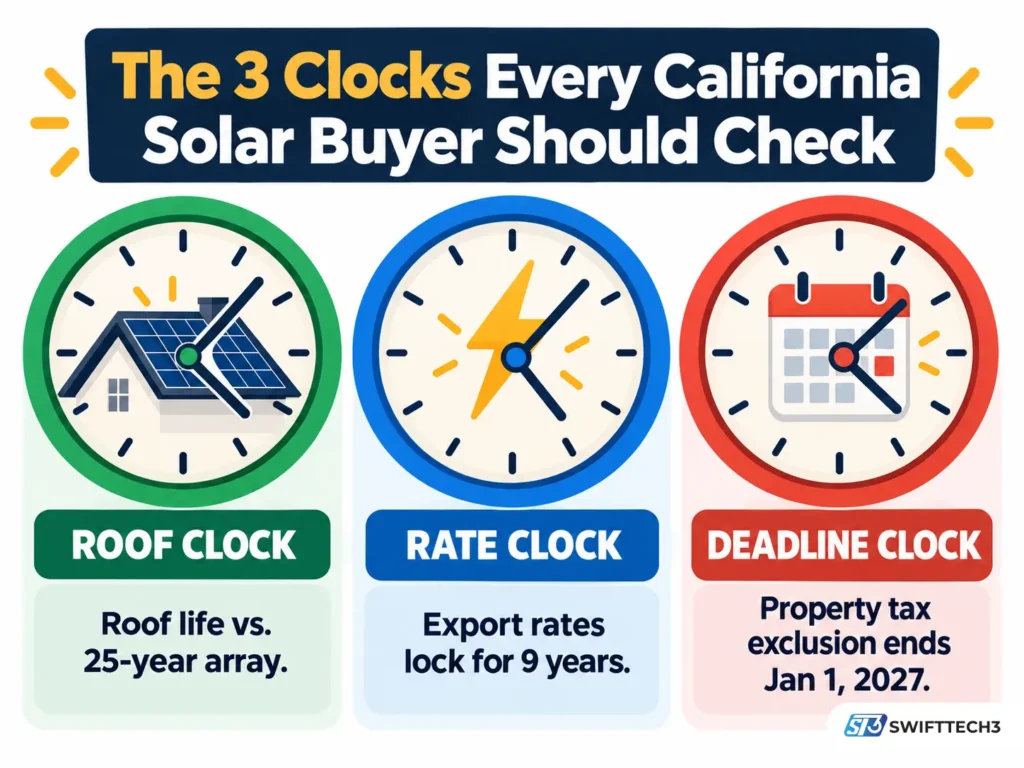
A useful way to keep the decision organized is to track three clocks. Each one is running at a different speed, and the one that runs out first should drive your schedule.
Clock 1: The Roof Clock
Solar panels typically carry performance warranties of 25 years or longer. NREL’s field-data reviews put typical crystalline-silicon degradation at roughly half a percent per year, so a well-installed array is built to outlast most roofing materials. That mismatch is the problem. If your roof has eight years of life left, you are committing to either an early removal-and-reinstall of the whole array or a roof failure under it.
A practical rule: ask the installer, in writing, how much service life they expect from your current roof and what the plan is if it needs replacement before the array is due for retirement. If the answer is vague, get an independent roofing opinion before signing.
The structural side deserves equal attention. Rooftop arrays add weight, but the larger concern is wind. ASCE 7-16, the engineering standard that many building codes reference, added design wind-load provisions specifically for rooftop solar panels, built on earlier work by the Structural Engineers Association of California. University wind-tunnel and full-scale tests, including work at the NHERI Wall of Wind facility, keep finding that panels near roof edges and corners see the highest peak pressures. In plain terms, the attachment spacing and the layout near the edges matter more than the brand on the panel.
This is the kind of problem the NIST building and construction research program exists to address more broadly. NIST develops safety standards for construction, runs programs on earthquake and windstorm impact reduction, and investigates structural failures so that codes improve. It does not publish a rooftop-solar failure statistic, so be wary of anyone who claims otherwise. The useful takeaway is the principle: retrofits to an existing structure are engineering decisions, not accessories.
Clock 2: The Rate Clock
Under the Net Billing Tariff, export credits are based on the CPUC’s Avoided Cost Calculator and vary by month, hour and weekday versus weekend. That works out to 576 different values a year (12 months × 24 hours × 2 day types). For residential customers who enroll in the first five years of the program, the export values are locked in for nine years; after that they reset periodically. Exactly which date triggers the lock (application or interconnection) is worth confirming with your utility’s Solar Billing Plan page, because the year you enter can change the numbers.
What this means for design:
- Production timing matters, not just production volume. Panels facing west or southwest produce later in the afternoon, closer to the high-value evening hours. Ask your installer to model your roof’s real orientations against the hourly export values, not a generic south-facing assumption.
- Self-consumption beats exporting. Every kilowatt-hour you use at home avoids the full retail rate. Efficiency work, such as air sealing and insulation upgrades, shrinks the load before you size anything.
- A battery is a tool, not a requirement. It shifts midday production into the evening, when your rates and the export credits are highest. Whether it pays back depends on your rate plan and usage pattern, so ask for the math with and without storage.
Clock 3: The Deadline Clock
California’s active solar energy system exclusion keeps the value of new solar from raising your property’s assessed value. Under Revenue and Taxation Code Section 73, it is scheduled to become inoperative on January 1, 2027, according to the State Board of Equalization (BOE). Systems completed before that date keep the exclusion, and a 2025 law (SB 710) clarified that already-qualifying systems stay excluded. A system completed after the date would generally be assessable as new construction.
An extension bill, AB 2389, was introduced this year to push the date to 2032, but the most recent reporting I could find says it stalled in committee in May, and I found no enacted extension as of late October 2026. Confirm the current status with the BOE or your county assessor before you decide.
Here is an illustrative calculation, not a prediction. If an assessor added $20,000 to your assessed value and your total property tax rate is somewhere between 1.1 and 1.3 percent, that is about $220 to $260 more per year, for as long as you own the home. Small next to the system’s cost, but it belongs in your payback math.
The practical problem is timing. With about nine weeks left, a contract signed today still has to clear design, permitting, installation, inspection and utility approval before the new year. Ask your installer for a dated schedule and what happens if the deadline is missed. If they will not commit to one, treat the exclusion as unavailable and price the project accordingly.
Your Electrical Panel: The Hidden Bottleneck
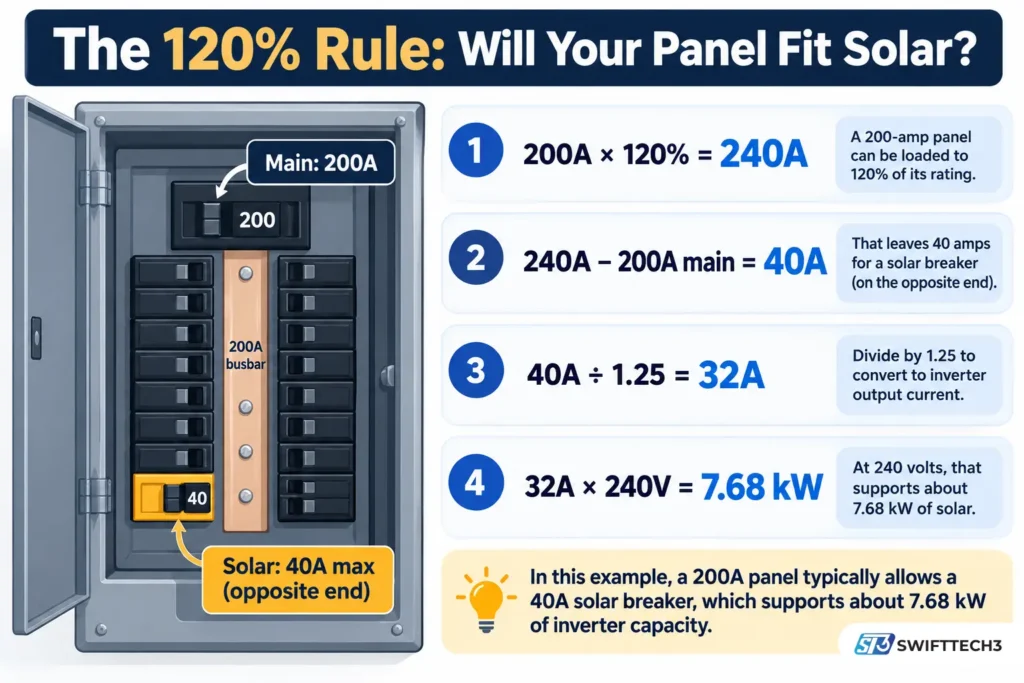
Roof and rates get the attention. The main service panel quietly kills or inflates more proposals. The National Electrical Code’s busbar rule, often called the 120 percent rule, limits how much solar a panel can accept. The sum of your main breaker and the solar breaker can equal 120 percent of the busbar rating, and the solar breaker must sit at the opposite end of the busbar from the main.
Here is the arithmetic for a common setup. A 200-amp busbar with a 200-amp main breaker allows 240 amps combined, which leaves 40 amps for solar. Inverter output is sized at 125 percent for this calculation, so the inverter can be at most 32 amps, or about 7.68 kW at 240 volts. A 100-amp panel with a 100-amp main allows only a 20-amp solar breaker, or about 3.84 kW. Add a battery and the numbers tighten further.
If your system does not fit, a main panel upgrade is not the only answer. Depending on the home, installers may use a main breaker derate, a supply-side (line-side) tap under NEC 705.11, or a listed power control system under NEC 705.13 that caps current on the busbar. Upgrades can cost several thousand dollars, so ask which option the designer evaluated and why they chose it.
Permitting and Utility Interconnection: Where the Time Actually Goes
Here is something older guides get wrong: permitting is no longer the slowest step in much of California. Under SB 379, the Solar Access Act, cities and counties with more than 50,000 residents had to adopt automated permitting such as SolarAPP+ (developed by NREL) by September 30, 2023, and smaller jurisdictions by September 30, 2024. Systems up to 38.4 kW qualify. Very small cities and counties, those under 5,000 residents and counties under 150,000, are exempt, so a rural address can still involve a traditional review.
The step that tends to stall now is the utility’s Permission to Operate (PTO). Interconnection with Pacific Gas & Electric (PG&E), Southern California Edison (SCE) and San Diego Gas & Electric (SDG&E) is governed by Rule 21, which sets timelines for utilities. In 2025, the California Solar & Storage Association filed a complaint with the CPUC alleging repeated missed Rule 21 deadlines by PG&E and SCE, which tells you the delay is documented rather than anecdotal.
What to do about it: ask whether the installer submits the interconnection application early and in parallel with permitting, and never switch the system on before you have written PTO. Operating without it can violate your interconnection agreement.
Heat and Wildfire Smoke: Two Output Losses Worth Pricing In
Every panel datasheet lists a temperature coefficient, the percentage of power lost for each degree Celsius above 25°C. Typical silicon panels fall between roughly -0.25 and -0.45 percent per degree. If a panel runs at 65°C cell temperature on a hot afternoon, that is 40 degrees over the test condition, and at -0.35 percent per degree you lose about 14 percent of rated output (40 × 0.35). A panel with a better coefficient loses less. In the Central Valley and inland Southern California, that spec is worth comparing.
Smoke is a different issue. A study by the National Center for Atmospheric Research found that smoke from the September 2020 fires cut California’s solar output by 10 to 30 percent during peak midday hours. An NREL analysis estimated the statewide average drop in PV generation that month at about 7.7 percent. Smoke events are temporary, but ash left on panels can linger, so ask whether your maintenance plan includes cleaning and performance checks after a heavy smoke season.
How to Choose an Installer: Questions That Separate Good from Average
Price matters, but these questions tell you more. A contractor with direct experience installing solar panels in California across different cities will already know which jurisdictions use automated permitting, which utilities are slow, and what local inspectors look for.
- Is the license right? Solar work in California requires a valid Contractors State License Board (CSLB) license in the C-46 (Solar), C-10 (Electrical) or B (General Building) classification. Check it on CSLB’s online license lookup before you sign.
- Did you get the required paperwork? California’s Solar Consumer Protection Guide from the CPUC and the CSLB Solar Energy System Disclosure Document are part of the sales process. If nobody offers them, treat that as a warning.
- Who is responsible for roof penetrations? Separate the equipment warranty (often 25 years) from the labor and workmanship warranty, and ask specifically about leaks around mounting points.
- What happens after install? Ask about monitoring, performance guarantees and who answers the phone in year five. A company that also handles roofing and electrical work under one roof can simplify accountability.
- How do they manage the project? Good contractors track schedules and costs closely, the same discipline behind construction project management and ERP systems. Ask who your single point of contact is.
Treat the quote like any other construction bid. Our guide to construction estimating tips explains why itemized line items, allowances and contingencies tell you more than a single bottom-line number. Ask for roof prep, electrical work, permits and interconnection to be listed separately.
On financing, loans, leases and power purchase agreements affect resale and long-term savings differently. Think about it the way you would break-even math on mortgage points: the right answer depends on how long you will stay in the home.
Personal Experience: What a Site Visit Tends to Reveal
Walk a handful of California rooftops with an installer and the same patterns keep showing up. None of them appear in a glossy proposal.
The roof is older than the owner thinks. Picture a 1998 tract home in the Central Valley with its original composition shingles. From the street it looks fine. Up close the granules are thinning and the south slope has curling edges. The homeowner wants a 25-year system on a roof with perhaps five good years left. The lesson: the roof decision comes first, and bundling the reroof with the solar work usually costs less than paying to remove and reset panels later.
The panel box is the real limit. Picture a 100-amp service in an older Bay Area home. The homeowner wants a battery and a future EV charger. The 120 percent rule leaves room for a 20-amp solar breaker. The lesson: ask about the electrical panel at the first call, not after the design is finished, and ask what the designer considered before recommending an upgrade.
Shade changes with the season. A tree that casts no shadow in July can shade the lower third of an array in December, when the sun sits low. The lesson: ask for a shading analysis that covers the winter months, and look at the roof at 9 a.m. and 3 p.m. in winter if you can.
Timing beats price. The projects that go smoothly tend to have an installer who starts the utility application early and tells the customer plainly which step is likely to slip. The lesson: a slightly higher quote from a team that manages the calendar can be worth more than a lower one that does not.
Common Mistakes to Avoid
- Sizing to your bill instead of your load profile. Under net billing, when you use power matters as much as how much you use.
- Skipping the structural check on older homes or on roofs with tile, slate or multiple layers.
- Treating interconnection as paperwork and not as a schedule risk.
- Assuming old incentives still apply. The federal homeowner credit ended for 2026 installations, and the state property tax exclusion ends January 1, 2027.
- Comparing price per watt only, without comparing roof prep, electrical upgrades and warranty terms.
- Switching the system on before PTO.
Best Practices Checklist
- Start with a roof inspection and ask for the remaining service life in writing.
- Get an electrical panel evaluation before the design is finalized.
- Ask for production modeling against hourly export rates, with and without a battery.
- Request a dated schedule that covers permitting, installation, inspection and PTO.
- Verify the CSLB license and collect the consumer-protection documents.
- Compare equipment warranties and workmanship warranties separately.
- Keep a record of monitoring data in the first year so you can spot underperformance early.
Frequently Asked Questions
How long does installing solar panels in California take?
The physical installation is usually a matter of days. The calendar time is dominated by design, permitting and the utility’s Permission to Operate, and it varies by city and utility. Ask your installer for a dated schedule rather than a general estimate.
Is solar still worth it in California after NEM 3.0 and the end of the federal credit?
It can be, but the case depends on your usage pattern, rate plan, roof and whether you add storage. Export credits are usually below retail, so systems that offset your own daytime and evening use tend to perform better than ones built mainly to export. Get a modeled estimate with and without a battery before you decide.
Do I need a battery with solar in California?
No battery is required. However, the CPUC says net billing customers can maximize bill savings by pairing storage with solar, and nearly 70 percent of them had done so by the end of 2024. Whether it pays back for you depends on your rates and usage.
What happens to California’s solar property tax exclusion in 2027?
The exclusion is scheduled to become inoperative on January 1, 2027. Systems completed before that date keep it, and a system completed afterward would generally be treated as assessable new construction. An extension bill was introduced in 2026, but I found no enacted extension as of late October 2026, so verify with the BOE or your county assessor.
Can my roof handle solar panels?
It depends on the roof’s age, material, framing and condition, and on where wind loads are highest. A roofer or structural professional should check it before installation. ASCE 7-16 includes wind-load provisions for rooftop solar, and tests show edge and corner zones see the highest pressures.
Will I need a main panel upgrade?
Not always. Under the NEC 120 percent rule, a 200-amp panel with a 200-amp main can take a 40-amp solar breaker. Alternatives such as a main breaker derate, a line-side tap or a power control system can avoid an upgrade in some homes. Ask your installer which options they evaluated.
How do I verify a solar contractor in California?
Use the CSLB online license lookup and confirm the contractor holds an active C-46, C-10 or B license. Ask for the CPUC Solar Consumer Protection Guide and the CSLB Solar Energy System Disclosure Document, and get the workmanship warranty in writing.
How much do heat and wildfire smoke reduce solar output?
Heat reduces output by the panel’s temperature coefficient for each degree above 25°C, which can add up to roughly 14 percent on a very hot rooftop at a -0.35 percent coefficient. A NCAR study found smoke cut California’s solar output by 10 to 30 percent during peak hours in September 2020, and NREL estimated a statewide average drop of about 7.7 percent for the month.
What is Permission to Operate (PTO)?
PTO is the utility’s written approval to turn your system on and run it in parallel with the grid. Under Rule 21 it is the final step after permitting and inspection, and you should not operate the system without it.
Conclusion and Actionable Takeaways
Installing solar panels in California in late 2026 is less about finding the cheapest quote and more about getting the order of operations right. Check the roof first, the electrical panel second, the rate and export math third, and the calendar throughout. The property tax deadline on January 1, 2027 is the one item with a hard date, so ask for a written schedule now.
Your next steps:
- Have your roof’s remaining life assessed before you request quotes.
- Ask for your panel’s busbar and main breaker ratings, and check them against the 120 percent rule.
- Ask for hourly export-rate modeling, with and without a battery.
- Get a dated project schedule that includes PTO, and ask what happens if the 2027 deadline is missed.
- Verify the contractor’s CSLB license and keep copies of all disclosure documents.
- For more practical guides on upgrading your property, browse our home improvement articles.
Disclaimer: This article is for general information and is not legal, tax, financial or engineering advice. Incentives, utility tariffs, building codes and deadlines change often. Confirm current rules with the California Public Utilities Commission, your utility, the State Board of Equalization or your county assessor, a licensed contractor, and a qualified tax professional before making decisions. Figures such as temperature losses and property tax examples are illustrative and will vary by system and property.