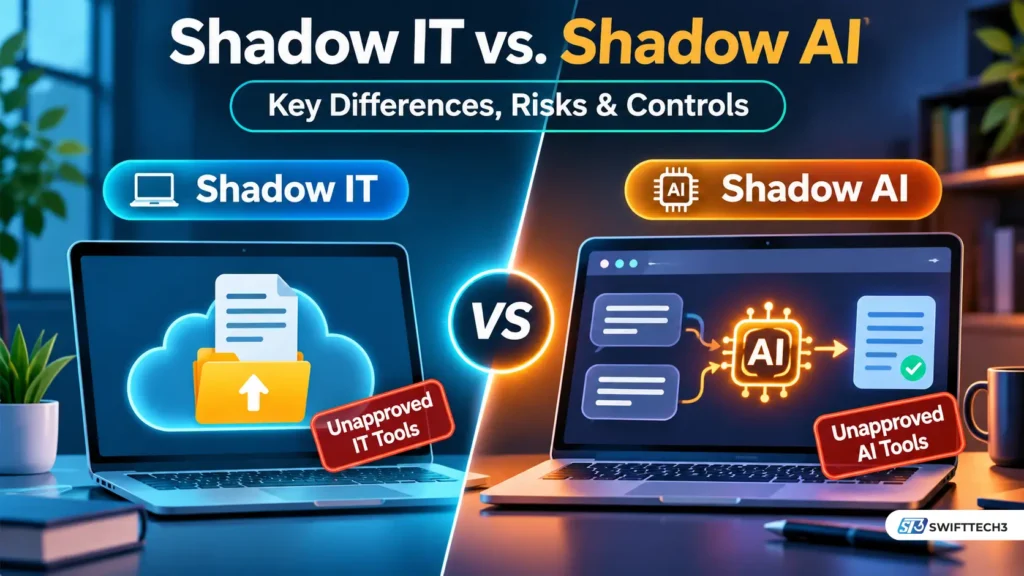
Shadow IT is any hardware, software or cloud service used without IT approval. Shadow AI applies the same behavior to AI tools, models and agents. It adds risks shadow IT lacks: prompts can expose data instantly, some models may retain it, and outputs can be wrong. IBM’s 2026 report found shadow AI in 43% of studied incidents.
A few years ago, the worst case was an employee parking a client spreadsheet in a personal cloud folder. Today, the same employee can paste that spreadsheet into a chatbot and ask it to “find the trends.” The data now goes into a model nobody vetted, under terms nobody read. This guide covers what separates the two problems, what the latest data says, where traditional controls fail, and how to govern both without driving AI use further underground.
What is the difference between shadow AI and shadow IT?
Shadow IT is about the tool. Shadow AI is about the data going into the tool and what the tool does with it. Most security vendors, including Check Point and IBM, describe shadow AI as a subset of shadow IT. The practical difference is where the risk sits.
| Question | Shadow IT | Shadow AI |
|---|---|---|
| What is unapproved? | An app, device or cloud service | Often a personal login, a pasted prompt, a browser extension, an agent, or an AI feature inside an approved app |
| Main data risk | Data stored or shared in the wrong place | Data processed, possibly retained, and returned as new output |
| When exposure happens | Gradually, as files sync or are shared | The moment text or a file is submitted |
| Output risk | Rare | Wrong or manipulated answers can enter official documents |
| Typical detection signal | New domains, OAuth grants, expense lines, installs | Prompts to allowed domains, non-corporate logins, agent activity, feature toggles |
| Governance question | Which apps are allowed? | Which data may go into which tool, account and agent? |
This table is the author’s synthesis of vendor and IBM descriptions, not a published standard.
What most people miss: an AI feature can arrive inside software you already approved, such as an assistant added to a note-taking app in a routine update. Nothing new was installed, so a scan for unknown apps finds nothing. Portnox makes this point in its shadow AI explainer.
Which terms do people confuse with shadow AI?
Four labels overlap, and mixing them up leads to the wrong policy.
| Term | What it means | Who uses it |
|---|---|---|
| Shadow IT | Any unapproved hardware, software or cloud service | Industry-wide |
| Shadow AI | Unapproved AI tools, models, features or agents | Industry-wide |
| BYOAI (“bring your own AI”) | Employees using personally chosen AI tools at work | Microsoft and LinkedIn’s Work Trend Index |
| Sanctioned AI | AI the organization has reviewed and approved | Governance teams |
According to Microsoft and LinkedIn’s 2024 Work Trend Index, 78% of AI users bring their own AI tools to work. The figure rises to 80% at small and medium-sized companies. The same report found only 39% of users had received AI training from their company. That report is from May 2024, so current rates may differ.
How common is shadow AI, and what does it cost?
Shadow AI is now one of the larger cost drivers in IBM’s breach research, and the share of incidents involving it has risen sharply. IBM’s reports are produced with the Ponemon Institute and are based on organizations that actually suffered breaches.
| Date | Finding | Source |
|---|---|---|
| July 30, 2025 | 20% of 600 surveyed organizations reported a breach due to shadow AI. High shadow AI use added $670,000 to average breach cost versus low or none | IBM Cost of a Data Breach 2025 |
| July 30, 2025 | In shadow AI incidents, 65% exposed customer personal data and 40% exposed intellectual property, versus global averages of 53% and 33% | IBM, 2025 |
| July 29, 2026 | Shadow AI involved in 43% of studied incidents, more than double the prior year. Global average breach cost: about $4.99 million, up 12% | IBM 2026, as reported by Cybersecurity Dive |
| July 29, 2026 | More than two-thirds of organizations lacked governance processes to limit shadow AI | IBM 2026, as reported by Cybersecurity Dive |
| July 29, 2026 | 602 organizations, 17 industries, 16 countries, breaches between March 2025 and February 2026 | IBM 2026 methodology |
Two cautions before you quote these numbers:
- The 2025 and 2026 figures are phrased differently. The 2025 headline counted organizations reporting a breach due to shadow AI. The 2026 coverage counts the share of incidents involving it. Both are described as a rise, but check IBM’s wording before putting them in one chart.
- These are breached organizations, not the whole economy. The numbers show what shadow AI looks like in incidents. They do not show how often an average company is hit.
I found no published study that compares shadow AI and shadow IT breaches head to head, so “which is riskier” has no definitive answer yet.
What risks does shadow AI add that shadow IT never had?
Shadow AI adds integrity risk on top of leakage risk. Shadow IT mostly moves data to the wrong place. Shadow AI can change the data, reuse it, or send back something you cannot trust. Document-security vendor Locklizard makes a similar point: Shadow AI adds integrity problems that classic shadow IT did not. That source is a vendor, so treat its framing as one view.
Training retention. Policies differ by plan. As of November 2026, OpenAI’s help center says content from its individual services (Free, Plus, Pro) may be used to train models unless the user opts out. It says ChatGPT Business, Enterprise, Edu and the API are not used for training by default. One edge case is easy to miss. On individual plans, giving a thumbs-up or thumbs-down can allow the whole conversation to be used for training, even after opting out. Other vendors have their own terms, so check each one.
Model and data poisoning. The OWASP Top 10 for LLM Applications (2025 edition) lists data and model poisoning as a named risk. It means manipulated pretraining, fine-tuning or embedding data that skews output or hides backdoors. I found no public data on how often this reaches companies through shadow AI, so treat it as a recognized risk, not a measured one.
Wrong output. OWASP also lists misinformation, where models produce plausible but incorrect content. A wrong contract summary or financial figure can slip into an official document because it reads confidently.
Agents with their own access. KnowBe4’s Javvad Malik argued in July 2026 that shadow IT was a problem of managing data, while shadow AI is a problem of authority, meaning who is acting in your organization’s name. That is an opinion, but it matches IBM’s 2026 finding that fewer than half of organizations actively secure non-human identities. OWASP lists “excessive agency” as a separate LLM risk.
Why does data leave faster in generative workflows?
Chat tools encourage small, frequent submissions, so no single action looks like a breach. A sales rep might paste pricing in the morning, a customer list at noon and a draft proposal in the afternoon. Each fragment is below any alert threshold, and together they are a serious disclosure. Because the text is retyped or reformatted, it rarely matches the file signatures many controls watch for.
This is reasoning about how chat tools work. I found no published measurement of fragment size or frequency.
Why do traditional IT controls miss shadow AI?
Most legacy controls look for known file types moving to known destinations. Shadow AI often moves neither.
- Domain blocklists fall behind as new AI tools launch, and they cannot separate a personal login from a corporate one on the same allowed domain.
- Pattern-based DLP catches card numbers but can miss a paraphrased strategy memo. Tightening rules tends to flood analysts with false positives.
- Copy restrictions on documents can be sidestepped with a screenshot or text recognition software, then pasted into any chatbot.
- Policy-only governance leaves gaps. According to IBM’s 2025 report, as summarized by Cybersecurity Dive, only 34% of organizations with AI governance policies regularly checked their networks for unsanctioned tools.
The compliance trap is that an acceptable-use policy and a blocklist can satisfy an audit while real leakage continues in a browser tab. Passing a check and protecting data are different outcomes.
Do AI bans work?
The evidence for bans is weak, and the claim that they backfire mostly comes from vendors. Check Point argues that bans push use out of sight, and that argument is plausible. I did not find an independent controlled study proving it. The Microsoft data shows strong employee demand, which suggests a ban alone is unlikely to stop use. A safer assumption is that people will use AI, so the job is to make the approved route easier than the unapproved one.
How do you govern shadow AI and shadow IT together?
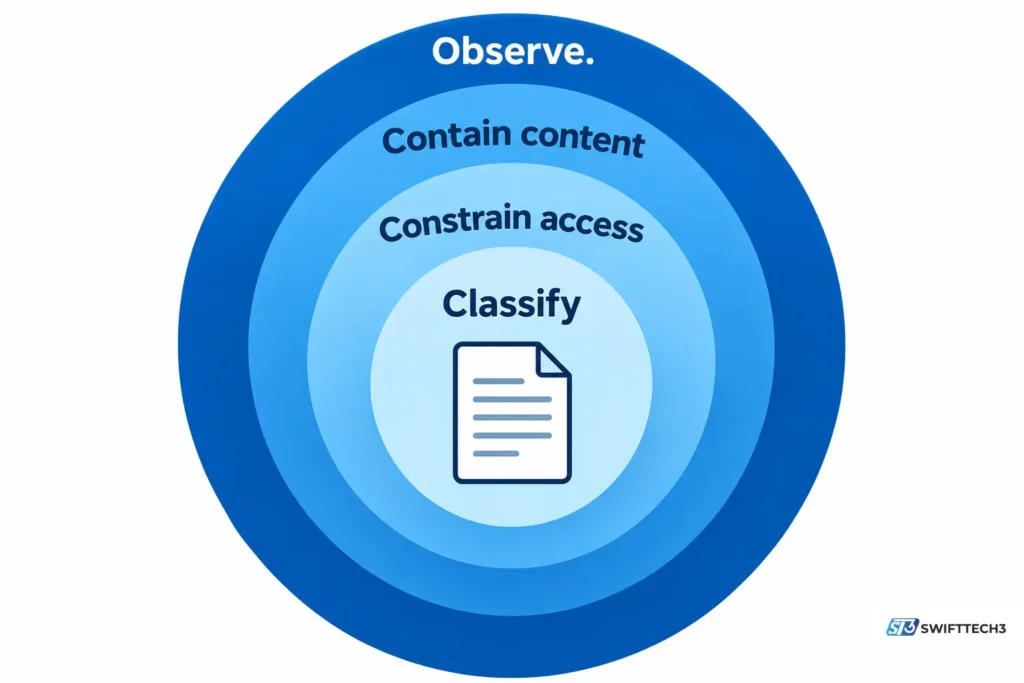
Design controls around the data first and the tool second. The framework below is an original, illustrative model built from the findings above. It is not an industry standard.
| Layer | Goal | Practical steps |
|---|---|---|
| 1. Classify | Know what is sensitive before it moves | Automated sensitivity labels on documents and fields |
| 2. Constrain access | Shrink what an AI agent or user can reach | Clear data ownership, expiring permissions, least privilege for agents and service accounts |
| 3. Contain content | Keep control attached to the file | Encryption and document-level DRM; mask sensitive fields before prompts leave your network |
| 4. Observe | See actual usage | Inventory AI tools in use, review logins, OAuth grants, extensions and AI feature toggles |
Document DRM vendors describe features such as dynamic watermarking, device binding, screen-capture prevention and remote revocation. Those are vendor claims. I found no independent test data on how well they stop content reaching an AI tool, so apply them where the document value justifies the friction.
Offer a sanctioned route. A secure AI gateway sends requests to approved enterprise models, masks sensitive fields and logs prompts for review. AI gateways and AI redaction tools are common building blocks. The tradeoffs are real: inspection adds latency, masking can weaken answers, and strict controls slow legitimate sharing. Write the rules into a documented AI governance and compliance policy so people know what is allowed and why.
Smaller teams without a dedicated security function may find it easier to hand monitoring to a provider. Our guide to managed service providers for small business covers that route.
How can you check your own exposure?
You can run this checklist without any special tooling:
- List every AI feature inside software you already approve, and note whether each is on by default.
- Review browser extensions and OAuth grants for AI assistants with mailbox, calendar or drive access.
- Ask a small group which AI tools they actually use, without penalty for answering honestly.
- Check whether staff can sign in to AI sites with personal accounts from work devices.
- Confirm which plan each approved AI tool runs on and read its data-use terms.
- Test whether a labeled confidential document triggers any warning when pasted into an AI tool.
Myth vs fact
| Myth | Fact |
|---|---|
| Blocking AI domains solves it | AI features also sit inside approved apps and on personal logins |
| Shadow AI is only a leak problem | It also affects output quality and what agents do with access |
| Paid plans and free plans handle data the same way | OpenAI’s published terms differ by plan; check each vendor |
| A signed policy equals protection | IBM’s 2025 data shows many policy holders did not check for unsanctioned tools |
FAQs
Is shadow AI a type of shadow IT?
Most security vendors, including Check Point and IBM, treat it as a subset. The difference is practical: shadow AI concerns data entered into models and what agents can do.
Which is riskier, shadow AI or shadow IT?
No published study compares them directly. IBM’s 2025 report linked high shadow AI use to $670,000 in extra breach cost, which suggests a meaningful premium. Shadow IT remains a risk in its own right.
Can AI chatbots train on my company’s data?
It depends on the plan and vendor. OpenAI states that its individual plans may use content for training unless opted out, and that its business plans do not by default. Always read the current terms for the exact tool in use.
How do you detect shadow AI?
Look for personal logins on approved domains, new OAuth grants, AI browser extensions, unusual API activity and AI features switched on in admin consoles. Pair this with a short employee survey.
Should a company ban AI tools?
A ban alone is unlikely to hold, given how widely employees already use their own tools. A better approach is clear data rules, an approved option and visibility into usage.
Does shadow AI create legal exposure?
It can. IBM notes that serious GDPR violations can bring fines of up to €20 million or 4% of worldwide annual revenue, whichever is higher. US sector rules such as HIPAA may also apply depending on the data, so ask qualified counsel.
Conclusion
Shadow IT put your data in the wrong place. Shadow AI can absorb that data, transform it and return output you cannot fully verify.
- Treat the two as related but different: control the tool for shadow IT, control the data and the agent’s access for shadow AI.
- Expect AI features to appear inside approved software, not only on new sites.
- Offer an approved AI route, because demand is high and bans are not proven to work.
Next step: this week, run the six-point exposure checklist above and write down which data types may never be pasted into any AI tool.
Related: Role of AI in Mobile App Security and Data Protection
Disclaimer
This article is for informational purposes only and is not legal, security or compliance advice. It is not affiliated with, sponsored by or endorsed by any brand or organization mentioned. Statistics, vendor terms, features and policies may change. Information last verified on November 23, 2026. AI output can be inaccurate, so verify important details with qualified professionals before acting.