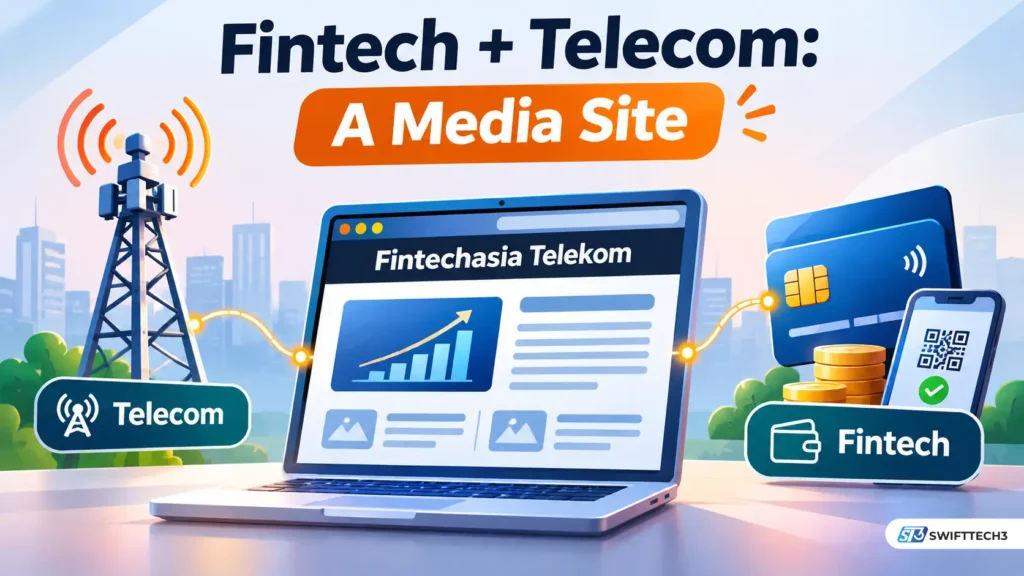
Fintechasia Telekom is a media website at fintechasiatelekom.com covering fintech, telecom, stock markets and cryptocurrency. Its About page calls it an independent platform run by a small editorial team. The site says its content is educational and that it provides no licensed financial, investment or legal advisory services. Based on its published pages, it is a publisher, not a bank.
Search the name and you will hit a contradiction. Some third-party blog posts describe it as a leading Asian company offering digital banking and blockchain services. The site’s own About page describes a news and analysis site. Only one of those descriptions comes from the site itself, and this guide sorts out which claims hold up.
What is Fintechasia Telekom?
Fintechasia Telekom is an editorial website, not a financial product. According to its About page, read live on November 23, 2026, it covers digital banking, global stock markets, cryptocurrency, corporate infrastructure management and telecom sector forecasting.
| Item | What the evidence shows | Status |
|---|---|---|
| Website | fintechasiatelekom.com | Confirmed on the live site |
| Self-description | “Independent platform” covering fintech, telecom updates and market tracking | Claimed by the site itself |
| Team | A “small editorial team” | Claimed; no named owner, legal entity or street address appears on the About page |
| Content sections | The About page lists five: ftasiaeconomy, ftasiastock, ftasiamanagement, ftasiatrading and ftasiafinance | Confirmed on the About page |
| Advice | Educational and informational only; no licensed advisory services | Stated by the site |
| Activity | The newest homepage post was dated November 23, 2026 | Confirmed on the live homepage |
What most people miss: the homepage navigation shows only three of those five sections (FTAsiaEconomy, Ftasiastock and FTAsiaManagement). The other two exist only as names on the About page. If you are looking for “ftasiatrading” or “ftasiafinance” content, check that it exists before relying on it.
Is Fintechasia Telekom a bank, lender or digital wallet?
No. The About page presents it as a media tracking site and states that it does not provide licensed financial, investment, legal or professional advisory services. None of the pages read for this article describe an account, card, loan, wallet or app you can sign up for.
That matters because the name sounds like a service provider. A site can write about digital banking, mobile payments and crypto without offering any of them. If you ever see a payment page, login form or investment offer using this name, do not treat it as the same entity. Verify the operator independently first.
Why do so many pages describe it differently?
Third-party blogs often describe it as a company, but the site’s own pages describe a publisher. Several blog posts say it offers digital banking, micro-lending or blockchain products. None of the pages read for this article named a licensed operator behind those claims, and the About page describes nothing of the kind.
| Claim you may see | What the site’s own About page says | Verdict |
|---|---|---|
| “A leading company in Asia” offering digital banking and blockchain | An independent media platform with a small editorial team | Unsupported by first-party pages |
| Offers micro-lending or stronger banking features than traditional providers | No lending or banking product is described | Unsupported |
| “Telekom FintechAsia” is a telecom–fintech platform you can use | The phrase is used as a concept label and in article titles on the same site | Concept, not a product |
| It is a content site about fintech and telecom | Matches the About page | Consistent with first-party evidence |
The site’s own security article uses “Telekom FintechAsia” to mean the connection between telecom networks and financial technology. It describes a “security model” in which a risk engine weighs SIM and device signals. The article read for this guide does not name any telecom operator, bank or API provider taking part in such a model. Treat it as an explainer of a concept, not evidence of a working network.
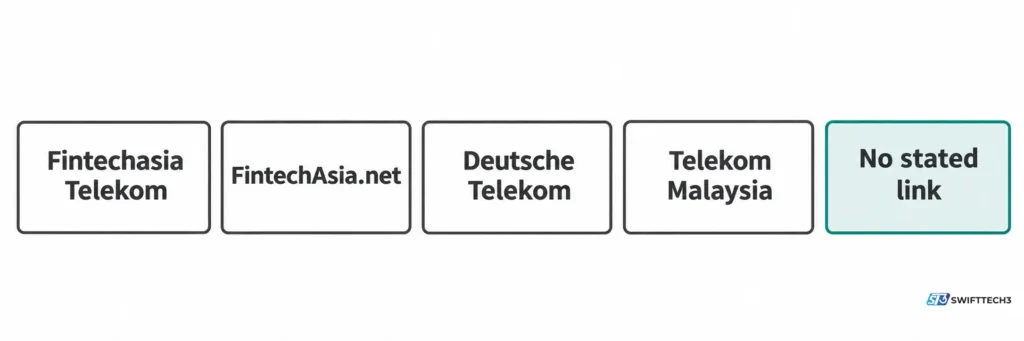
Is Fintechasia Telekom connected to Deutsche Telekom, Telekom Malaysia or FintechAsia.net?
No connection is stated on the pages read. Similar names are not proof of ownership or partnership.
| Name | What it is | Relationship to fintechasiatelekom.com |
|---|---|---|
| Fintechasia Telekom | Editorial site at fintechasiatelekom.com | This is the site itself |
| Telekom FintechAsia, Telekom Fintechasianet | Phrases used in article titles on that same site | Same site, different title wording |
| FintechAsia.net | A separate domain | No ownership link published on the pages read |
| Deutsche Telekom (“Telekom”) | A German telecom group | None stated; the site’s About page lists “deutsche telekom” terms in a keyword index, which is a search-term list, not an affiliation |
| Telekom Malaysia | A separate Malaysian telecom company | None stated |
What changed recently: the word “Telekom” itself is changing hands in places. According to Deutsche Telekom, on September 3, 2026 the Greek brand COSMOTE TELEKOM began a rebrand to simply “Telekom.” Deutsche Telekom says it holds a stake of around 55 percent in OTE Group, which operates in Greece. If you search “Telekom” with a finance term, expect results about real telecom operators that have nothing to do with this website.
What does Fintechasia Telekom actually publish?
It publishes short explainer-style articles on fintech, telecom, markets and crypto. Recent homepage headlines in the live check on November 23, 2026 included pieces on FTAsiaManagement technologies, FTAsiaStock news and crypto, and a post on accurate timestamps in stock market news.
The About page also includes a long “keyword index” of search phrases. That is a sign the site is built around search terms, so read it as a general explainer source rather than original reporting. The About page names no reporters, credentials or sourcing policy. Posts are bylined to a single author, Ayesha Faiz, but the About page does not describe her background.
For readers who want the broader topic, our guide to FTAsiaFinance technology covers a neighboring section name from the same family of terms.
How do telecom networks actually support digital finance?
Telecom networks carry the connection that mobile wallets, banking apps and mobile money rely on. The strongest verified numbers come from the GSMA and the World Bank, not from Fintechasia Telekom.
| Figure | Value | Source and period |
|---|---|---|
| Mobile money transaction value | More than $2.1 trillion | GSMA State of the Industry Report on Mobile Money 2026, covering 2025 |
| Growth in transaction value | 23 percent versus 2024 | GSMA, same report |
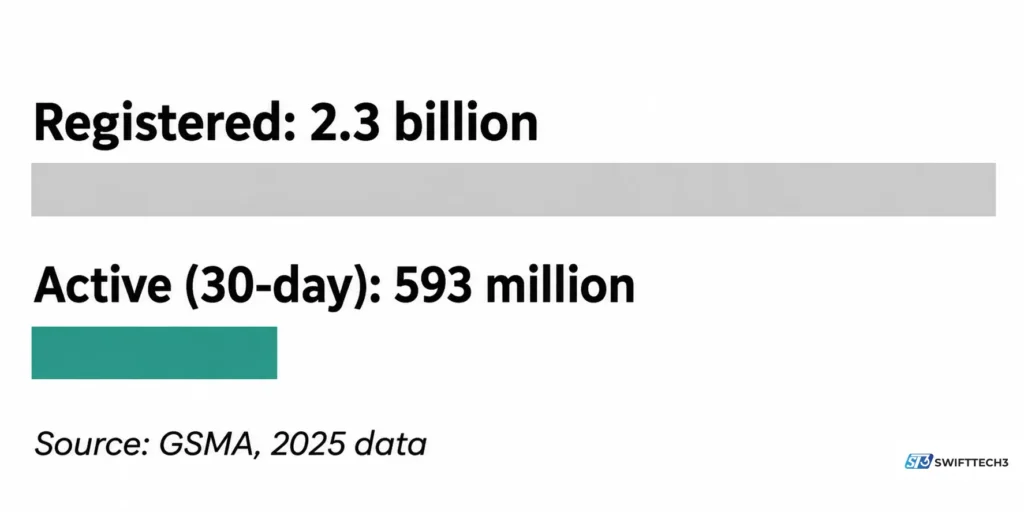
| Registered mobile money accounts | 2.3 billion, up 268 million | GSMA, same report |
| Active 30-day accounts | 593 million | GSMA, same report |
| Adults who own a mobile phone | 86 percent | World Bank Global Findex 2025 (2024 data) |
| Adults with a financial account | 79 percent | World Bank Global Findex 2025 (2024 data) |
| Adults without an account | 1.3 billion | World Bank Global Findex 2025 |
| Adults without an account who have a phone | About 900 million, including about 530 million with smartphones | World Bank Global Findex 2025 |
The insight most summaries skip: registered is not active. Using the rounded published figures, 593 million active accounts against 2.3 billion registered is roughly 26 percent. About a quarter of registered mobile money accounts were used in the past 30 days. Large “account” numbers overstate how many people use mobile money regularly.
A phone alone does not deliver inclusion either. The World Bank’s own finding is that roughly 900 million people without accounts already have phones, so connectivity is necessary but not sufficient. Cost, trust and available services still decide who actually gets a financial account.
Can your phone number help protect your money, or put it at risk?
Both. A phone number is a convenient way to verify you, and it is also a weak point if a criminal takes it over.
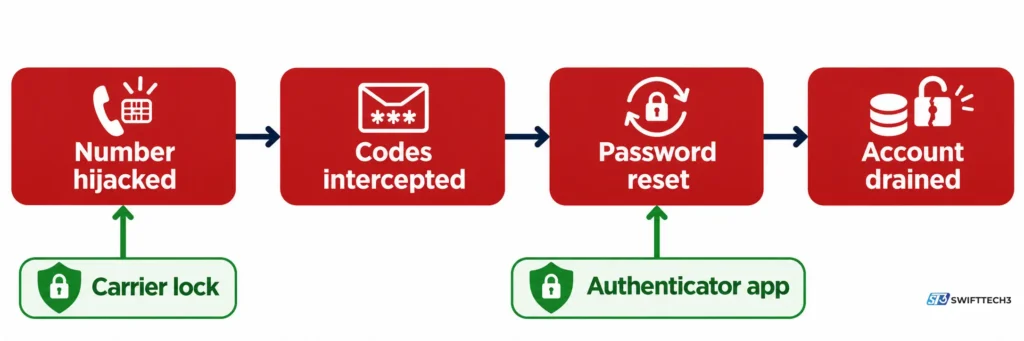
The site’s security article says SMS one-time passwords are not completely secure and can be captured through phishing, malware, social engineering or SIM-swap fraud. That is consistent with how SIM swapping works. According to the Federal Communications Commission (FCC), these scams let attackers hijack a number and then receive the texted codes meant for you.
For US readers, the rules recently changed. The FCC’s SIM Swap and Port-Out Fraud Order was published in the Federal Register on December 8, 2023. According to a law-firm summary (Nelson Mullins) of a November 17, 2026 notice from the FCC’s Wireline Competition Bureau, wireless providers must comply with the revised rules by December 17, 2026. Per that summary, providers must:
- Notify customers about SIM change and port-out requests.
- Offer customers a no-cost option to lock their accounts against SIM changes and number ports.
- Give notice of available account protection mechanisms.
- Set up a clear process for investigating and reporting SIM swap and port-out fraud.
These duties apply to wireless carriers, not to fintech apps or to websites like Fintechasia Telekom. Practical steps, based on general security practice:
- Ask your carrier whether it offers an account or port-out lock, and turn it on if so.
- Where your bank offers an authenticator app or passkey, use it instead of text codes for sensitive actions.
- Treat an unexpected loss of mobile signal as a possible warning sign and contact your carrier from another device.
For deeper reading, see our pieces on AI-based online fraud prevention and the future of eSIM connectivity.
Who should use Fintechasia Telekom, and who should skip it?
Use it as a starting point for learning the vocabulary of telecom-enabled finance. Skip it as the basis for any money decision.
| Good fit | Poor fit |
|---|---|
| Beginners who want plain-language explainers on telecom and fintech | Anyone seeking investment, tax or legal advice |
| Readers building a list of terms to research elsewhere | Anyone who needs named experts, audited data or original reporting |
| Students comparing how different sites describe the same topic | Anyone looking for a bank, wallet or lending service |
For personal money topics, compare with how digital banking affects personal finance and check numbers against primary sources such as the GSMA, the World Bank and your regulator.
Common mistakes when researching this name
- Treating the name as a company. It is a website. Check the domain before trusting any financial claim.
- Assuming “Telekom” means Deutsche Telekom. The word is a brand used by several unrelated operators.
- Quoting blog statistics without a primary source. Always trace a figure back to the GSMA, the World Bank or a regulator.
- Trusting SMS codes for high-value actions. They help, but they are not the strongest option.
How can you check a site like this yourself?
- Confirm the exact domain and compare it with the one you were sent.
- Read the About page and look for a named company, owner and address.
- If it claims to offer financial services, check the operator’s authorization with the relevant regulator.
- Read the privacy policy and terms before entering personal data.
- Verify any statistic against the original report, not a repost.
Frequently asked questions
What is Fintechasia Telekom?
It is a media website at fintechasiatelekom.com covering fintech, telecom, markets and crypto. Its About page describes it as an independent platform run by a small editorial team.
Is Fintechasia Telekom a bank or financial service?
No evidence on its published pages shows it offering banking, lending, payments or investments. It says it provides no licensed advisory services.
What does “Telekom FintechAsia” mean?
On the site itself, it is a phrase used in article titles and as a label for the link between telecom networks and fintech. It is not a described product.
Is it the same as FintechAsia.net?
They are different domains, and no ownership link appears on the pages read. Treat them as separate sites unless the owners state otherwise.
Is it connected to Deutsche Telekom?
No affiliation is stated. Its About page lists Deutsche Telekom terms in a keyword index, which is not a partnership claim.
How big is mobile money?
According to the GSMA, more than $2.1 trillion flowed through mobile money in 2025, across 2.3 billion registered accounts. About 593 million were active in the past 30 days.
Are SMS one-time passwords safe?
They add a step, but they can be intercepted through phishing, malware or SIM swapping. Authenticator apps and passkeys are stronger options where offered.
Can I rely on the site for investing decisions?
No. The site says its content is educational and not licensed advice. Check figures against primary sources and consult a licensed professional.
Conclusion
Fintechasia Telekom is best understood as an explainer site about telecom and fintech, not a company you can bank with. The real data on mobile money and financial inclusion comes from the GSMA and the World Bank, and the real SIM-swap protections come from carriers under FCC rules.
Next step: before acting on anything tied to this name, confirm the exact domain and, for any financial offer, the operator’s regulatory authorization.
Related: Crypto wallet security in 2026
Disclaimer: This article is for informational purposes only and is not financial, legal or security advice. It is not affiliated with, sponsored by or endorsed by Fintechasia Telekom, Deutsche Telekom, Telekom Malaysia, the GSMA, the World Bank or any other organization mentioned. Prices, features, rules and policies may change, so verify important details with official sources before acting. Information last verified on November 23, 2026.