A cybersecurity risk assessment is a structured process for identifying the threats and vulnerabilities facing your systems and data, estimating how likely each is to cause harm and how large the impact would be, and ranking them so you can decide whether to reduce, accept, transfer or avoid each risk. It should be repeated, not done once.
Time works against you here. According to published summaries of IBM’s Cost of a Data Breach Report 2026, the average breach took 247 days to identify and contain: 183 days to find and 64 more to contain. That is up from 241 days in 2025 and about two-thirds of a year. A risk assessment is how you decide, before that clock starts, which weaknesses get your money first.
This guide covers the seven steps, a scoring method that does not fool you, how to choose a framework, which US rules require an assessment, and the mistakes that make a finished assessment useless.
What is a cybersecurity risk assessment, and how does it differ from a scan or a pen test?
A risk assessment is the decision-making step of cyber risk management. You weigh likelihood against impact and rank the results. Scans, penetration tests and audits supply evidence for that step, but none of them replaces it.
NIST’s SP 800-30 Rev. 1 treats risk assessment as one of four steps in risk management. GRC Solutions describes it as the first part of the cyber risk management process.
| Term | What it is | Replaces a risk assessment? |
|---|---|---|
| Vulnerability scan | Automated detection of known weaknesses such as missing patches or misconfigurations | No. It covers only the weakness half of the picture |
| Penetration test | An authorized, simulated attack that tests whether weaknesses can be exploited | No. It tests exploitability but does not rank business impact |
| Gap analysis or compliance checklist | Compares your practices to a standard | No. HIPAA Journal reports that OCR has said a gap analysis does not satisfy the HIPAA risk analysis requirement |
| Risk analysis (HIPAA’s term) | The name HIPAA uses for the required assessment | Same obligation |
| Third-party risk assessment | Reviews one vendor or system | A component of the full assessment |
| Cyber risk management | The whole cycle: identify, analyze, treat, monitor | The assessment is one phase of it |
What most people miss: the same activity carries different labels depending on who is asking. A HIPAA auditor wants a “risk analysis,” an ISO 27001 auditor wants a “risk assessment,” and a customer questionnaire may call it a “security review.” Check the exact wording before you promise a document.
How do you perform a cybersecurity risk assessment?
Work through seven steps in order: scope, inventory, threat scenarios, likelihood and impact, rating, treatment, and reporting with review. The published methods I reviewed (IBM, NIST, ISO, university and vendor guides) share this loop, though they split or merge the steps differently.
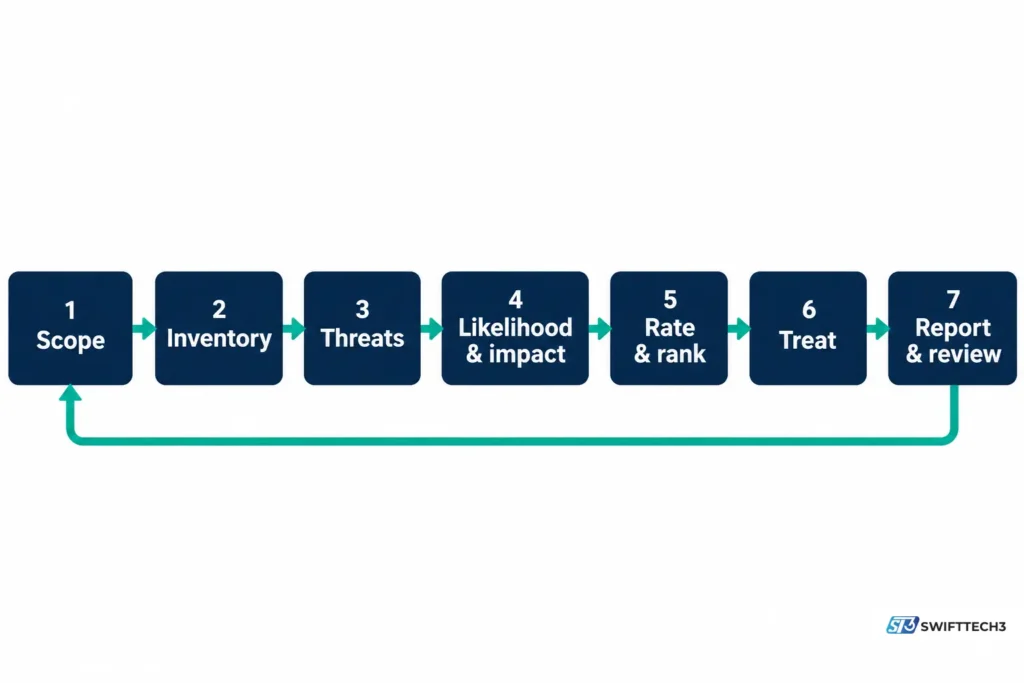
1. Define scope, criteria and risk appetite. Write down which systems, locations and processes are in scope, who decides, and how you will rate risk before you look for problems. ISO/IEC 27001:2022 clause 6.1.2, as summarized by GRC Solutions, requires risk criteria and repeatable results. The FTC Safeguards Rule requires written criteria for categorizing risks.
2. Inventory assets and map data flows. List every system, data set, vendor, cloud service and AI tool that touches in-scope data, then rank each by business value and sensitivity. Cloud services split duties between you and the provider, so record which side owns each control (see how managed AWS providers handle shared responsibility). Include unsanctioned AI tools too; AI governance and compliance practices start with an AI system inventory.
3. Identify threats and vulnerabilities as scenarios. Write each risk as a sentence: who or what, exploiting which weakness, harming which asset, with what consequence. ISO/IEC 27005:2022 introduced risk scenarios and contrasts event-based identification with asset-based identification. IBM’s explainer points to MITRE ATT&CK and the National Vulnerability Database as reference sources.
4. Estimate likelihood and impact. Use one scale and judge impact against confidentiality, integrity and availability. NIST CSF 2.0 subcategory ID.RA-04 expects potential impacts and likelihoods to be identified and recorded.
5. Rate inherent and residual risk, then rank. Inherent risk is the level before additional treatment. Residual risk is what remains after controls. CSF 2.0 ID.RA-05 uses threats, vulnerabilities, likelihoods and impacts to understand inherent risk and prioritize responses.
6. Choose a treatment for each risk. Naming differs by source: accept, avoid, transfer, mitigate (Optro); treat, tolerate, terminate, transfer (GRC Solutions); acceptance, transfer, avoidance, reduction (Rutgers). Whatever you call them, assign each decision an owner and a due date. Optro advises re-reviewing accepted and transferred risks periodically.
7. Report, monitor and reassess. Keep a risk register, give executives a short summary, and give technical teams the detail. Rutgers lists an executive summary and a technical report with a risk matrix and ratings among its standard deliverables. Reassess on a schedule and after major changes (see “How often” below).
How do you score and prioritize cyber risks without fooling yourself?
Pick one scale, define every level in concrete terms, and record why you chose each rating. A score is only as trustworthy as its definitions.
Below is an illustrative worksheet. The frequencies and losses are assumptions for demonstration, not published statistics. Expected annual loss is events per year multiplied by loss per event, calculated in code on November 22, 2026.
| Scenario (illustrative) | Likelihood (1-5) | Impact (1-5) | L × I | Assumed events/year | Assumed loss per event | Expected annual loss |
|---|---|---|---|---|---|---|
| Phishing leads to mailbox takeover (no MFA) | 4 | 3 | 12 | 0.50 | $20,000–$120,000 | $10,000–$60,000 |
| Ransomware on file server (backups untested) | 3 | 5 | 15 | 0.10 | $150,000–$900,000 | $15,000–$90,000 |
| Vendor portal breach exposes customer data | 2 | 5 | 10 | 0.05 | $200,000–$1,500,000 | $10,000–$75,000 |
| Lost unencrypted laptop | 3 | 2 | 6 | 0.20 | $5,000–$40,000 | $1,000–$8,000 |
| Total | $36,000–$233,000 |
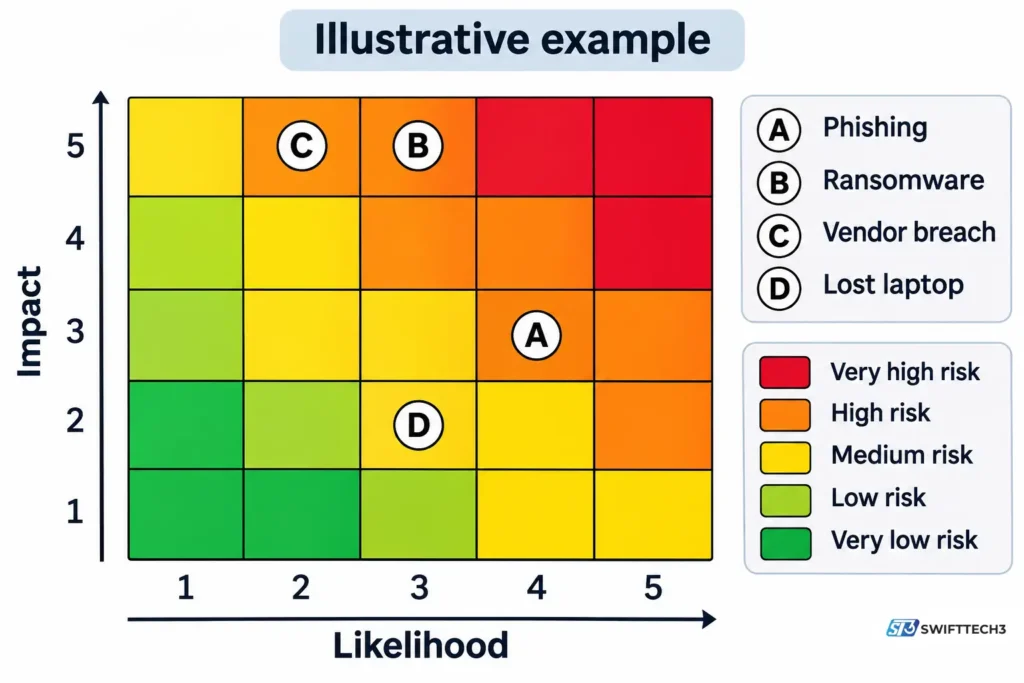
Notice two things. The ransomware scenario ranks first on both the 1-5 score and expected loss. The laptop ranks last on both. But the 1-5 score is ordinal: 15 is not “25% worse” than 12. The dollar column is what lets you compare a control’s price with the loss it prevents.
Suppose multi-factor authentication cuts the phishing scenario from 0.5 events per year to 0.1 (an assumption). Expected annual loss drops by $8,000 to $48,000. If the control costs less than that range, the case is strong. If it costs far more, look for a cheaper treatment.
Anchor your scale in one unit. One published vendor scale places “once a month” next to “10%–25%” in the same band, mixing frequency and probability. Pick one. Scales also need not be 5×5: Rutgers publishes a four-level rating of High, Medium-High, Medium-Low and Low.
Why is a CVSS score not the same as risk?
Because the CVSS Base score measures how severe a flaw is in the abstract, not how likely it is to hurt you. FIRST’s CVSS v4.0 user guide states that Base scores measure severity and should not be used alone to assess risk.
FIRST first published CVSS v4.0 in November 2023. It labels scores CVSS-B, CVSS-BT, CVSS-BE or CVSS-BTE so readers know whether threat and environment metrics were applied. FIRST says a score using all of them comes much closer to a measure of risk. Many scanner reports still show Base only.
| Signal | Question it answers | Source |
|---|---|---|
| CVSS Base | How severe is the flaw in general? | FIRST (scoring body) |
| Known exploitation | Is anyone attacking this right now? | CISA’s Known Exploited Vulnerabilities (KEV) catalog |
| Exposure | Can an attacker reach the system? | Your own inventory and network map |
| Asset value | What do we lose if it falls? | Step 2 of your assessment |
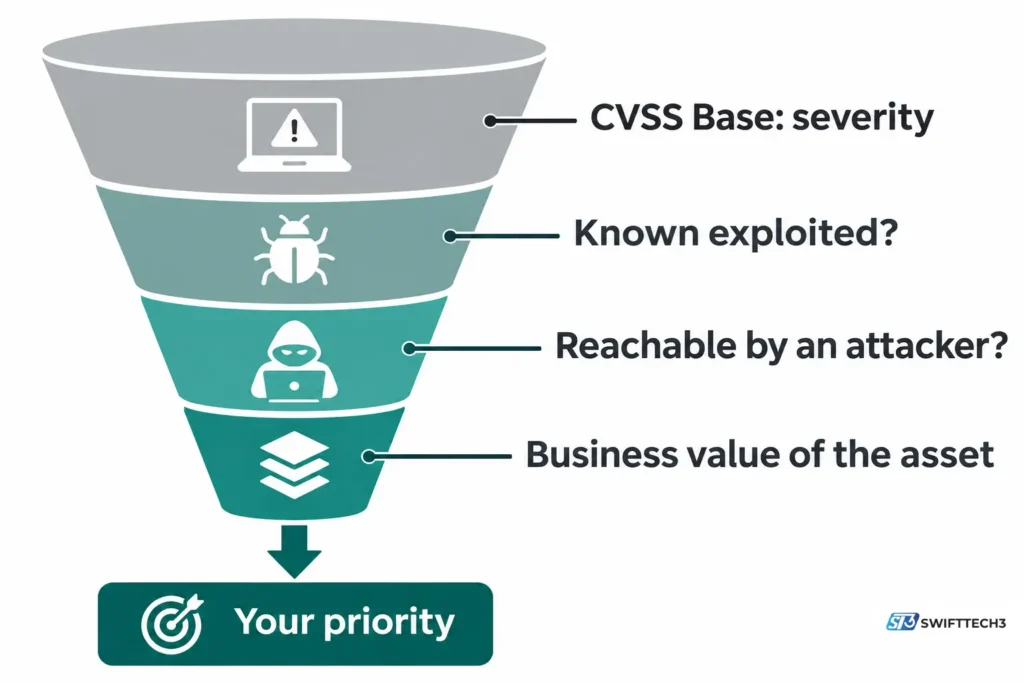
CISA describes the KEV catalog as the authoritative source of vulnerabilities exploited in the wild. A vulnerability qualifies on reliable evidence of active exploitation; scanning, security research and proof-of-concept code do not count. Federal civilian agencies must fix KEV entries under Binding Operational Directive 22-01 (November 3, 2021), and CISA strongly encourages every organization to prioritize them.
A practical order: KEV-listed and exposed, then high severity and exposed, then high severity and internal, then the rest, adjusted for asset value.
Which framework should you use: NIST, ISO 27005, FAIR or OCTAVE?
Use NIST CSF 2.0 or ISO/IEC 27001 to organize your program, then pick a risk method (NIST SP 800-30, ISO/IEC 27005 or FAIR) to do the scoring. This is my reading of the published documents, not an official rule.
| Framework | What it gives you | Scoring method included? | Notes as of November 2026 |
|---|---|---|---|
| NIST SP 800-30 Rev. 1 | Step-by-step assessment guide | Yes, a full assessment process | Published September 2012 for federal systems and organizations; NIST’s page shows no later revision |
| NIST CSF 2.0 | Six functions (Govern, Identify, Protect, Detect, Respond, Recover) | No. It describes outcomes, not a scoring method | Released February 26, 2024; free; quick-start guides include one for small businesses |
| ISO/IEC 27005:2022 | Guidance for assessing and treating information security risk under ISO/IEC 27001 | Yes | Fourth edition, October 2022; a paid standard |
| Open FAIR (O-RT, O-RA) | Quantitative analysis: loss event frequency times loss magnitude, in dollars | Yes | The Open Group publishes it; suits a few high-stakes scenarios |
| OCTAVE (SEI, Carnegie Mellon) | Asset-focused, team-led method | Yes | Original 1999; OCTAVE Allegro (2007) is a streamlined variant focused on information assets |
| MITRE ATT&CK, CIS Controls | An adversary-technique reference and a prioritized control set | No | Inputs to steps 3 and 6, not assessment methods |
What most people miss: CSF 2.0 changed the code format. Risk Assessment subcategories now use two digits, such as ID.RA-05 rather than ID.RA-5. A guide that cites the old format is quoting CSF 1.1, which predates the Govern function. NIST’s CSF 2.0 catalog also cross-references more than 50 other documents.
Is a cybersecurity risk assessment required by law in the US?
For several sectors, yes. There is no single federal law covering every business. As of November 2026, these are the main US hooks.
| Rule | Who it covers | What it says about risk assessment | Status |
|---|---|---|---|
| FTC Safeguards Rule (16 CFR Part 314) | Financial institutions under FTC jurisdiction, including auto dealers | Program must rest on a written risk assessment with criteria for categorizing risks | In force. Institutions holding customer information on fewer than 5,000 consumers are exempt from the written requirement |
| HIPAA Security Rule | Covered entities and business associates | Requires an accurate and thorough assessment of risks to electronic protected health information (45 CFR 164.308(a)(1)(ii)(A)) | In force. A January 6, 2025 proposal would add detail, but final action was reported in July 2026 as delayed to at least July 2027 |
| SEC rules (public companies) | Registrants filing 10-Ks and 8-Ks | Annual disclosure of processes for assessing, identifying and managing material cyber risks, plus board oversight; material incidents on Form 8-K Item 1.05 within four business days of a materiality determination | In effect |
| PCI DSS v4.0.1 | Organizations handling payment card data | Targeted risk analyses where requirements allow flexible frequency | v3.2.1 retired March 31, 2024; future-dated requirements mandatory since March 31, 2025 |
The HIPAA proposal, if finalized as drafted, would require risk analyses at least every 12 months and a written technology asset inventory and network map. It could still be revised or withdrawn. Meanwhile, a 2026 Sidley Austin analysis describes four OCR ransomware-related resolution agreements, each citing inadequate risk analysis.
How often should you repeat a cybersecurity risk assessment?
At least once a year and whenever something material changes. Optro says annual assessments satisfy most frameworks, and Rutgers recommends annual recertification of its assessed services. The HIPAA proposal would also require annual review.
Trigger an earlier review when you:
- adopt a new cloud platform, vendor or AI tool
- go through an acquisition or office move
- suffer a significant incident
- face a new regulation or contract requirement
- change who can access sensitive data
Should you do it yourself, hire a consultant or use a managed provider?
A small, simple environment can run a first pass in-house using NIST’s CSF 2.0 quick-start guide for small businesses. Regulated, multi-vendor or cloud-heavy environments usually benefit from outside help.
I found no authoritative, independent price survey for assessments as of November 2026, so this article gives no price range. Ask providers for a fixed quote tied to a written scope.
Before hiring anyone, ask for:
- the scoring scale and how each level is defined
- a sample register you will own afterward
- both an executive summary and a technical report
- a follow-up plan for remediation and re-testing
- named risk owners for each finding
If you lack in-house IT, an MSP may cover monitoring and patching (see how managed service providers help small businesses). Keep the risk decisions with your leadership, not the vendor.
What has changed recently?
| Date | Change |
|---|---|
| October 2022 | ISO/IEC 27005 fourth edition published |
| November 2023 | CVSS v4.0 published with B/BT/BE/BTE labels |
| February 26, 2024 | NIST CSF 2.0 adds Govern, renumbers subcategories |
| January 6, 2025 | HIPAA Security Rule proposal published |
| March 31, 2025 | PCI DSS future-dated requirements become mandatory |
| July 2026 | HIPAA Security Rule final action reported delayed to at least July 2027 |
| 2026 | IBM reports a $4.99M global average breach cost (up 12%) and a 56% rise in AI-driven attacks |
Several top-ranking guides still quote older cost figures. IBM’s own explainer page, published in August 2024, cites the 2024 figure of $4.88 million. IBM’s 2026 report page shows $4.99 million. As reported in published summaries of the 2026 report, the US average was $11.5 million.
What are the most common mistakes?
- Treating a scan or pen test as the assessment. They feed it; they do not rank business risk.
- Ranking by CVSS Base score alone. FIRST says not to.
- Leaving out vendors, SaaS and AI tools. CSF 2.0 gave supply chain risk its own Govern category.
- Using scales without numbers. “High” means something different to every reader.
- Assigning no owner. ISO/IEC 27001 expects risk owners to be identified.
- Accepting a risk and forgetting it. Accepted risks need periodic review.
- Running it once. Annual is the floor.
- Quoting stale breach costs in a business case.
How can you test your own assessment in ten minutes?
Use this “Defensible Assessment Test,” an eight-question checklist I built from the requirements described above. Answer yes or no.
- Is the scope written down, dated and owned?
- Are your rating levels defined in concrete terms and one unit?
- Does the inventory include cloud, vendors and AI tools that touch in-scope data?
- Is each risk written as a scenario?
- Do you record both inherent and residual ratings?
- Does every risk have an owner, a treatment decision and a due date?
- Does vulnerability priority use exploitation evidence and exposure, not Base score alone?
- Is the next review date set, with triggers for an earlier one?
Eight yes answers means the assessment is defensible. Fix the first “no” before doing anything else.
FAQs
What are the steps of a cybersecurity risk assessment?
The short version is five steps: scope, asset inventory, threat and vulnerability identification, risk analysis, and treatment with monitoring. This guide expands that to seven by adding explicit rating and reporting steps. Some published guides use eight.
What is the difference between risk assessment and risk management?
Risk assessment identifies and ranks risks. Risk management is the full cycle: assessment, treatment decisions, monitoring and review. GRC Solutions describes assessment as the first part of risk management.
How often should a cybersecurity risk assessment be done?
At least annually and after major changes such as new vendors, platforms or incidents. Optro says annual assessments meet most framework requirements and suggests more frequent reviews as programs mature.
What are the types of cyber risk assessment?
Methods are commonly split into qualitative (low/medium/high), quantitative (dollar-based, as in FAIR) and hybrid. ISO/IEC 27005:2022 also distinguishes asset-based from event-based (scenario) identification. Some vendors add labels such as “generic” or “site-specific,” which are not standard terms.
Is a cybersecurity risk assessment required by law in the US?
Only in certain sectors. The FTC Safeguards Rule and HIPAA both require one, public companies must disclose their risk assessment processes to the SEC, and PCI DSS expects targeted risk analyses.
What is the difference between inherent and residual risk?
Inherent risk is the level before additional mitigation. Residual risk is what remains after controls or other treatment. Recording both shows whether your controls actually move the needle.
Do small businesses need one?
Often yes, especially if they handle payment cards, health data or customer financial information. Even where no law applies, a simple register covering your ten most valuable assets is a reasonable start. A managed service provider can help if you lack IT staff.
How much does a data breach cost?
IBM’s 2026 report shows a global average of $4.99 million, up 12%. Published summaries put the US average at $11.5 million. Averages mask wide variation, so use them for context, not as a forecast of your own loss.
Key takeaways and next step
A cybersecurity risk assessment ranks risks by likelihood and impact so you spend on the right fixes first. Define your scope and scale before searching for problems, score with numbers you can defend, and never let a CVSS Base score stand in for risk. Check which US rules apply to you, and repeat the assessment at least yearly.
Next step: this week, write a one-page scope and scoring scale, list your ten most valuable assets, and put the next review date in your calendar.
Related: The hidden security stack behind US online platforms
Disclaimer
This article is for informational purposes only and is not legal, compliance or professional security advice. It is not affiliated with, sponsored by or endorsed by any organization, standard body or company mentioned. Regulations, standards, prices and statistics may change. Information last verified on November 22, 2026. AI output can be inaccurate, so consult a qualified security or legal professional before relying on it for compliance decisions.