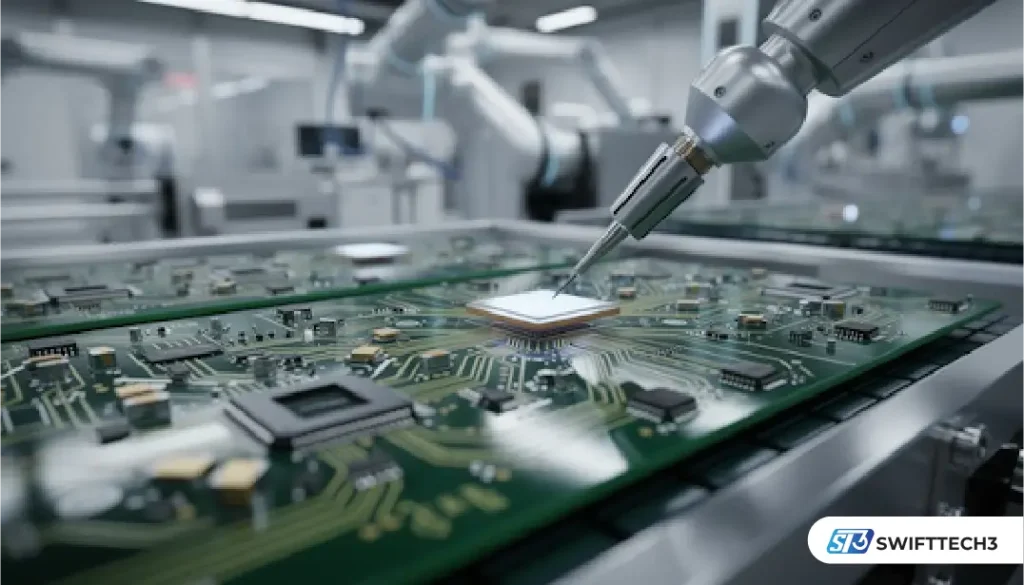
South Korea and the Philippines sit at opposite ends of the chip value chain, and that is exactly why buyers should treat them as complements. Korea is strongest in memory, components, materials and advanced packaging. The Philippines is strongest in assembly, testing and packaging (ATP). Which one matters for a given part depends on the stage of production you are sourcing.
How the Two Markets Compare
| Area | South Korea | Philippines |
|---|---|---|
| Advanced memory (DRAM, HBM) | Global leader | Not a focus |
| Electronic components (MLCCs, substrates, PCBs) | Deep ecosystem | Developing |
| Wafer fabrication | Major capability | Very limited |
| Assembly and testing | Established | Core specialization |
| Packaging | Advanced and expanding | Long-standing strength |
| Electronics manufacturing | Strong | Strong, export-oriented |
| IC design | Growing | Emerging |
A single chip often crosses several of these borders. It may be designed in one country, fabricated in a second, packaged and tested in a third, and built into a finished product in a fourth.
Why South Korea Matters More in the AI Era
AI servers need enormous amounts of high-bandwidth memory, and Korean firms supply most of it. Counterpoint Research put SK hynix at about 34% of DRAM revenue and 57% of HBM revenue in the third quarter of 2025, with Samsung close behind in DRAM. That demand is pulling the wider ecosystem along with it: substrates, materials, test equipment and advanced packaging.
The same pull affects buyers further down the chain. When memory makers prioritize AI data-center orders, conventional parts can tighten and prices can move. Procurement teams should plan for that.
What You Can Source From Korea
Korea’s catalog goes well past memory. Buyers can find power semiconductors, analog and mixed-signal ICs, multilayer ceramic capacitors, package substrates, PCBs, camera and optical modules, sensors and automotive electronics. When comparing electronic component suppliers in South Korea, first work out what role each one plays: manufacturer, authorized distributor, independent distributor or specialist. A manufacturer suits high-volume programs. A distributor is usually better for engineering teams that need several brands or smaller quantities.
Why the Philippines Is Different but Just as Important
The Philippines does not fabricate leading-edge wafers. It finishes chips: assembling, packaging, testing and preparing them for integration into products. The scale is large. SEIPI, the country’s industry foundation, reports electronics exports of US$49.64 billion in 2025, about 58.8% of total Philippine exports.
The industry’s own leaders are candid about the gap. Press coverage of SEIPI’s president notes that wafer fabrication is still the missing link in the domestic chain. The OECD’s review of the Philippine ecosystem covers the ATP base and the policy questions around moving up the value chain.
Buyers researching semiconductor companies in the Philippines will find multinational ATP operations alongside local firms. The two countries are also linked directly. SFA Semicon Philippines in Clark, for example, was set up by Korea’s STS Semiconductor to do packaging and test.
Personal Experience: Qualifying a New Source
On one sourcing project I watched, the team’s first instinct was to rank countries by price. The better question turned out to be which stage of the process they were actually buying. The part they needed, a power IC, had its wafer made in one country, was packaged in another, and was tested in a third. Once they split the evaluation by stage, supplier conversations got shorter, and the real risks showed up (a single-source substrate, a long test queue) instead of staying hidden behind a country label.
The lesson I took away: country-level research is a starting point, and supplier-level proof is what protects the build.
The Part Most Guides Skip: Authenticity and Traceability
Diversifying sources raises the odds that part of your supply passes through an independent distributor, and that is where counterfeit risk concentrates. For critical parts:
- Prefer manufacturers and franchised or authorized distributors where you can.
- Ask for full lot and date-code traceability and certificates of conformance.
- For broker purchases, look for counterfeit-avoidance practices aligned with SAE AS6081 and inspection practices such as IDEA-STD-1010.
- Check datasheets and specifications yourself before approving a new source. Do not rely on a supplier summary.
- Consider incoming inspection or independent testing on high-risk lots.
Directory-style guides, including the two linked above, are useful for building a shortlist, not for vetting. Verify each company through its own certifications, references and sample lots.
Why Sourcing Is Becoming More Regional
Cost still matters, but buyers now weigh capacity, technology, geographic risk, lead time and supply continuity alongside it. That does not mean abandoning established hubs. It means building more flexible networks, much like the redundancy thinking behind edge computing use cases, where distributing capability reduces single points of failure. It also reflects how tightly physical parts and software depend on each other, a theme covered in why hardware-software integration matters.
Advanced Packaging: The Area to Watch
AI processors increasingly combine multiple dies and high-bandwidth memory in one package. Korea is investing heavily here. The Philippines already has deep ATP experience, though moving into advanced packaging will take continued investment in equipment, skills and infrastructure. Both markets are worth watching.
FAQ
What is South Korea best known for in semiconductors?
Memory (DRAM, NAND and HBM), plus a broad base of components, substrates and materials.
What does the Philippines specialize in?
Assembly, testing and packaging, along with electronics manufacturing services.
Are the two countries competitors?
Mostly not. They cover different stages of the value chain, and Korean companies already operate in the Philippines.
Does the Philippines make chips from scratch?
Not at leading-edge scale. Wafer fabrication remains limited there.
What should I check before approving a new component supplier?
Product specialization, volume capacity, quality systems, sample availability, lead times, export experience, technical support and traceability.
How do I reduce counterfeit risk?
Buy from manufacturers or authorized channels where possible, require traceability documentation, and inspect or test critical lots.
Will AI demand affect availability of ordinary components?
It can. When capacity shifts toward AI memory and packaging, other parts may see longer lead times or price changes, so plan buffers.