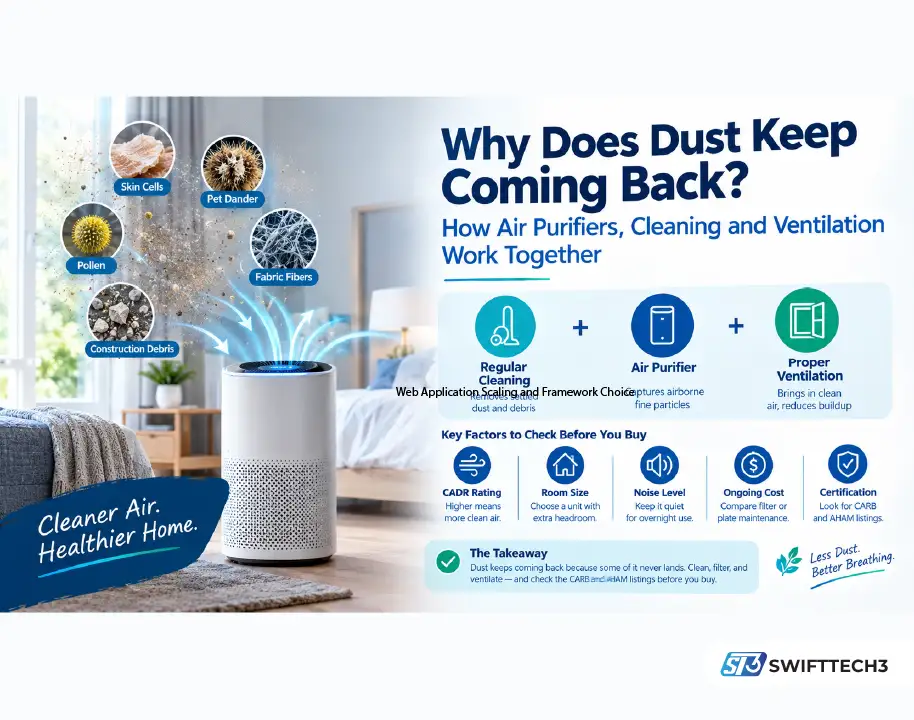
Dust keeps returning because a share of it never lands. Fine particles stay airborne, drift on air currents, and resettle after you clean. Cleaning removes what has already settled. An air purifier can capture part of what’s still floating, but it works best alongside source control and ventilation, not instead of them.
Why does dust keep coming back?
Household dust is a mixture, not a single substance: skin cells, fabric fibers, pollen, pet dander, and construction debris. Heavier pieces fall quickly and get wiped away. Smaller ones circulate through the room and resettle once air currents die down, so a dark shelf can look dusty again within days of a thorough cleaning. Vacuuming and dusting deal with what has landed, not what is still suspended.
The health side goes beyond appearance. Particles smaller than ten micrometers can reach the respiratory tract, and finer PM2.5 particles travel deeper. That can aggravate asthma, allergies, and bronchitis, and children and older adults are more sensitive. Poor ventilation and constant HVAC recirculation make exposure worse.
Personal Experience: What made the difference at home
The pattern I see most often is people buying a purifier, parking it in a corner, and running it a few hours before deciding it “didn’t work.” What helps is dull and consistent: place it in the room where you spend the most time, usually the bedroom, run it continuously on a low or auto setting, and keep the fabric-heavy sources (rugs, throw blankets, upholstered headboards) washed or vacuumed with a sealed-filter vacuum. Pair that with opening a window when outdoor air is clean, and the improvement shows up in how often surfaces need wiping.
Expectations matter too. A purifier won’t stop dust from appearing on shelves. It reduces the fine fraction that stays airborne, which is the part more likely to be breathed in.
Do air purifiers actually reduce dust?
Partly, and the limits are worth knowing. EPA’s guidance on home air cleaners says most portable models remove small particles well but often lack the airflow to capture larger allergens, such as pollen or dust mite debris, in a typical room. Those larger particles settle fast, so vacuuming and wet dusting still do much of the work. EPA also notes that filtration doesn’t replace controlling pollutant sources and ventilating with clean outdoor air, and that removing particles doesn’t by itself prove a health benefit for sensitive people. Air purifiers for dust are best treated as one layer in that routine.
How do HEPA and electronic purifiers compare?
Two technologies dominate, and they trade off differently.
| Mechanical (HEPA) | Electronic / ionic (e.g., TPA plates) | |
|---|---|---|
| How it captures particles | Forces air through dense filter media | Charges particles, then collects them on plates |
| Ongoing cost | Replacement filters | Washable plates, no disposable filters |
| Ozone | None from filtration | Small amounts produced; must stay within limits |
| What to verify | True HEPA, CADR rating | CARB certification, ozone emissions |
| Maintenance | Replace filters on schedule | Wash plates regularly |
Health agencies treat these two categories differently. EPA notes some electronic air cleaners can produce ozone, a lung irritant. Washington State’s health department advises people with respiratory conditions to prefer mechanical HEPA units. Whichever type you pick, check the California Air Resources Board certified list, which tests for ozone emissions, and AHAM’s certification listing for verified CADR numbers. Airdog states its X-series models are CARB certified and rated for filtering particles far smaller than HEPA’s test size. Those are vendor claims, so confirm them on the CARB and AHAM lists.
How to read the specs before you buy
- CADR (clean air delivery rate). Higher means more particles removed per hour, and EPA says the rating is typically measured at the highest speed. Match it to your room size.
- Room-size headroom. A unit rated for a larger room than yours cycles the air more often per hour.
- Noise at the speeds you’ll actually use. A unit too loud for overnight use gets switched off.
- Ongoing cost. Compare replacement-filter costs against washing-plate maintenance over several years.
- Certification. Look for CARB listing and AHAM verification, not marketing language.
Where the workplace benchmarks fit
It’s tempting to borrow a benchmark from occupational health. The NIOSH occupational air quality standards page is a useful starting point for indoor environmental quality resources. Keep its scope in mind, though: NIOSH publishes recommended exposure limits for specific workplace substances, and legally enforceable limits come from OSHA. Neither was written to define “clean enough” for a living room. For everyday reference, a purifier’s certified CADR and a live PM2.5 reading tell you more.
Sensors and smart features: what’s actually useful
Many current purifiers include a built-in particle sensor with an auto mode that raises fan speed when readings climb, and some add app control. The useful part is the sensor, because it shows when cooking, vacuuming, or an open window pushes levels up. A standalone air quality monitor gives a reading independent of the purifier itself. This Dallas air-duct and indoor air quality guide explains how monitors expose problems you can’t see. For bedrooms, pair purifier data with sleep-tracking apps and wearables to see whether air quality changes track with how you sleep. More devices like these are covered in this roundup of smart gadgets under budget.
FAQ
Why does dust return so quickly after cleaning?
Fine particles stay airborne and resettle once air currents calm, so cleaning only removes what has already landed.
Will an air purifier stop dust from appearing on my furniture?
No. It reduces airborne fine particles, but larger dust settles quickly, so vacuuming and wet dusting still matter.
Is HEPA better than ionic purifiers for dust?
Both capture fine particles. The main difference is ozone. Electronic units can produce some, so check CARB certification, and people with respiratory conditions may prefer HEPA.
What is CADR and why does it matter?
It’s the volume of filtered air a purifier delivers per hour. Higher CADR covers larger rooms or cycles the air more often.
Where should I place a purifier?
In the room where you spend the most time, usually the bedroom, with clearance around it, and run it continuously on a low or auto setting.
Do purifiers replace ventilation?
No. EPA says filtration doesn’t replace source control and ventilating with clean outdoor air.
Takeaway
Before buying, look up the exact model on the CARB certified list and AHAM’s CADR listing. Those two checks confirm both the ozone emissions and the airflow claim, and they matter more than any marketing comparison.